









The Evolution of the Foldable Form Factor
The mobile industry has long speculated about Apple’s entry into the foldable hardware market. With the recent debut of the iPhone Duo, those speculations have transitioned into a tangible commercial reality. By entering a category previously dominated by Android manufacturers, Apple has signaled a shift in how it approaches premium hardware design. The iPhone Duo distinguishes itself not through novelty alone, but through a refined mechanical approach that addresses the structural fatigue common in early foldable devices.
At its core, the iPhone Duo utilizes a proprietary “Dynamic Hinge” mechanism. This component is engineered to distribute tension evenly across the display panel, effectively neutralizing the crease that has historically plagued flexible screen technology. Apple’s transition to a foldable architecture represents a departure from the traditional rigid slab design, necessitating a complete overhaul of the internal layout to accommodate the hinge and the split-battery system required to power a sprawling, multi-panel display.
Technical Specifications and Display Engineering
The technical foundation of the iPhone Duo centers on its dual-OLED assembly. When fully unfolded, the device offers a seamless 8-inch screen, providing a display surface that rivals entry-level tablets. The panel utilizes an LTPO (Low-Temperature Polycrystalline Oxide) backplane, which allows for a variable refresh rate ranging from 1Hz to 120Hz. This ensures that the device maintains power efficiency when displaying static content while delivering fluid motion during intensive tasks.
To achieve this, the company developed a specialized protective layer consisting of a synthetic polymer blend that mimics the tactile response of traditional cover glass while maintaining the necessary flexibility to withstand thousands of folds. The integration of the silicon-based A-series chip remains at the heart of the device, though it has been recalibrated to handle the thermal management challenges inherent in a compact, dual-chassis environment. The heat dissipation system utilizes thin graphite sheets and a vapor chamber, ensuring that the device remains performant under sustained workloads without overheating the internal hardware.
Revolutionizing the User Interface
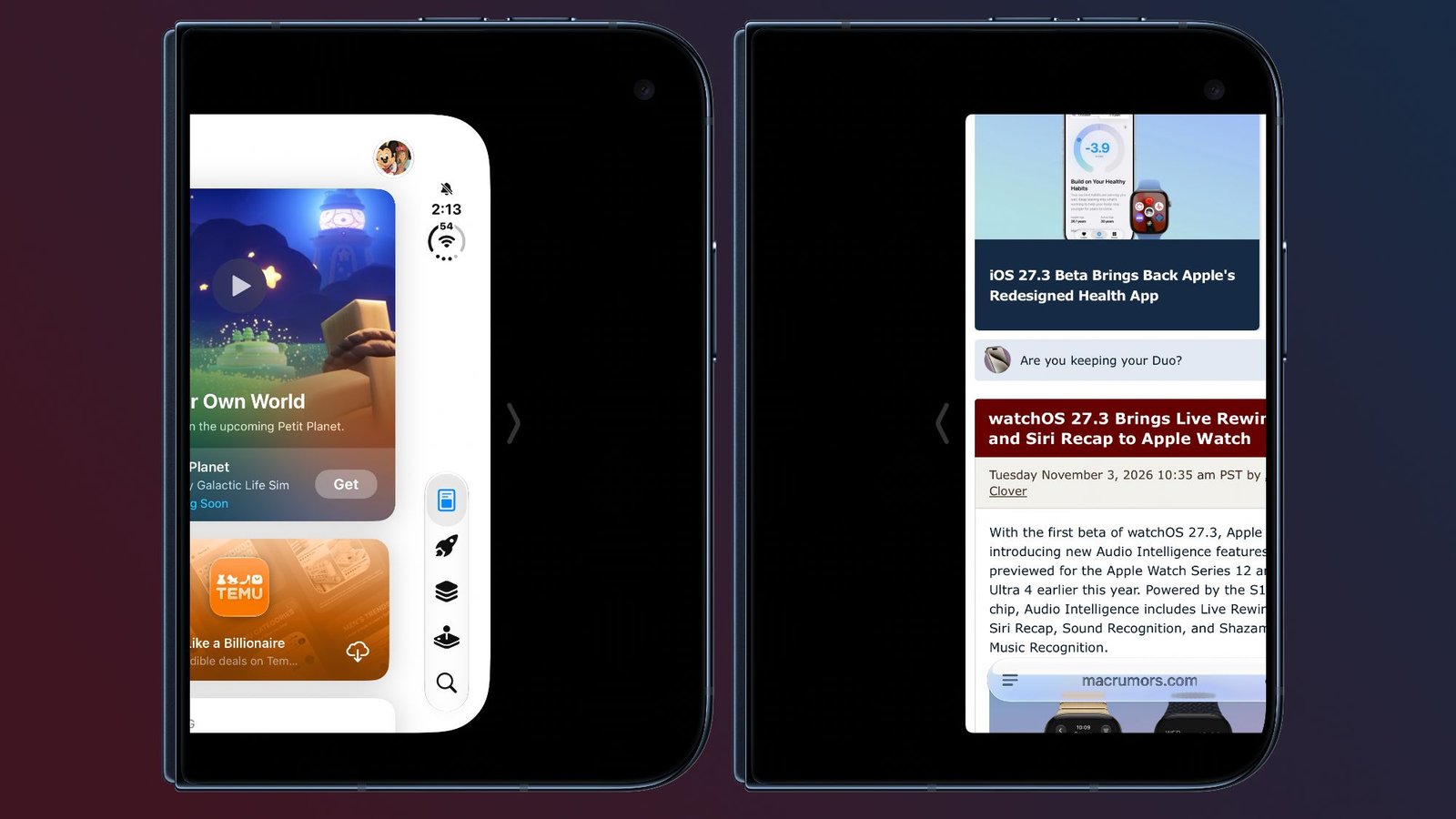
Software optimization is perhaps the most significant hurdle in the adoption of foldable devices, and Apple has addressed this through a specialized iteration of iOS. The iPhone Duo features a split-screen multitasking framework that goes beyond simple side-by-side applications. Users can drag and drop elements between distinct segments of the screen or initiate a “Continuity Mode” that transitions an app from the outer notification display to the full internal canvas instantaneously.
This interface management is governed by the operating system’s ability to recognize the physical angle of the hinge. When the device is held in a partially folded “laptop mode,” the UI shifts automatically. The bottom half of the screen can transform into a precision trackpad or a secondary keyboard, while the top half displays active content. This context-aware functionality demonstrates a strategic move to turn the device into a productivity tool, bridging the gap between a standard smartphone and a portable workstation.
Use-Cases for the Professional Market
While the $2,000 price point positions the iPhone Duo as a luxury item, the device offers genuine utility for power users and professionals. Architects, graphic designers, and data analysts benefit from the increased screen real estate, which allows for granular editing that would be cumbersome on a standard 6-inch handset. The ability to view complex spreadsheets or high-resolution architectural schematics in a portable form factor creates a new tier of mobile efficiency.
Beyond creative industries, the device supports advanced peripheral integration. Because the internal architecture supports a more robust data throughput, users can tether the iPhone Duo to external monitors or external SSDs more effectively than previous models. The combination of high-speed processing and the expansive display makes it a viable candidate for replacing a secondary laptop during travel or short-term mobile projects.
Market Impact and Future Trajectory
The introduction of the iPhone Duo serves as a benchmark for the broader consumer electronics industry. By setting a high price point, Apple has effectively validated the premium nature of foldable technology. This move encourages component suppliers to invest further in the durability and mass production of foldable panels, which will likely lead to reduced costs over time. Competitors will now face pressure to improve their own hinges and display resilience to keep pace with the benchmarks set by this device.
Moreover, the release forces app developers to adopt more flexible design patterns. As the industry moves toward adaptive screen sizes, the “one size fits all” approach to app development is becoming obsolete. The iPhone Duo acts as a catalyst for a broader ecosystem shift where software must be inherently modular to succeed.
As Apple continues to refine its foldable technology, the trajectory suggests that these devices will eventually migrate from a niche luxury category to a mainstream product line. The primary challenge remains the long-term longevity of the flexible display, but if early performance data holds true, the iPhone Duo may well be the device that signals the beginning of the post-slab smartphone era. Through careful design choices and a focus on software parity, Apple has managed to frame the foldable form not as a gimmick, but as a practical, professional-grade evolution of modern computing.
Disclaimer: This content is auto-generated for informational purposes only.
Source: Read Original News