









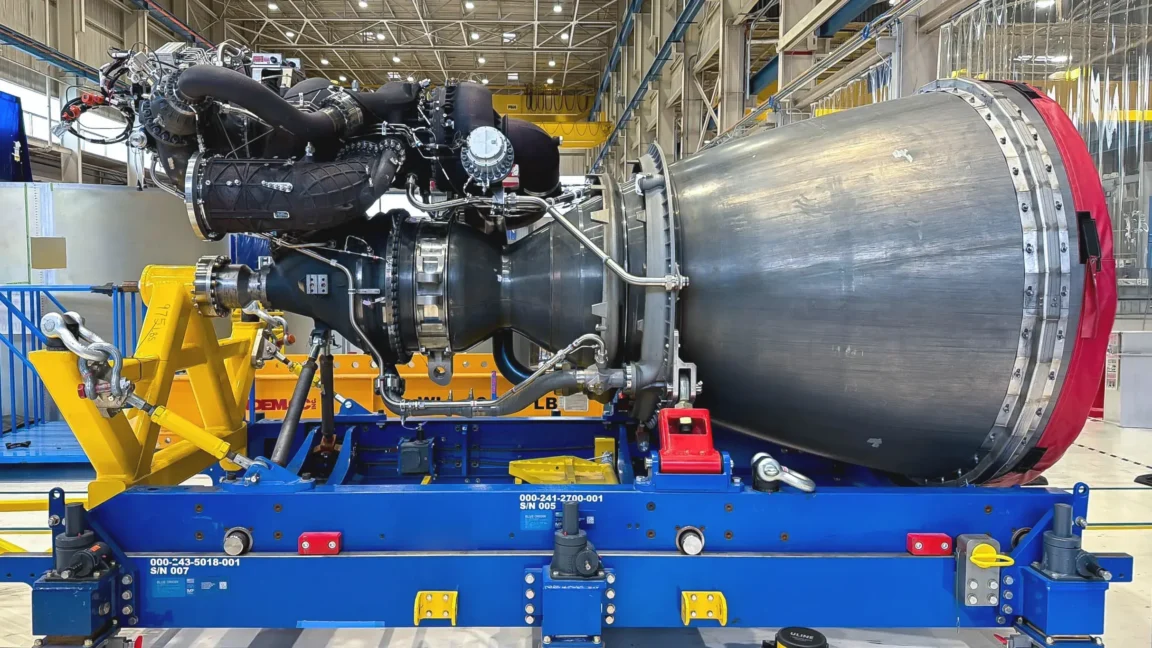
Modernizing the Propulsion Architecture
Blue Origin has unveiled a major shift in its launch vehicle strategy, targeting a future where space access is frequent, inexpensive, and highly efficient. The primary driver of this evolution is the Northstar engine, a successor to the existing BE-4 currently utilized on the New Glenn launch vehicle. By refining the mechanical complexity of its propulsion systems, the company is prioritizing manufacturability alongside raw power.
The Northstar engine maintains the foundational oxygen-rich staged combustion cycle that defines the BE-4, but it introduces a significantly streamlined design. By reducing the overall part count by half and utilizing advanced additive manufacturing for approximately 65 percent of its components, Blue Origin is targeting a dramatic reduction in production overhead. The company projects that Northstar will cost only 25 percent of the price associated with the BE-4. Furthermore, the goal of assembling a single engine in under 24 hours represents a major departure from traditional aerospace manufacturing timelines, which often span months for a single propulsion unit.
From a performance standpoint, the upgrade is substantial. While the BE-4 produces 640,000 pounds of thrust, the Northstar is engineered to deliver 715,000 pounds. This increase in power is critical for heavier lift requirements and the ambitious flight cadence envisioned by leadership. Crucially, the transition to Northstar will not disrupt existing supply chains for external partners, as Blue Origin intends to continue producing the BE-4 specifically for the United Launch Alliance (ULA) Vulcan rocket program.
Extending Reach with the GS3 Stage
While the engine upgrades focus on the first stage of the vehicle, Blue Origin is simultaneously addressing the need for deeper space transport through the development of the GS3 third stage. This hydrogen-oxygen-fueled stage is designed to provide the necessary kinetic energy to propel heavy payloads from low Earth orbit toward more distant destinations, specifically geostationary orbit and the lunar surface.
Hydrogen-oxygen propulsion is highly efficient for vacuum operations where high specific impulse—the measure of how effectively fuel is converted into thrust—is paramount. By incorporating the GS3 stage, New Glenn will possess the versatility to handle a broader array of missions. Whether placing high-bandwidth telecommunications satellites into precise geostationary slots or delivering heavy infrastructure for lunar exploration, the GS3 acts as a specialized utility stage. This modular approach allows the core New Glenn vehicle to remain a workhorse for diverse mission profiles without requiring a total redesign for specialized deep-space deliveries.
Manufacturing at Scale
The long-term objective of these upgrades is to shift the industry standard for launch frequency. During the recent UP.Summit held at the Shuttle Landing Facility in Florida, CEO Dave Limp highlighted that the surge in global demand for space access requires a rethink of how rockets are built. The ambition is to eventually support a launch rate exceeding 1,000 missions per year.
To achieve this, Blue Origin is focusing on high-rate, repeatable manufacturing processes. The adoption of 3D printing for the majority of the Northstar engine components allows for a reduction in raw material waste and a consolidation of parts that previously required complex welding and machining. By eliminating these bottlenecks, the company is attempting to treat rocket engines more like industrial equipment that can be mass-produced, rather than artisanal hardware that requires extensive hand-assembly and multi-stage testing. This industrialization is essential if the company is to meet the logistics demands of the burgeoning satellite internet and orbital infrastructure markets.
Economic and Strategic Implications
The broader implication of these technological updates is a reduction in the barrier to entry for orbital missions. For the aerospace industry, the cost per kilogram of payload delivered is the most significant metric for profitability and mission viability. By lowering the cost of engine production to a quarter of current levels, Blue Origin is positioning itself to lead the market on price, potentially forcing a paradigm shift across the entire launch provider sector.
The move to integrate methane-liquid oxygen combustion for the first stage, paired with a hydrogen-oxygen third stage, reflects a sophisticated understanding of orbital mechanics. Methane is preferred for first stages due to its density, clean burning characteristics, and potential for use in engine reusability, while hydrogen remains the gold standard for high-efficiency upper-stage operations. By leveraging both fuel profiles within the New Glenn ecosystem, Blue Origin is extracting maximum capability from each stage of the flight.
The Road Ahead
With the Northstar engine currently deep into its test-firing campaign, Blue Origin has moved beyond the theoretical design phase and into active validation. The testing at the company’s facilities provides the empirical data required to ensure that the simplified parts can withstand the high-pressure and high-temperature environment of an oxygen-rich staged combustion cycle.
As these hardware iterations progress, the focus will likely shift toward the integration of the GS3 stage into the wider launch manifest. If successful, these two developments—a cheaper, more powerful engine and a specialized upper stage—will redefine the operational capacity of New Glenn. As demand for orbital logistics continues to climb, Blue Origin’s commitment to high-volume manufacturing could be the factor that determines the company’s role in the next generation of lunar exploration and global space infrastructure. By focusing on scalability and modular design, the company is preparing for a future where space launch is a daily occurrence rather than a rare, headline-grabbing event.
Disclaimer: This content is auto-generated for informational purposes only.
Source: Read Original News