









“Sweating your guts out”: Top End workers battle grueling heat as build-up intensifies
As the Northern Territory’s annual “build-up” reaches a boiling point, outdoor workers across Darwin are feeling the strain of a season that many say is more punishing than ever.
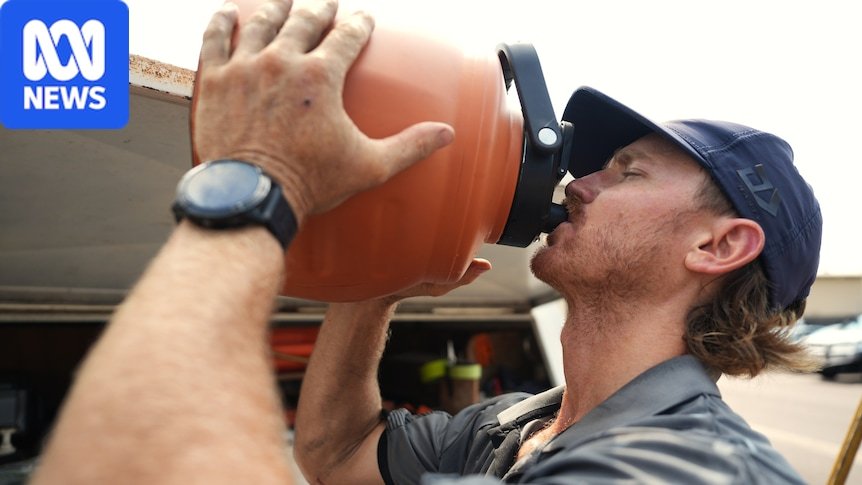
Construction worker Joel Albury is among the hundreds currently facing the relentless humidity, finding himself consuming nearly eight litres of water per shift just to stay hydrated.
“You’re just sweating your guts out,” Mr. Albury said. “We go through the Yeti water bottles—there’s four litres in one of them, and we fill them up twice a day.”
His experience is echoed by colleagues across the city’s building sites. Scott Cerqui, another outdoor worker, admitted that the intensity of the heat has forced him to upgrade his gear. “It does take it out of you,” Mr. Cerqui said. “I had to upgrade the water bottle this year, get a couple of extra litres in the Yowy.”
The Bureau of Meteorology (BOM) has confirmed that the Top End is grappling with a combination of high humidity, low wind, and the sun sitting directly overhead. While Darwin’s thermometer readings are only roughly half a degree above the long-term average, the atmospheric moisture levels are nearing their maximum capacity, making the heat feel significantly more oppressive.
Data highlights the shift; while October last year saw a peak of 34.7 degrees, this year recorded a maximum of 35.5 degrees. November is continuing the trend, with temperatures consistently hovering around the 35-degree mark.
BOM senior forecaster Sally Cutter noted that while conditions are unlikely to escalate much further, residents face a long road to recovery. “We are going to see a continuation of these sorts of conditions for the next month or so,” Ms. Cutter said. She warned that the current El Niño pattern is expected to delay the arrival of the monsoon, with the relief of the wet season likely pushed into the new year. Current projections suggest the 2026-27 wet season will be slightly drier than typical years.
The heat has prompted the Northern Territory Health Department to issue urgent “extreme heat” warnings, specifically for parts of Arnhem Land, where temperatures have climbed toward 40 degrees. Officials have cautioned that without proper precautions, the heat in these regions “could be fatal.”
While the Top End swelters, the picture remains varied across the territory. Further south, Central Australia is bracing for a different kind of weather pattern. Following weeks of intense storms and flooding, forecasters are tracking a trough developing over Western Australia that is expected to bring renewed showers and storm activity toward the western border and into Central Australia next week.
For now, however, those working on the front lines in Darwin continue to count their litres, waiting for the relief of the monsoon.
Disclaimer: This content is auto-generated for informational purposes only.
Source: Read Original News