








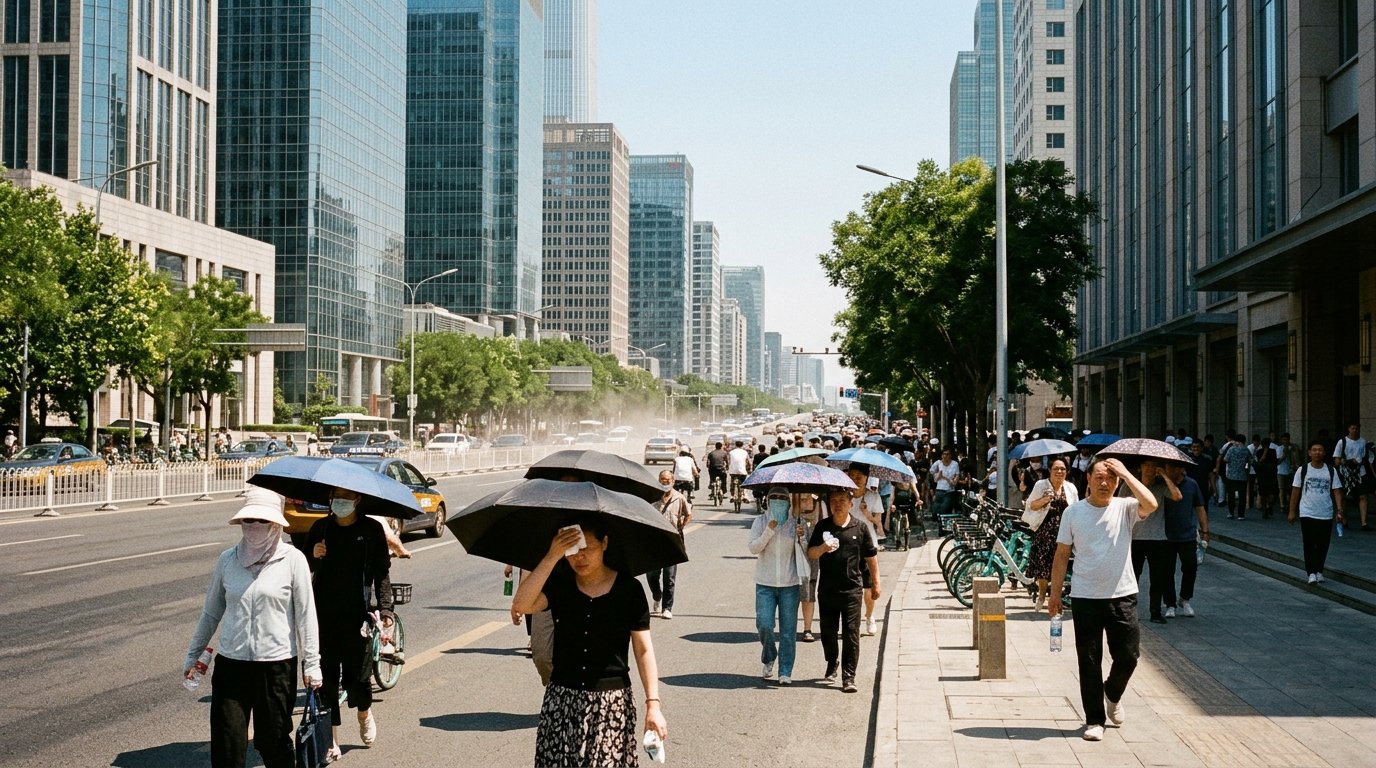
A recent study published in Computational Urban Science has shed new light on the intersection of climate change and public mental health, revealing that the psychological toll of extreme heat in Beijing is far from uniform. By leveraging millions of social media records, researchers have mapped the city’s emotional landscape during heat waves, uncovering a clear spatial divide in how different urban environments shape human well-being.
Led by Yali Wei and colleagues, the research team analyzed 11.62 million Sina Weibo posts from 2019, covering 327 administrative subdistricts across Beijing. By identifying four distinct heat wave events—defined as periods where daily maximum temperatures exceeded 35 °C for at least three consecutive days—the team was able to move beyond traditional, limited questionnaire surveys. Using a dictionary-based sentiment analysis framework, they categorized emotional expressions into seven types: happiness, surprise, anger, disgust, fear, sadness, and a general category of “good.”
The findings highlight a striking spatial heterogeneity. Residents in Beijing’s suburban areas, particularly in southeastern districts like Daxing and Tongzhou, were more likely to express positive emotions such as “happy” and “surprise.” Conversely, those living in the dense, inner-city areas reported a higher frequency of negative sentiments, specifically “sadness” and “disgust.”
To understand the drivers behind these emotional variations, the researchers employed a sophisticated spatial causal analysis known as Geographical Convergent Cross Mapping (GCCM). Unlike standard regression models, GCCM accounts for the nonlinear and complex interdependencies of urban life. The analysis identified two primary environmental factors that significantly influence emotional states: the Normalized Difference Vegetation Index (NDVI) and nighttime light intensity (NTL).
The study concluded that urban greenery acts as a critical buffer, with high NDVI values causally linked to lower heat stress and improved psychological well-being. In contrast, high nighttime light intensity—a proxy for intense urbanization and socioeconomic activity—was correlated with higher psychological burdens. Interestingly, both greenery and economic vitality were associated with the “good” emotional category, suggesting that while urban density can be stressful, it also provides aesthetic and sensory stimulation that supports immediate well-being. Other indicators, such as point-of-interest entropy (a measure of land-use diversity) and the density of impervious surfaces, showed weaker direct causal links to emotional outcomes, suggesting they play a secondary role during extreme temperature events.
The study does acknowledge limitations, including a demographic bias toward younger users on social media and a lack of granular data on individual socioeconomic factors like income or occupation. However, the researchers emphasize that their high-resolution mapping provides a powerful new tool for urban planners. By identifying “emotional hotspots” that correlate with low vegetation or high heat-island impact, city officials can move away from one-size-fits-all cooling strategies.
Instead, the findings advocate for targeted interventions, such as the strategic expansion of green spaces in the city center and the mitigation of heat-island effects in areas showing high concentrations of negative sentiment. As global temperatures continue to rise, the integration of geographic big data offers a vital framework for building resilient, climate-adaptive cities that prioritize the mental health of their residents.
The research, titled “Spatial heterogeneities of heat waves’ impact on emotions and their causal factors based on multi-source geographic big data-a case study in Beijing city,” is published in Computational Urban Science (DOI: 10.1007/s43762-026-00272-7).
Disclaimer: This content is auto-generated for informational purposes only.
Source: Read Original News