








The Hardware Architecture of Grand Theft Auto VI
The anticipated release of Grand Theft Auto VI has brought the hardware limitations of current-generation consoles into sharp focus. As developers finalize the software for its November 2026 launch, technical analysis reveals a significant disparity in performance across the PlayStation 5 family. While Rockstar Games is targeting a standard 30 frames per second (FPS) across all current-gen platforms, the base PlayStation 5 model faces distinct hurdles in maintaining this objective during high-intensity sequences.
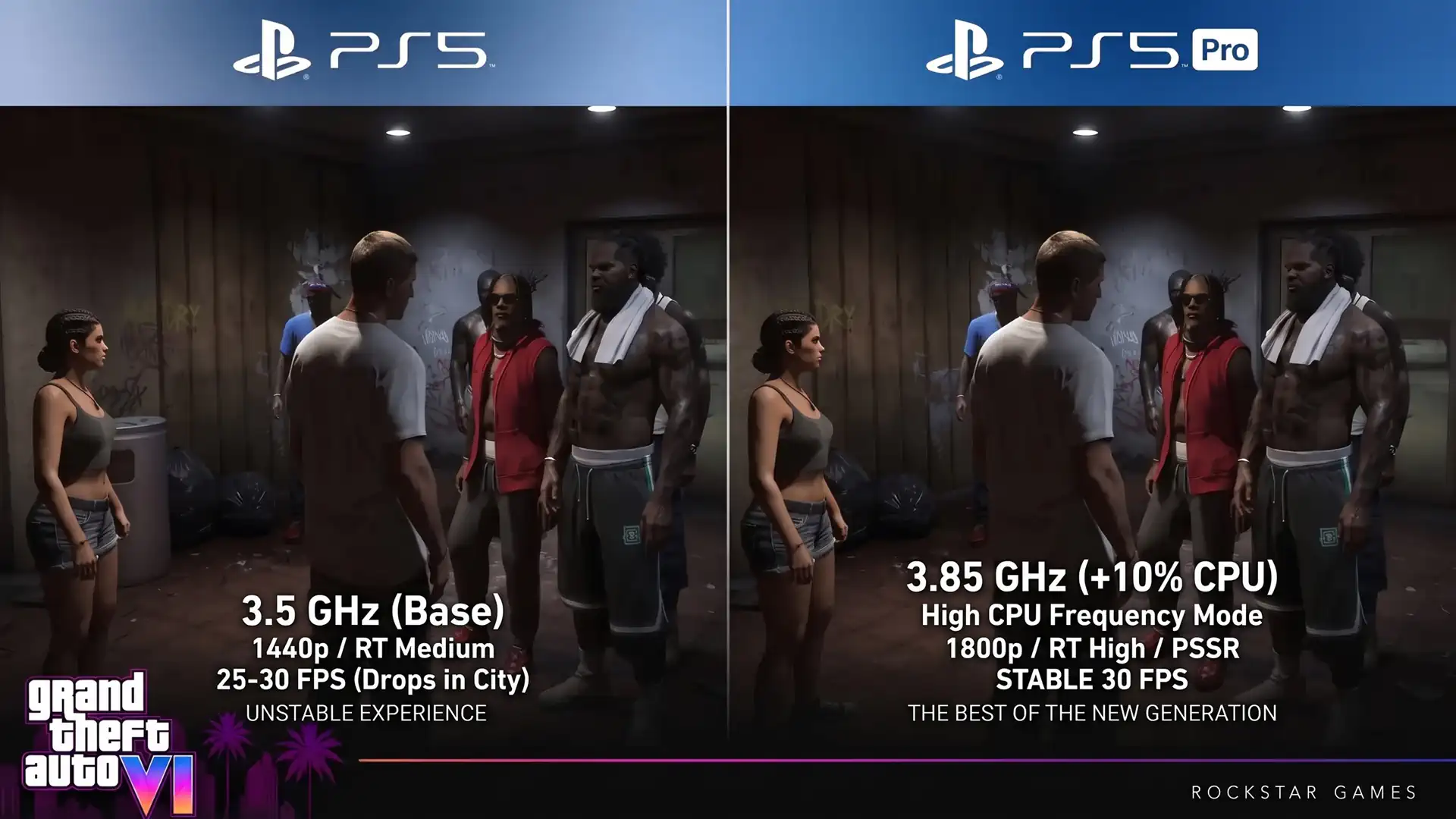
The root of these performance concerns lies in the interaction between the CPU and GPU within the base console. The PlayStation 5 relies on an AMD Zen 2 processor clocked at a dynamic frequency of up to 3.5 GHz. In resource-heavy environments—such as the densely populated state of Leonidas or scenarios involving complex particle effects like explosions—the system encounters the limitations of its SmartShift power distribution technology. When the AMD RDNA 2 GPU, rated at 10.28 teraflops, hits its peak load, the system automatically downclocks the CPU to 3.2 GHz to manage power consumption and thermal limits. This reduction in processing speed often occurs exactly when the game requires the most computational overhead for physics calculations, resulting in frame rate drops that dip below the 30 FPS threshold.
CPU Clock Frequency and System Stability
A critical factor distinguishing the base PlayStation 5 from its Xbox Series counterparts is the management of CPU frequency. Technical benchmarks demonstrate that the Xbox Series X maintains a fixed clock frequency of 3.8 GHz (without Simultaneous Multithreading, or SMT) or 3.6 GHz (with SMT). By keeping the frequency locked, the Xbox architecture avoids the fluctuations that occur when power is diverted between the processor and the graphics engine.
The base PlayStation 5’s reliance on dynamic frequency scaling introduces a latency variable that does not exist in the same way on the Xbox Series X. For a massive open-world title like Grand Theft Auto VI, which necessitates the continuous processing of complex behavior algorithms for hundreds of non-player characters (NPCs) and real-time destruction physics, the ability to maintain a consistent clock speed is vital. When the frame generation time exceeds the 33.3-millisecond window required for a steady 30 FPS, players will observe stuttering, uneven frame pacing, and a lack of smoothness during high-action sequences.
The PlayStation 5 Pro Advantage
Recognizing the bottlenecks inherent in the base architecture, the PlayStation 5 Pro offers a suite of hardware improvements designed to rectify these performance deficiencies. The Pro model provides a 10% increase in CPU boost clock speed, reaching 3.85 GHz. This higher clock ceiling provides the necessary headroom to handle intense game logic without triggering the severe throttling observed in the standard model.
Beyond the raw CPU speed, the Pro version includes a 28% increase in GDDR6 memory bandwidth, moving to 576 GB/s, and an additional 2 GB of DDR5 memory dedicated to background system operations. This memory boost allows more game assets to be processed and swapped rapidly, reducing the burden on the primary system resources. Perhaps most crucially for high-fidelity rendering, the Pro incorporates accelerated ray tracing units. These units streamline the rendering of complex lighting hierarchies, allowing for sophisticated visual effects that would otherwise force the base model to sacrifice frame stability to keep up with the rendering pipeline.
Rendering Complexity and Upscaling Challenges
The challenge of rendering a modern open-world environment at 1440p resolution is immense. Grand Theft Auto VI employs global illumination and advanced physics, both of which require significant GPU cycles. On the base PlayStation 5, processing these features alongside the game’s dense city traffic creates a scenario where the hardware struggles to maintain a consistent frame delivery.
Without the implementation of advanced hardware-based upscalers like PSSR (PlayStation Spectral Super Resolution), the base model is tasked with raw rendering that pushes the console to its thermal and power limits. The Pro model’s inclusion of advanced upscaling technology is intended to mitigate this by rendering at a lower internal resolution and reconstructing the image to a higher output quality. By offloading some of the rendering burden, the Pro ensures that the console remains well within its performance envelope, maintaining a stable frame rate even when the in-game action reaches its highest level of intensity.
Predicting the User Experience at Launch
As the November 19, 2026, release date approaches, players should adjust their expectations based on the hardware tier they own. The base PlayStation 5 is capable of providing an enjoyable experience, but users may encounter noticeable performance fluctuations during the most graphically demanding portions of the game. For individuals prioritizing a stable 30 FPS experience, these technical disparities indicate that the PlayStation 5 Pro will provide a more consistent output, effectively bypassing the power-management bottlenecks that affect the standard edition.
The technical impact of these findings highlights a growing trend in the console market: the bifurcation of performance standards within a single generation. As game developers continue to push the boundaries of engine complexity, the overhead required to maintain smooth visuals becomes increasingly difficult to manage on original hardware. While the industry aims for broad compatibility, the inherent limitations of 2020-era silicon, when faced with the modern demands of titles like Grand Theft Auto VI, create a clear distinction between the entry-level experience and the performance offered by premium hardware revisions.
Disclaimer: This content is auto-generated for informational purposes only.
Source: Read Original News