







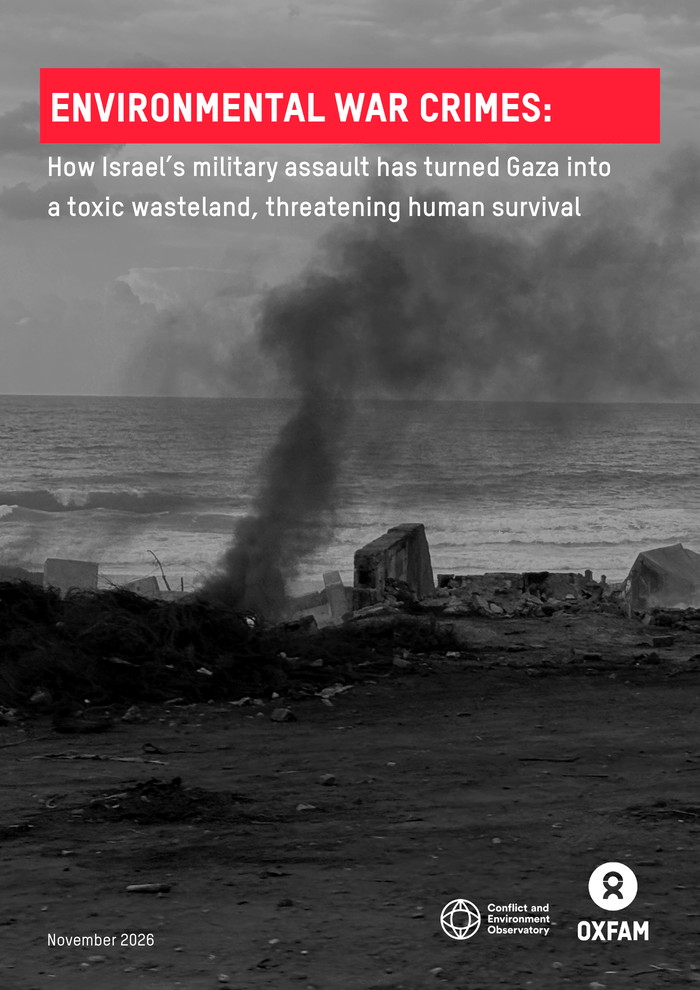
More than 99 percent of the Gaza Strip now shows indicators of environmental contamination as a result of Israel’s military assault, according to a new report released by Oxfam and the Conflict and Environment Observatory (CEOBS). The analysis, titled “Environmental War Crimes,” warns that the extensive use of explosive and incendiary weapons has created a toxic landscape that poses severe, long-term threats to human health and survival.
The report highlights a near-total geographical spread of pollution risks, with roughly 78 percent of Gaza’s land area directly impacted by military operations. Scientists and researchers utilized satellite imagery, remote sensing, and open-source data to map the environmental catastrophe, identifying the presence of heavy metals, asbestos from pulverized buildings, dioxins, and hazardous explosive residues.
“Israel’s ongoing military assault in Gaza includes the destruction and contamination of its environment, which are environmental war crimes threatening life now and for generations to come,” said Amitabh Behar, Oxfam International Executive Director. “The destruction has fundamentally degraded the conditions necessary for human safety and survival.”
The public health implications of this contamination are profound. With sanitation systems largely non-functional, raw sewage is poisoning both the soil and the Mediterranean Sea. Current data indicates that approximately 40,000 cubic meters of untreated sewage are discharged into the sea daily, while another 15,000 cubic meters leak into the ground from damaged collection networks. Testing has revealed that faecal coliform levels in groundwater wells have spiked dramatically, nearly ten times higher than rates recorded in 2021.
The sheer scale of destruction—estimated by the UN at over 61 million tonnes of debris—has transformed Gaza’s urban centers into massive reservoirs of hazardous material. Areas such as Gaza City, Jabalia, and the North Gaza Governorate are facing the most acute risks, as pollutants from bombardment are continuously resuspended into the air as toxic dust. In agricultural regions like Beit Hanoun and Wadi Gaza, the contamination of clay-rich soils threatens to render future food production unsafe, as these areas are prone to retaining long-term pollutants.
Despite the mounting evidence of an unfolding environmental disaster, international efforts to assess and mitigate the damage are being thwarted. The report emphasizes that Israel’s continued refusal to grant independent experts access to Gaza prevents a formal, field-level Post-Conflict Environmental Assessment (PCEA). Without such data, recovery plans are being discussed in a vacuum, ignoring the hazardous reality on the ground.
“Fixing Gaza’s environment will be highly challenging because contamination is dispersed across urban rubble, farmlands, water systems, and soils,” noted report author Lama Abdul Samad. “The analysis highlights the urgent need for Israel to grant access for a detailed environmental assessment to clarify the risks to public health.”
The health consequences are expected to be multi-generational, with children and pregnant women at the highest risk of respiratory harm, toxic exposure, and disease. Oxfam and CEOBS are calling for an immediate end to the blockade, the facilitation of unrestricted aid, and the implementation of a Palestinian-led environmental remediation program.
The report concludes that reconstruction cannot be treated as a purely structural undertaking. Unless environmental assessment and decontamination are prioritized as central pillars of recovery, the population of Gaza will remain trapped in a landscape that continues to cause harm long after the military bombardment subsides. The organizations involved are urging the international community to demand accountability and to ensure that environmental justice is a non-negotiable component of any future peace and rebuilding efforts.
Disclaimer: This content is auto-generated for informational purposes only.
Source: Read Original News