








Apple has officially commenced the beta testing phase for its much-anticipated “Audio Intelligence” suite, a collection of four distinct AI-powered features designed for the Apple Watch Series 12 and the Apple Watch Ultra 4. First unveiled during the company’s hardware showcase in September, these tools are now available to developers as part of the iOS 27.3 update. By integrating advanced sound recognition, music identification, and conversational processing, Apple is positioning the smartwatch as a sophisticated assistive tool that operates directly on the user’s wrist.
The rollout focuses on balancing high-utility features with strict privacy constraints. For users who are deaf or hard-of-hearing, the system introduces a sound recognition utility capable of monitoring the environment for critical alerts, such as fire alarms, sirens, or doorbells. Additionally, the integration of Shazam directly into the watch interface allows for rapid song identification, leveraging the internal microphone to detect music playing in the vicinity and returning the track title and artist name to the watch display.
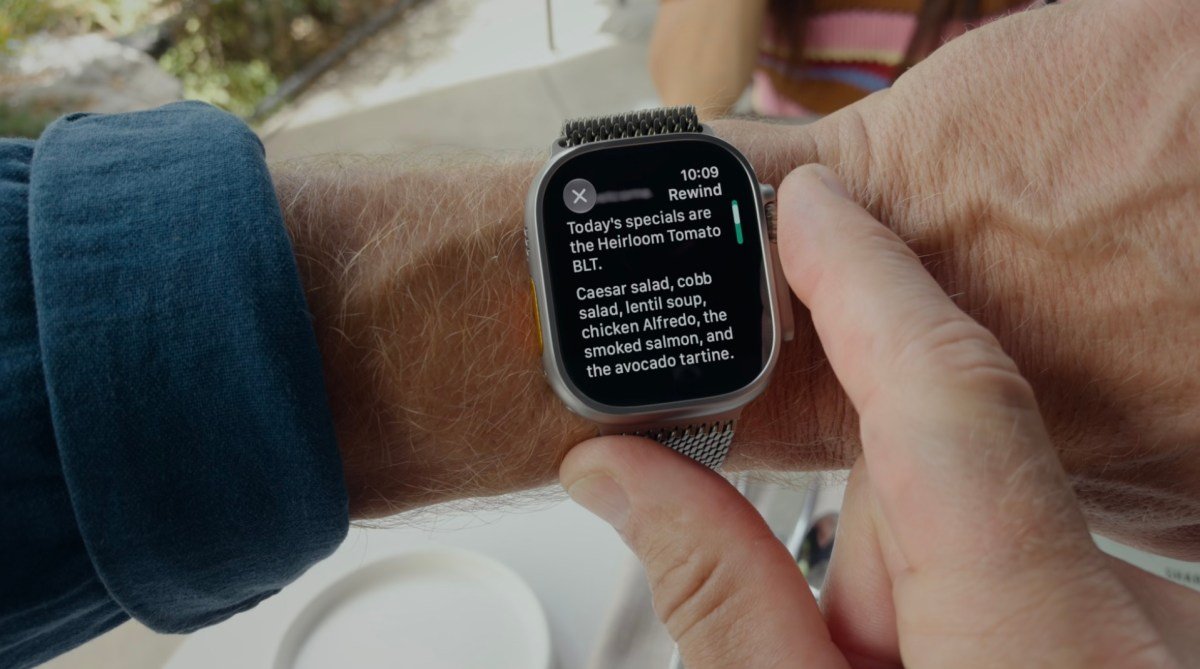
Perhaps the most significant departures from traditional wearable functionality are the features designed to interact with human speech: Live Rewind and Siri Recaps. Live Rewind is engineered to serve as a digital safety net for fleeting information. When a user engages the feature by double-pressing the digital crown, the device captures the previous 15 seconds of audio. This audio is processed into a concise text snippet displayed on the watch face, allowing the user to review verbal directions, restaurant menu items, or lecture details they may have missed.
To address social privacy concerns, Apple has implemented a visual and audible signaling system. When the recording gesture is performed, the watch emits a distinct chime and displays an animation, providing notice to those nearby that a snippet is being captured. By default, these snippets are transient; if the user does not manually save the information to the Siri app within 30 seconds, the data is permanently erased. Users also have the ability to prompt Siri for clarification on the recorded text, such as asking for definitions of technical terms or details mentioned in the conversation.
Siri Recaps represents a more advanced application of ambient listening, focusing on productivity and information retention. Rather than providing a verbatim transcript—which often consumes significant storage and creates privacy friction—the technology summarizes conversations into a high-level list of key takeaways. These summaries might include actionable tasks, deadlines, or specific factual details such as pricing or schedules.
The utility is designed for environments where taking manual notes is impractical, such as during professional meetings, training sessions, or parent-teacher conferences. To ensure the feature remains unobtrusive, Apple has configured the system to remain dormant when headphones are connected or noise-cancellation features are active. To manage potential clutter, the system is configurable through schedules; users can restrict the feature to work hours or disable it entirely via the Control Center. Unsaved recaps are automatically purged after seven days, and the system is programmed to filter out sensitive data, including government identifiers, financial credentials, and harmful content.
The technical foundation for Audio Intelligence relies on a sophisticated chain of hardware and cloud processing designed to prioritize data security. The Apple Watch Series 12 uses the S11 chip, which includes a dedicated secure enclave—a hardware-isolated memory space that prevents the general operating system from accessing raw audio data. This buffer processes the ambient audio locally, ensuring that raw recordings remain inaccessible even to the device’s main software.
The data flow follows a specific path: lightweight AI models on the S11 chip identify active conversation patterns, which are then relayed to the paired iPhone for further processing. The phone performs local transcription to generate a condensed text version, stripping away filler words. This encrypted text is subsequently sent to Apple’s Private Cloud Compute (PCC) to generate the final summary. Once the summary is synthesized and returned to the user, the data within the Private Cloud Compute is purged. This end-to-end encryption ensures that neither the raw audio nor the final notes are accessible to Apple, maintaining user confidentiality throughout the lifecycle of the information.
By focusing on summarization and transient text capture, Apple aims to bridge the gap between wearable convenience and data integrity. The integration with existing ecosystems, such as the Notes and Journal apps, suggests that these features are intended to become part of a user’s daily administrative workflow. Because the processing is distributed across the S11 chip, the iPhone’s compute engine, and the secure cloud, Apple claims there is no meaningful impact on the battery life of the watch or the phone.
As the technology moves through its developer beta and toward a broader public rollout, the effectiveness of these features will depend on the accuracy of the summarization algorithms and the user’s comfort level with wearable recording. For the target demographic—professionals, students, and those requiring assistive sound tools—Audio Intelligence represents a shift in how smartwatches interact with the audible environment. By strictly limiting what is saved and providing clear visual cues for operation, Apple is attempting to define a new standard for how wearables handle ambient data in public and private spaces.
Disclaimer: This content is auto-generated for informational purposes only.
Source: Read Original News