




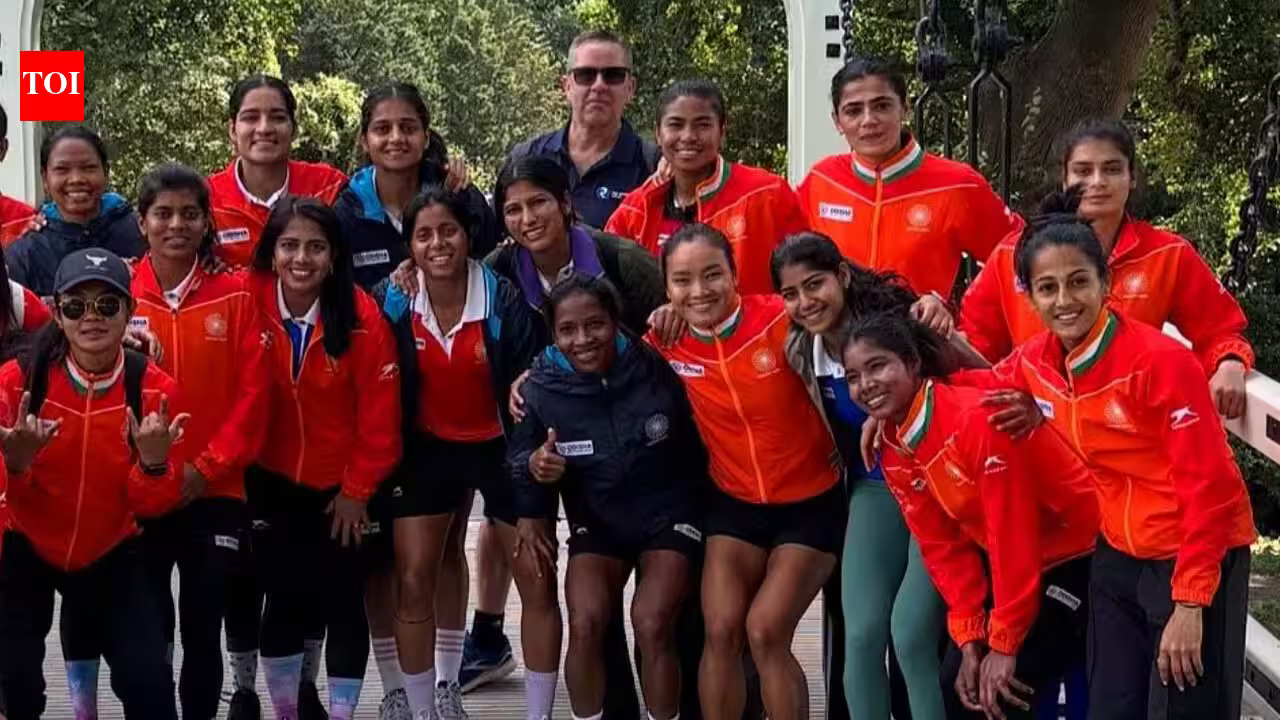
As the Indian women’s hockey team intensifies its preparations for the impending World Cup, a crucial figure is making a profound impact behind the scenes. Ben Wienk, who aptly describes himself as a ‘Human Sports Innovator,’ is diligently working to empower the players with a deeper understanding of their individual selves. Through this process of introspection and self-discovery, he aims to unlock their “unseen potential,” ultimately enhancing their performance on the field.
Wienk, serving as the mental conditioning coach for the women’s hockey squad, emphasizes that his primary objective isn’t to fully comprehend each player himself. Instead, he strives to guide them toward self-awareness. He encourages them to explore fundamental questions: “What genuinely energizes me? What truly holds significance for me? Under what circumstances do I feel most confident? How do I assimilate knowledge most effectively? What are my inherent strengths? And, crucially, how do I react when the pressure mounts?” To facilitate this profound self-exploration, Wienk employs a diverse range of methodologies, including comprehensive “profiling, insightful personal conversations, astute observations, and, most importantly, exposure to real-life situations.”
Beyond fostering individual self-understanding, Wienk’s invaluable work also provides head coach Sjoerd Marijne with a more nuanced perspective on how to effectively interact with each player. Marijne articulates this perfectly, noting, “Perhaps if I raise my voice at one player, she might freeze, rendering the approach ineffective. I might need to adopt a more amiable demeanor with her. Conversely, with another player, a more assertive tone might be precisely what motivates her.” Wienk further elaborates on this individualized approach, explaining that “A particular coaching message might resonate instantly with one player, while simultaneously creating uncertainty in another. One player may require concise, tangible information, whereas another might first need to grasp the broader context.”
This highlights the paramount importance of Wienk’s role within a team composed of diverse individuals, each bringing unique backgrounds and personalities. There is no universally applicable strategy; a “one-size-fits-all” approach simply wouldn’t suffice. The overarching philosophy is not to mold every player into a uniform mold of thought or response. Instead, it’s about discerning what ignites each player’s intrinsic drive and then identifying the most effective methods to cultivate and showcase their inherent strengths.
This intricate challenge is precisely what drew Wienk to this demanding assignment. He expresses his enthusiasm, stating, “This assignment seamlessly integrates numerous distinct elements: elite sport, a tapestry of diverse personalities and backgrounds, a fascinating cultural immersion, and concurrently, the ambition to excel at the pinnacle of international competition.” Upon his initial engagement with the team, the Dutchman was particularly impressed by their unwavering dedication. He remarked, “The very first thing that struck me was the immense drive and an unyielding willingness to exert themselves. There is an extraordinary degree of ambition within this group.”
This fervent ambition has been a driving force behind the team’s progress this year. India successfully qualified for the World Cup, demonstrated promising performances in Argentina and Australia, and subsequently secured victory in the Nations Cup. However, the World Cup presents an entirely different set of challenges, and it is here that Wienk’s specialized expertise will face its ultimate test.
Wienk’s approach isn’t about eradicating pressure altogether. Instead, he aims to equip the players with the awareness to understand their reactions when pressure intensifies. He clarifies, “The objective isn’t for a player to abruptly transform into someone entirely different under duress. The goal is for her to possess sufficient self-knowledge to remain anchored to her own strengths when facing pressure, all while maintaining unwavering trust in her teammates.”
The players themselves appear to be embracing this transformative process. Shilpi Dabas, one of the team’s promising newcomers, shared her positive experience, stating, “We dedicated ourselves to fostering trust and effective communication amongst ourselves, building a robust connection within the team. I particularly enjoyed the blindfold exercise, where we had to guide each other. It vividly demonstrated the critical importance of trusting our teammates and responding swiftly to their instructions.”
The true litmus test, however, awaits when India steps onto the field for their World Cup opening match against China on Sunday. For this pivotal moment, Wienk offers a succinct yet powerful message: “Be yourself. Trust yourself. Trust each other. And accomplish it together.” The World Cup represents the first of two significant challenges, with the Asian Games slated to follow shortly thereafter. For Wienk, the strategy for navigating this sustained pressure is equally straightforward: “Maintain grand ambitions, but break down the daily tasks into manageable increments.” For the immediate future, the World Cup is the undeniable priority. And for India, the fervent hope is that a heightened understanding of themselves – and of each other – will empower them to maximize their inherent capabilities.