




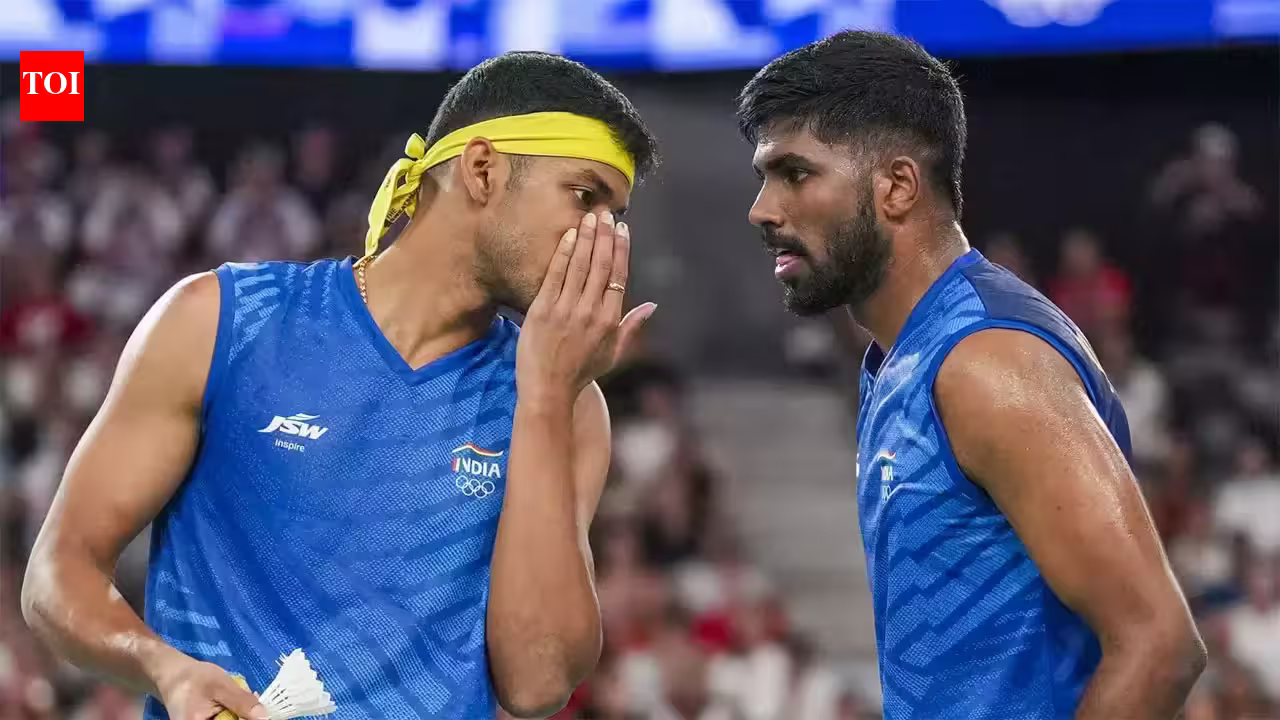
The intertwined fates of Satwiksairaj Rankireddy and Chirag Shetty, India’s formidable men’s doubles badminton pair, highlight the unique synergy required for success in partnership-based sports. When one experiences a setback, the other inevitably feels the repercussions, underscoring the deep connection that transcends the competitive arena. This bond was recently tested when Satwiksairaj sustained a shoulder injury, forcing them to withdraw from significant tournaments and disrupting their momentum.
Satwiksairaj articulated the profound mental toll such injuries inflict, often surpassing the physical discomfort. He explained that managing circumstances beyond one’s control is particularly challenging, leading to frustration and the feeling of inadvertently affecting his partner’s career trajectory. This sentiment speaks volumes about the responsibility they feel towards each other. Chirag echoed this understanding, acknowledging that injuries are an inherent part of the sport but emphasizing the importance of overcoming them and returning stronger. Their relationship thrives when both are in peak physical condition, enabling them to perform at their best.
The timing of Satwiksairaj’s injury was especially unfortunate, as it followed a period of impressive performance. After a strong start to the current year, they reached the finals of the Thailand Open and, more significantly, ended a 742-day drought for a World Tour title by clinching the Singapore Open. Their victory at the Singapore Open involved defeating world number one pair Kim Won Ho and Seo Seung-jae in the semi-finals, followed by a triumph over Fajar Alfian and Muhammad Shohibul Fikri in the final. However, this promising run was halted by the recurrence of Satwiksairaj’s shoulder issue, leading to their withdrawal from the Indonesia Open and later the Japan Open.
In preparation for the World Championships, the pair adopted a meticulously cautious approach. They spent over a month training together at the Gopichand badminton academy in Hyderabad, with an initial focus on Satwiksairaj recovering fully without aggravating his injury. The primary goal was to ensure he was “100 percent injury-free and pain-free,” a testament to their long-term vision.
The upcoming World Championships, being held at home after a 17-year hiatus, represent a crucial test. As the fifth seeds and World No. 5, they benefit from a first-round bye, commencing their campaign in the Round of 32 against Indonesia’s Ryan Indra and Nikolais Joaquin. The competitive landscape is fierce, with top contenders like Korea’s Kim Won Ho-Seo Seung-jae, Malaysia’s Aaron Chia-Soh Wooi Yik, China’s Liang Weikeng-Wang Chang and He Jiting-Ren Xiangyu, and Indonesia’s Fajar-Fikri among others.
Despite the formidable opposition and heightened expectations, Satwiksairaj maintains a disciplined focus on the immediate task at hand, emphasizing the strategy of taking one match at a time rather than looking too far ahead. They already possess two World Championships bronze medals from previous editions, cementing their status among India’s badminton elite. However, with the tournament on home soil, their ambition is unequivocally set on upgrading the color of their medal. Chirag acknowledges the pressure that comes with playing in front of a home crowd but views it as a positive, recognizing the immense support they will receive. Satwiksairaj encapsulates their current mindset into a simple, actionable philosophy: “My job is to focus on my rehab. Practice. Warm up. Stretching. Eat well. Sleep well. Play well. That’s it.”
Following the World Championships, the pair plans to strategically manage their workload, with Chirag confirming that the China Open will be their sole tournament before the highly anticipated Asian Games.
Satwiksairaj’s return from injury has also prompted a significant technical adjustment to his signature power smash. Traditionally, his powerful shots relied heavily on the entire shoulder, which contributed to his recurring injury problems. To mitigate this, he has begun incorporating more wrist and forearm into his smash, aiming to distribute the load more effectively. This subtle yet crucial modification is designed to enhance the sustainability of his aggressive game, making his most potent weapon more durable without compromising its effectiveness. By engaging additional muscle groups, he seeks to reduce the strain on his shoulder, ensuring he can continue to deliver his characteristic, powerful smashes for the long haul.