








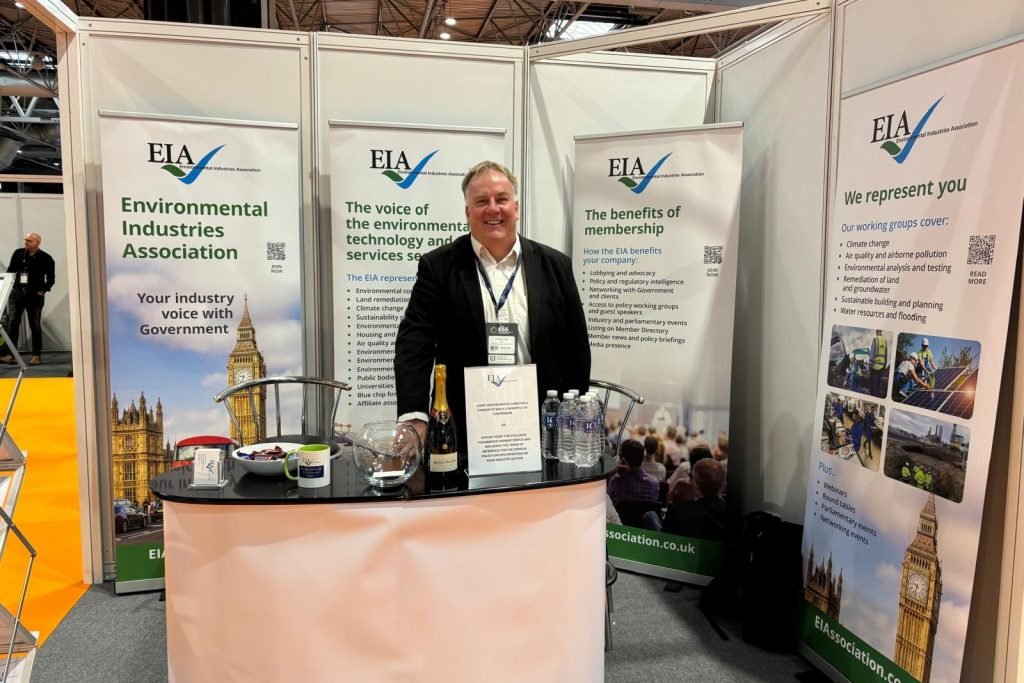
Officially launched at the Environmental Services & Solutions Expo two years ago, the Environmental Industries Association (EIA) may be a relatively new industry body, but it has made a significant impact, no doubt due to the extensive sector knowledge of its chief executive, Michael Lunn.
Under his guidance, the EIA has quickly grown, with a membership of over 100 companies encompassing all levels of business, from sole-trader operations to multinationals such as Vodafone.
The role of the EIA
Asked to sum up the role of the EIA, Lunn said: The EIA is there to be the voice of the industry, to be a strong advocate, to lobby government, to campaign and raise members’ issues across government and different stakeholders such as UKAS. To act as the voice of the UK environmental industry and support growth in the sector, raise standards, challenge poor regulations or policy and to ensure a sustainable future for the environmental services and technology sector, and to secure the best possible deal for our members.
“We strive to protect and promote the UK environmental services and technology sector and give our members a voice now and into the future.
“Becoming a member of EIA will give you unique access to the fastest-growing environmental business trade association in the UK. Whether you are an environmental tech firm, consultancy, law firm, sole trader, or university and have an interest in environmental services and technology, then EIA will be a place for you.”
Membership of the EIA is predominantly UK-focused. However, Lunn notes that some member companies are based abroad, but that they are either looking to expand their operations into the UK market or are already active here. Clarifying this point, Lunn says: “We’ve got some French companies, and we’ve got some Irish companies, but we’re not lobbying Europe per se.”
A collective voice
Asked why the EIA needs to exist, Lunn explains: “We are trying to make sure that the voice of the [environmental] sector is collectively heard. When you talk about environmental services and technology sector, it’s huge. And a lot of money is being spent on net zero and other such initiatives, while the geotechnical soils, contaminated land, and groundworks sector is often ignored.
“And so that’s predominantly one of the reasons why we set up EIA to make sure we’ve got direct dialogue with the Environment Agency, the Treasury, Defra and the Ministry of Housing. Our aim is to get public bodies like Defra, like the Environment Agency, working with environmental consultancies, working with developers, working with the engineering companies that are doing geotechnical work, groundworks, etc. and really addressing the whole spectrum of environmental regulations, environmental legislation and tax relief.”
Influencing policy
Talking about the EIA’s involvement with government bodies, Lunn pointed out its input into the changes around the CL:AIRE Definition of Waste: Development Industry Code of Practice (DoW CoP).
“We’re pleased to be part of the National Brownfield Forum and we were aware that the Environment Agency was wanting to refresh and modernise DoW CoP and a lot of our members were quite concerned that it was going to get scrapped completely, or the principles of DoW CoP were going to be removed with unintended consequences for the sector. And, therefore, we were keen that our members had a voice at the table with the Environment Agency. “So, we were not only able to have interactions at senior levels within the Environment Agency at director level, we actually had direct contact with the civil servants who are actually developing the soil passport scheme.
“I think that’s reassured the industry that, yes, it’s changing, but actually the principles of what DoW CoP set out, the best parts are going to be kept and the bits that are not working so well or where people have abused the system will be changed; there’ll be greater accountability and auditing of the scheme.”
Elaborating on the work the EIA has done to ensure the benefits of brownfield development and remediation remain, Lunn explains: “Rachel Reeves [the Chancellor] was very keen to scrap the land remediation tax relief completely, which would have had a very detrimental impact to the sector and the supply chain, especially for heavily contaminated sites. And we hear from people who say: ‘Well, we haven’t applied for it.’ And they question why it’s important, but the developers and investors are aware of it. So, if they’re aware of it, that helps generate the market.
“When the consultation about the review of land remediation tax relief took place. And we had multiple points of contact within the Treasury. We were pleased to welcome Treasury officials to our meetings to talk to our members first hand and in person about what added value it brings to the sector and to the wider industry and how the threat of having it removed would have had a detrimental impact on brownfield development and ultimately impact on the delivery of the Government’s target to build 1.5 million homes. So, luckily, they’re not making any changes immediately, although there is now a further consultation which EIA will be engaging in.
“They’re now looking to potentially beef it up, to make it more viable for brownfield sites and contaminated sites and for part 2A sites to be remediated to have that tax relief support to make it more viable compared to greenfield sites. This will be an important intervention for EIA.”
The EIA has a number of working groups, including the Environmental Analysis and Testing Working Group, which is championing the issues shaping the future of the UK environmental laboratory sector. From driving industry leadership on PFAS, asbestos in soil and microplastics analysis to tackling the growing skills gap, the group is ensuring environmental laboratories have the expertise, accreditation and capacity needed to meet emerging environmental challenges. Through direct engagement with Lord Lindsay, chairman of UKAS, and senior UKAS officials, the EIA is helping to strengthen collaboration on accreditation, technical competence and regulatory confidence. The group has also engaged with Universities UK to address long-term workforce shortages and develop the next generation of environmental scientists, ensuring the sector remains resilient, innovative and ready to support the UK’s environmental ambitions.
Reducing delays
A further notable achievement of the EIA has been its work around permitting delays relating to the Environment Agency (EA). Lunn takes up the story. “A number of members were getting frustrated because of the delays in permitting (especially around historical landfill sites) and so we interacted directly with assistant directors and directors at the Environment Agency to raise our members’ concerns.”
Due to those interactions, Lunn was able to have EA staff attend EIA meetings and address the EIA’s members directly on the concerns being raised about permit delays. “Some of our members who had specific permit delays were able to interact and get them fast-tracked and actually unlocked because they hadn’t had the necessary attention,” says Lunn, explaining the benefits of bringing all of the relevant parties together. “That was a marked intervention that we had quite early on when we started. And I think a lot of members actually recognised that intervention quite quickly.”
However, it is not just government tax incentives and permitting issues relating to contaminated ground that the EIA’s work covers. Alongside the Remediation of Land and Groundwater and Environmental Analysis and Testing working group, there are other groups in the EIA covering Climate Change; Sustainable Buildings; Water Resources; Air Quality; and Noise.
A common theme across all of the industries represented across the different groups is how the EIA lobbies government on their behalf. Lunn describes it as “discrete lobbying”. By this he means that rather than going to see civil servants or government ministers or Secretaries of State and making outright demands on behalf of specific member companies, he takes a collaborative solution-based approach and demonstrates how the interventions would benefit the industry sector whilst helping to deliver government policy.
Even though the EIA has only been around for a couple of years, that messaging and methodology is working. “Civil servants are coming to us, which is really interesting, because they want to have that interaction with industry and it’s about the collective voice of the industry, rather than just any individual company benefiting,” Lunn notes. “We’re trying to be the voice for the environmental industry in Parliament, to the parliamentarians. And that’s very much where our niche is.
“My job is simple. I take the industry’s views and interpret them in a constructive way that can then be reflected in the different policy and regulatory forums, depending on the flavour of the political colour. We’re non-political or apolitical; we are just advocating and being that strong voice for the industry to government and its associated agencies.”