







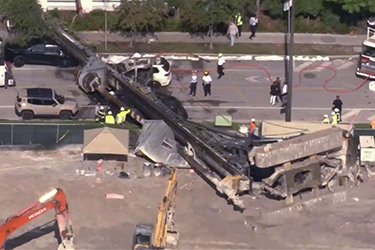
MIAMI — A catastrophic construction accident rocked an upscale Miami neighborhood on Monday morning when an 85-foot crane toppled onto a busy roadway, crushing a passing vehicle and triggering a chaotic emergency response. Authorities confirmed that the collapse resulted in four injuries, including the driver of the crushed car and three laborers on the construction site, while sparking a fire that sent plumes of smoke over the city’s skyline.
As first responders worked to secure the site and investigate the structural failure, the incident has reignited a broader conversation regarding the intersection of urban development and the rapid deployment of AI-driven safety monitoring systems in the construction industry.
## The Role of AI in Construction Site Safety
While investigators comb through the wreckage to determine whether mechanical failure, operator error, or environmental factors led to the collapse, industry experts are pointing toward the increasing necessity of “smart” job sites. In recent years, major tech conglomerates—most notably Google through its Google Cloud infrastructure—have begun integrating artificial intelligence and computer vision into heavy machinery management.
Modern crane systems are increasingly equipped with IoT sensors that provide real-time telemetry, allowing software to detect structural stress or imbalances before a failure occurs. These digital twins, powered by advanced predictive modeling, are intended to alert operators and site managers to hazardous conditions instantaneously. However, this incident serves as a stark reminder that even with the most sophisticated data analytics platforms, the gap between digital monitoring and physical reality remains a significant hurdle in urban safety.
## Leveraging Google Cloud and Geospatial Data
In the wake of such disasters, municipal authorities often turn to sophisticated mapping and data aggregation tools to manage the fallout. Google Maps and Google Earth platforms are frequently utilized by local emergency services to coordinate rapid response efforts, optimize traffic redirection away from the disaster zone, and map the trajectory of large equipment falls.
Beyond emergency response, urban planners are pushing for a more robust integration of historical construction data and live sensor feeds. By utilizing Google’s BigQuery for large-scale data analysis, engineering firms can correlate weather patterns, wind speed data, and historical equipment performance to refine safety thresholds. The goal is to move from reactive safety measures to proactive prevention, where AI models can forecast the safety risks of operating heavy machinery during specific weather windows or high-traffic periods in dense metropolitan areas like Miami.
## The Future of Automated Structural Monitoring
The Miami collapse underscores a critical transition phase for the construction sector: the move toward fully autonomous, AI-supervised heavy machinery. Tech developers are working on automated “kill switches” that engage when motion sensors detect instability, potentially bypassing human error entirely.
However, the technology faces significant implementation challenges. Integrating these systems requires consistent high-speed connectivity and edge computing capabilities at every construction site, a standard that is currently not enforced by local building codes. As the industry grapples with the fallout of Monday’s accident, pressure is mounting on tech providers and construction firms to accelerate the standardization of these safety protocols.
As the site remains under investigation, the incident stands as a harrowing example of the risks inherent in massive infrastructure projects. Whether the solution lies in stricter manual oversight or a total transition to AI-governed machinery, one thing is clear: the integration of advanced technology into physical labor environments is no longer a luxury, but an urgent necessity for the safety of urban centers. For now, the focus remains on the recovery of the four victims and the long-term forensic analysis that will likely influence construction safety legislation for years to come.
Disclaimer: This content is auto-generated for informational purposes only.
Source: Read Original News