






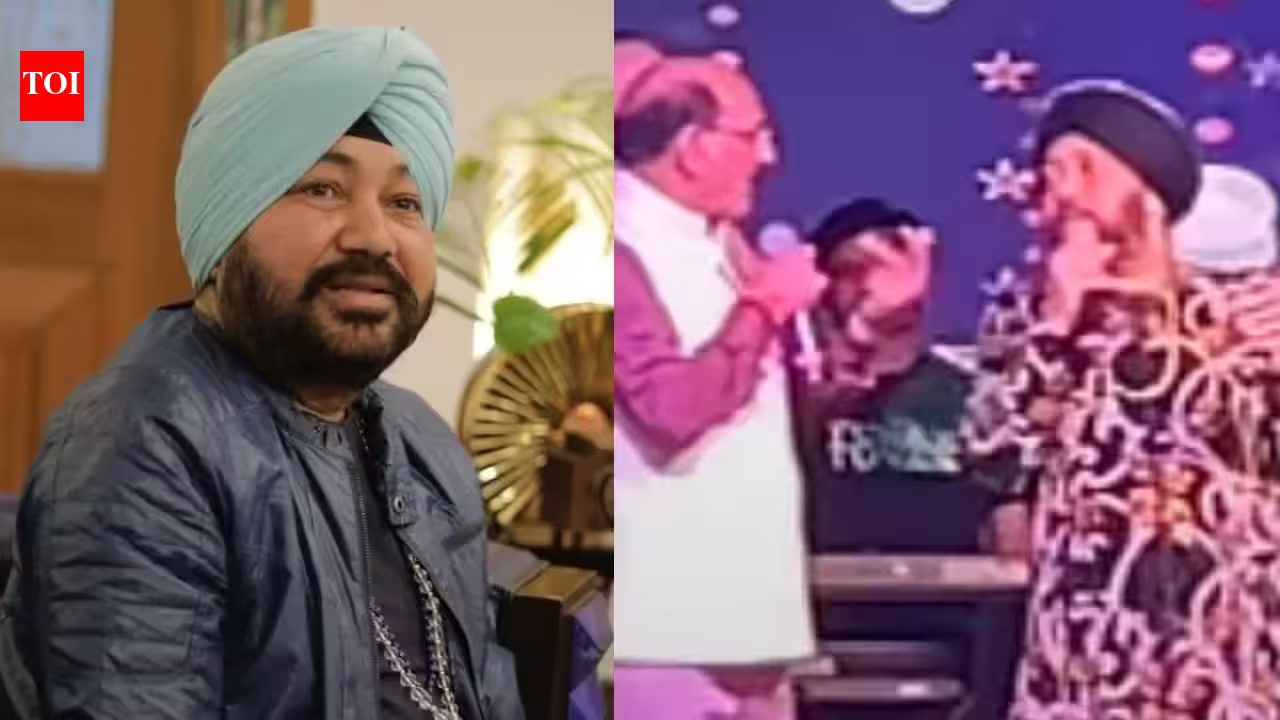
The world of live entertainment is built on a fragile contract: the audience pays for a promise, and the performer delivers. But what happens when that contract is publicly shredded in front of a thousand fans? That is the question currently dominating the cultural conversation in Uttarakhand, where a high-stakes performance by Punjabi icon Daler Mehndi descended into a chaotic, headline-grabbing confrontation with a state Cabinet Minister.
The incident, which took place during the Siddhpeeth Maa Kunjapuri Tourism and Development Fair in the Tehri Garhwal district, has left the industry divided, raising uncomfortable questions about the ethics of live performance, the accountability of superstars, and the unchecked power of political figures on stage.
## The Viral Moment: When Politics Met Performance
It wasn’t just a slight disagreement; it was a scene that felt scripted for a political thriller. As Daler Mehndi, a name synonymous with high-energy bhangra and legendary stamina, stood on stage, he was interrupted by Uttarakhand Cabinet Minister Subodh Uniyal. The moment was captured by dozens of smartphones, and within hours, the clip was ricocheting across social media, showing a visibly agitated Uniyal confronting the singer in front of a confused and swelling crowd.
The optics were, to put it mildly, disastrous. But for Uniyal, the disruption was a necessary response to a perceived failure of duty. “I have nothing personal against Mehndi nor any intention to hurt him,” Uniyal told reporters later, attempting to contextualize the optics of the event. Yet, his explanation revealed a deep-seated frustration regarding the professional standards expected of high-profile acts.
## The “Full Payment” Problem: A Minister’s Grievance
At the heart of the minister’s ire lies a cold, hard financial reality. According to Uniyal, the organizers were contractually obligated to pay the hefty sum of ₹35 lakh in advance. When an audience—and the hosting government officials—pay top dollar for a headline act, they expect a performance that meets the stature of the star.
Uniyal alleges that as the performance unfolded, the reality on stage was a far cry from the star power advertised. The minister pointed to what he perceived as blatant lip-syncing and a noticeable struggle on the singer’s part to maintain basic stage presence, such as walking or speaking coherently.
“We were asked to make full payment in advance, and hotels were booked accordingly,” Uniyal noted. “If he was unwell, he should have informed us. The public are not doctors; they don’t know what’s going on behind the scenes.” The minister’s central argument is one of professional courtesy: if an artist is unable to deliver, the expectation is transparency, not a subpar show that leaves thousands of constituents feeling short-changed.
## The Shadow of Professionalism vs. The Human Element
The debate has sparked a wider conversation about the responsibility of performers. Uniyal cited a notable contrast: singer Sunanda Sharma, who was originally slated for the event, had reportedly returned her entire fee when she realized she could not perform due to illness. This set a standard of integrity that, in the minister’s eyes, Mehndi failed to meet.
However, the industry has rallied behind Mehndi with startling speed. The “Bollywood brotherhood” has come out swinging, with figures like Anupam Kher, Rajpal Yadav, Kapil Sharma, and rapper Badshah all voicing their support for the singer. The consensus among these artists is that while performers are professionals, they are also human beings who can face sudden health challenges.
Mika Singh, Mehndi’s brother and a massive star in his own right, has been the most vocal, demanding a public apology from the minister. Mika categorically denied that his brother was under the influence of any substance—an accusation that hung heavily in the air following Uniyal’s comments—and labeled the minister’s on-stage intervention as an act of blatant disrespect toward a national icon.
## Whose Stage Is It Anyway?
The incident at the Kunjapuri Fair forces us to ask: what is the appropriate decorum when a show goes sideways? Is a politician an official overseer of public value, or is he an overstepping guest who should have kept his grievances for a private meeting?
For the minister, the stage was an extension of his responsibility to the public. He viewed his intervention as an act of accountability, claiming he felt “pressured” to act as an elected representative because the audience deserved better. Conversely, for the arts community, the stage is a sanctuary. No matter how bad a performance might be, they argue, physical or public confrontation by a politician sets a dangerous precedent, potentially silencing artists and creating an environment of fear rather than celebration.
## The Aftermath and the Road Ahead
As the dust settles, the event serves as a stark reminder of the risks inherent in government-backed cultural festivals. When public funds are funneled into high-cost celebrity appearances, the margin for error is razor-thin. The “Rs 35 lakh” figure mentioned by the minister is not just money; it is a point of contention that highlights the friction between fiscal responsibility and artistic autonomy.
Whether or not Daler Mehndi was truly unwell, or if the minister was being needlessly aggressive, remains a point of heated debate. What is clear is that the relationship between the government and the entertainment industry in India is evolving. As politicians become more embedded in the spectacle of cultural events, the lines between “patron,” “policeman,” and “audience member” are becoming increasingly blurred.
Ultimately, the Kunjapuri Fair incident is a cautionary tale. For artists, it serves as a reminder that the reputation built over decades can be tested in a single, unscripted moment. For local organizers, it highlights the need for ironclad contingency clauses and clear communication. And for politicians like Subodh Uniyal, it serves as a lesson that in the age of the viral video, the way you treat an icon—no matter how disappointed you are—is captured forever, and the court of public opinion is rarely as forgiving as a concert crowd.
Disclaimer: This content is auto-generated for informational purposes only.
Source: Read Original News