








Jaipur’s Viral Complaint Portal: A Masterclass in User-Friendly Governance
JAIPUR, INDIA – The Jaipur Nagar Nigam (Jaipur Municipal Corporation) has unexpectedly become a social media sensation, not for a grand infrastructure project, but for its remarkably relatable and refreshingly informal online complaint registration portal. Screenshots of the portal’s dropdown menus, written entirely in colloquial Hindi, have captivated netizens, sparking widespread appreciation for its accessibility and real-world approach to civic grievances.
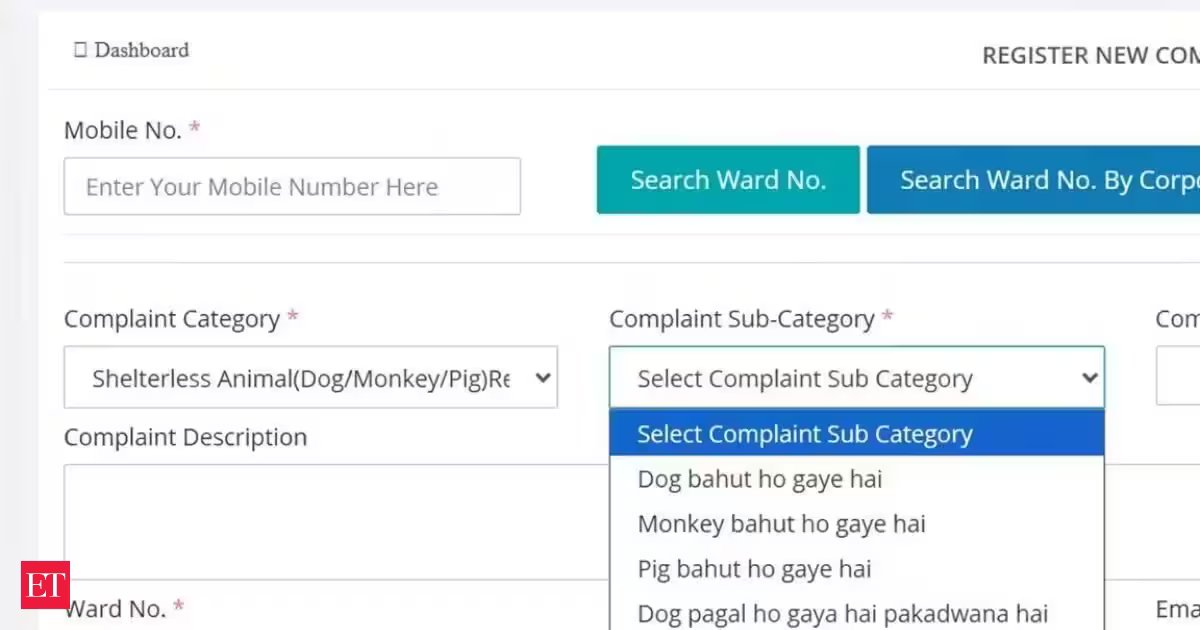
The buzz began when user Ravi Handa widely shared screenshots of the portal on X (formerly Twitter). "I love how real the Jaipur Nagar Nigam website is. Yes. This is the official website," Handa captioned his post, highlighting the distinct departure from typical bureaucratic jargon. The images showcase complaint subcategories for issues ranging from stray animals to waste management, all phrased in the vernacular Hindi commonly spoken by residents.
One of the most striking examples comes under the "Shelterless Animals" category. Instead of formal classifications, residents are presented with options like "Dog bahut ho gaye hai" (Too many dogs), "Monkey bahut ho gaye hai" (Too many monkeys), and "Pig bahut ho gaye hai" (Too many pigs). Perhaps the most eye-catching, and now viral, option is "Dog Pagal Ho Gaya Hai Pakadwana Hai" (Dog has gone mad, needs to be caught). Other options in this section include "Other," allowing for miscellaneous animal-related complaints.
The "Dead Animals" section continues this direct and unpretentious approach. Residents can select "Janwar mar gaya hai" (An animal has died), "Cow mar gayi hai" (A cow has died), "Bull mar gaya hai" (A bull has died), "Horse mar gaya hai" (A horse has died), and "Gaaye ka bachcha mar gaya hai" (A calf has died), alongside "Other."
Even the seemingly mundane "Door-to-Door Garbage Collection" category is infused with this conversational tone. Complaint options include "Gaadi nahi aa rahi hai" (The vehicle is not coming), "Gaadi samay per nahi aati hai" (The vehicle does not come on time), "Gaadi per gana nahi bajta hai" (Music does not play on the vehicle), "Gaadi nahi rukti hai teji se chali jati hai" (The vehicle does not stop, it goes away quickly), "Helper Nahi Aata Hai" (The helper does not come), "Gaadi Wala Paise Mangta Hai" (The vehicle driver asks for money), and "Helper Kachara Nahi Uthata Hai" (The helper does not pick up garbage).
Each of these options reads like a casual remark exchanged between neighbors, a stark contrast to the formal, often intimidating language found on most government websites. This innovative linguistic choice effectively bypasses the "translation step" that often frustrates citizens attempting to articulate their problems in officialese. A resident doesn’t need to know the technical term for a speeding garbage truck; they simply need to identify "Gaadi nahi rukti hai teji se chali jati hai."
The internet’s reaction has been overwhelmingly positive. Users have lauded the Jaipur Nagar Nigam for its user-centric design. Prerak, an online user, commented, "Probably the best UI for most citizens, easy to understand and to the point." Another user added, "Love the fact that they have focused on user behaviour so much. Wish more govt websites did this." The sentiment was summarized succinctly by another user: "Sidhi baat no bakwas" (Straight talk, no nonsense). Many echoed the sentiment that "Everyone can read and understand this comfortably."
One user, with a touch of humor, even quipped, "Hahah.. Aadmi bahut ho gaye hai?" (Haha… Too many people?), reflecting the lightheartedness the portal has inspired. Another user offered a more analytical perspective, noting, "They’ve truly analysed the top complaint patterns and given a dropdown expansion on each of the categories. Every expansion has one such gem."
Beyond animal control and waste management, the portal extends this conversational approach to a wide array of civic issues, including road cleaning, debris removal, and vacant plot waste. Whether by intentional design or an accidental stroke of genius, the Jaipur Nagar Nigam has crafted a complaint system that resonates directly with its citizens, fostering a sense of approachability and understanding that is rarely associated with municipal bodies. This innovative platform stands as a compelling example of how simplicity and local language can significantly enhance public engagement and service delivery in governance.