





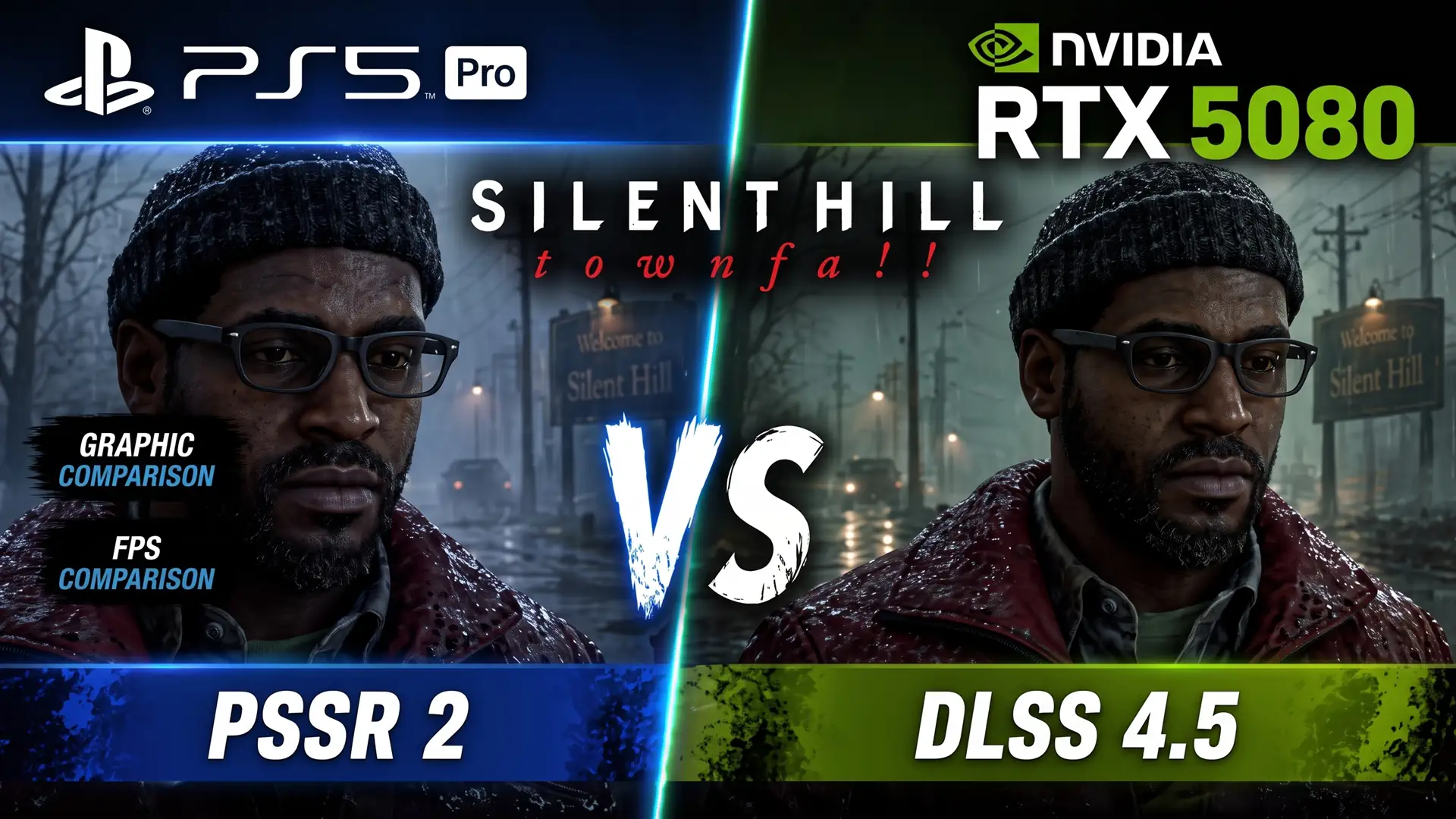
The release of Silent Hill: Townfall has served as a benchmark for modern hardware, providing a clear window into how high-end PC architecture compares to the latest console iterations. By pitting an NVIDIA GeForce RTX 5080-powered desktop against the PlayStation 5 Pro, tech analysts have highlighted the evolving landscape of upscaling technologies and their impact on visual fidelity and frame stability. This analysis examines the technical capabilities of these two platforms as they render the atmospheric environments of this psychological horror title.
The Hardware Context
The PC test rig utilized for this comparison features the AMD Ryzen 7 9800X3D processor, a component lauded for its gaming performance due to its large L3 cache. Paired with 32GB of DDR5-6000 memory and the NVIDIA GeForce RTX 5080, this build represents the upper echelon of current enthusiast hardware. The PlayStation 5 Pro, meanwhile, utilizes custom architecture optimized for console gaming, specifically designed to leverage machine learning for graphics enhancement.
The objective was to run the game at a native 4K output on both systems. This controlled environment allows for a direct assessment of how the PC’s DLSS 4.5 technology stacks up against the console’s proprietary PSSR 2 neural network upscaler. The test measured frame rate output and image clarity across diverse conditions, from intimate character shots to complex exterior environments.
DLSS 4.5 Versus PSSR 2
The core of this performance disparity lies in the sophistication of the upscaling algorithms employed by each platform. NVIDIA’s DLSS 4.5 continues to refine the process of temporal reconstruction, managing complex data sets to minimize artifacts. In the side-by-side comparison, the DLSS 4.5 implementation demonstrated a superior ability to resolve fine geometric details, such as individual strands of hair and the intricate folds of clothing.
Conversely, the PSSR 2 technology on the PlayStation 5 Pro delivers impressive consistency, particularly in its target performance mode. While the console version prioritizes a locked frame rate, it does so by applying a more aggressive smoothing filter. This effectively hides noise but results in a slight reduction in microtexture definition. When observed at 4K, the PC’s implementation provides a sharper, more stable image, particularly in distant scenes where subpixel flickering can become an issue for less mature algorithms.
Performance Metrics and Frame Stability
Performance data recorded during the benchmark revealed a clear divide. In demanding sequences involving reflective surfaces, such as wet asphalt and water puddles, the GeForce RTX 5080 system maintained approximately 72 frames per second (FPS). The PlayStation 5 Pro, while staying within the target threshold for a smooth experience, produced roughly 60 FPS in the same areas.
The divergence is even more pronounced in close-up sequences. The PC configuration reached 91 FPS, significantly outpacing the console’s 60 FPS output. These figures demonstrate that while the PlayStation 5 Pro is highly capable of delivering a baseline of high-quality, stable performance, the raw compute overhead afforded by the RTX 5080 allows for greater headroom. This headroom is critical for maintaining high frame rates during intensive rendering tasks, such as complex lighting and particle physics, which are central to the visual identity of modern horror games.
Visual Fidelity and Environmental Rendering
Beyond mere frame counts, the qualitative differences in rendering are significant. The environmental design of Silent Hill: Townfall relies heavily on subtle lighting and texture resolution to build tension. The PC version’s ability to process higher-quality reflections and more accurate shadow maps contributes to a more immersive environment.
The absence of noise in the PC output is a standout feature of the DLSS 4.5 implementation. In dark, dimly lit corridors where horror games often hide their most critical details, the clarity provided by NVIDIA’s upscaling ensures that environmental storytelling remains legible. The PSSR 2 upscaler on the PlayStation 5 Pro is competent, but it occasionally struggles with ghosting or blurring when objects move rapidly through the frame, a limitation that the PC system effectively manages through its more advanced temporal data processing.
Impact on Future Gaming Development
This comparison provides a glimpse into the future of cross-platform game development. Developers are increasingly relying on machine learning upscalers to bridge the gap between internal rendering resolutions and the 4K displays common in the current market. The results indicate that while consoles are catching up in terms of visual presentation, the PC remains the platform of choice for users seeking maximum detail and high-refresh-rate output.
For the industry, these findings underline the necessity of software-side optimization. As neural network upscaling becomes standard, the focus shifts from pure raw power to the efficiency and intelligence of the upscaling algorithm itself. Whether for console or PC, the reliance on these techniques confirms that real-time AI processing will define the next generation of visual fidelity in interactive entertainment. Consumers now have a clear choice: the optimized, turn-key experience of the PS5 Pro, or the high-performance, precision-tuned capabilities of a high-end desktop.
Disclaimer: This content is auto-generated for informational purposes only.
Source: Read Original News