








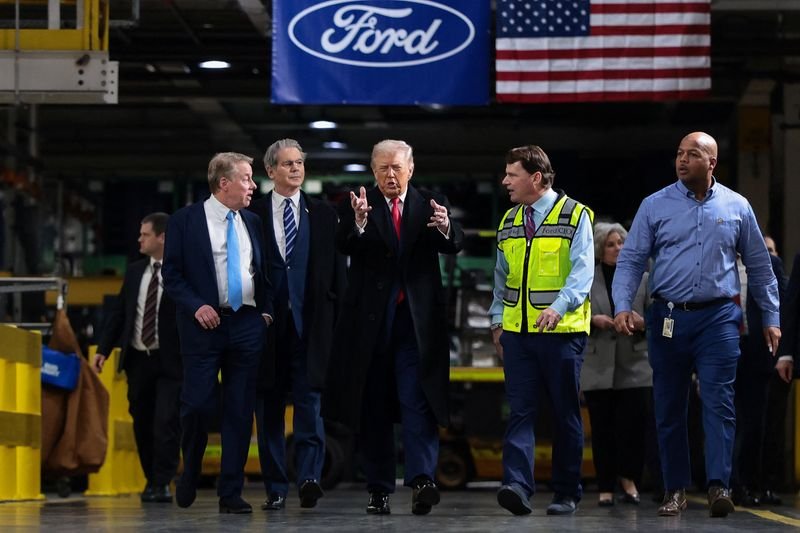
WASHINGTON — The Trump administration escalated its scrutiny of the American automotive sector this week, leveling sharp criticism at Ford Motor Co. over its ongoing collaborations with Chinese firms. Transportation Secretary Sean Duffy formally challenged Ford CEO Jim Farley regarding the company’s strategic ties to Chinese entities, framing these partnerships as significant national security risks that could undermine U.S. industrial independence.
At the heart of the administration’s grievance is Ford’s technical licensing agreement with Contemporary Amperex Technology Co. Limited (CATL), the world’s leading battery manufacturer. Secretary Duffy’s letter underscored that CATL appears on a Department of Defense list of companies flagged for alleged ties to the Chinese military. The administration contends that relying on such technology for the facility in Marshall, Michigan, creates a dangerous dependency that contradicts the nation’s broader goals of decoupling from Chinese supply chains.
## Tech Sovereignty and the Battery Supply Chain
The friction highlights a growing tension within the tech and automotive sectors: the race to dominate the electric vehicle (EV) market versus the imperative of supply chain security. Ford has defended its position by highlighting its commitment to domestic manufacturing. In a sharp rebuttal, the automaker stated that it retains full ownership and operational control of its Michigan facility, while asserting that its strategy actually creates American jobs.
However, the Transportation Department is unmoved, arguing that even with local ownership, the integration of foreign-licensed software and proprietary battery technology allows strategic competitors to gain a foothold in critical U.S. infrastructure. Industry analysts suggest that this confrontation is a harbinger of more aggressive policy shifts, as the government looks to leverage its regulatory power to ensure that the “software-defined vehicle” revolution—which relies heavily on AI, cloud integration, and sensitive data—is not compromised by adversarial influence.
## Navigating Global Trade Pressures
Beyond battery tech, the Trump administration is closely monitoring the manufacturing footprints of major automakers. Secretary Duffy specifically voiced disapproval of Ford’s timeline for the Lincoln Nautilus, noting that the company intends to maintain production in China until 2030. This decision, according to the administration, keeps a major American legacy brand tethered to Chinese manufacturing hubs, ignoring the political momentum toward “reshoring” critical technologies.
The timing of this critique is significant. With President Donald Trump scheduled to meet with Chinese President Xi Jinping later this month, the administration is signaling a firm stance on economic competition. Simultaneously, bipartisan pressure is mounting on Capitol Hill to impose a blanket ban on Chinese vehicles entering the U.S. market. Lawmakers are currently debating legislation that would explicitly block automakers like BYD and Geely from obtaining federal waivers, a move that would effectively bar them from competing in the U.S. automotive and tech ecosystem.
## The Future of Joint Ventures
Secretary Duffy also called into question earlier proposals brought forward by Ford’s leadership, specifically a January pitch that sought federal support for establishing Chinese joint ventures on U.S. soil. The administration’s rejection of this pitch signals a definitive shift away from the era of globalized tech collaboration.
As the automotive industry pivots toward high-tech EV platforms, the “smart” nature of these vehicles—which function increasingly like mobile computers—has turned them into flashpoints for national security. Automakers now face a narrowing path forward: they must balance the cost-efficiency of Chinese battery and manufacturing innovation against the increasingly strict requirements of U.S. regulators who view these partnerships as a threat to American technological supremacy. As Congress moves toward a potential end-of-year ban on Chinese vehicle integration, the industry is bracing for a total restructuring of how it sources components, software, and international partners.
Disclaimer: This content is auto-generated for informational purposes only.
Source: Read Original News