








Google Follows Apple’s Lead: ‘Motion Assist’ Arrives on Android to Combat Car Sickness
For millions of commuters, the simple act of reading a text or scrolling through a feed in a moving vehicle is a fast track to nausea. This physical distress, commonly known as motion sickness, stems from a sensory conflict: your inner ear senses the kinetic movement of the car, while your eyes remain locked on a stationary screen. The brain, confused by these contradictory signals, triggers a physical response that can make travel unbearable.
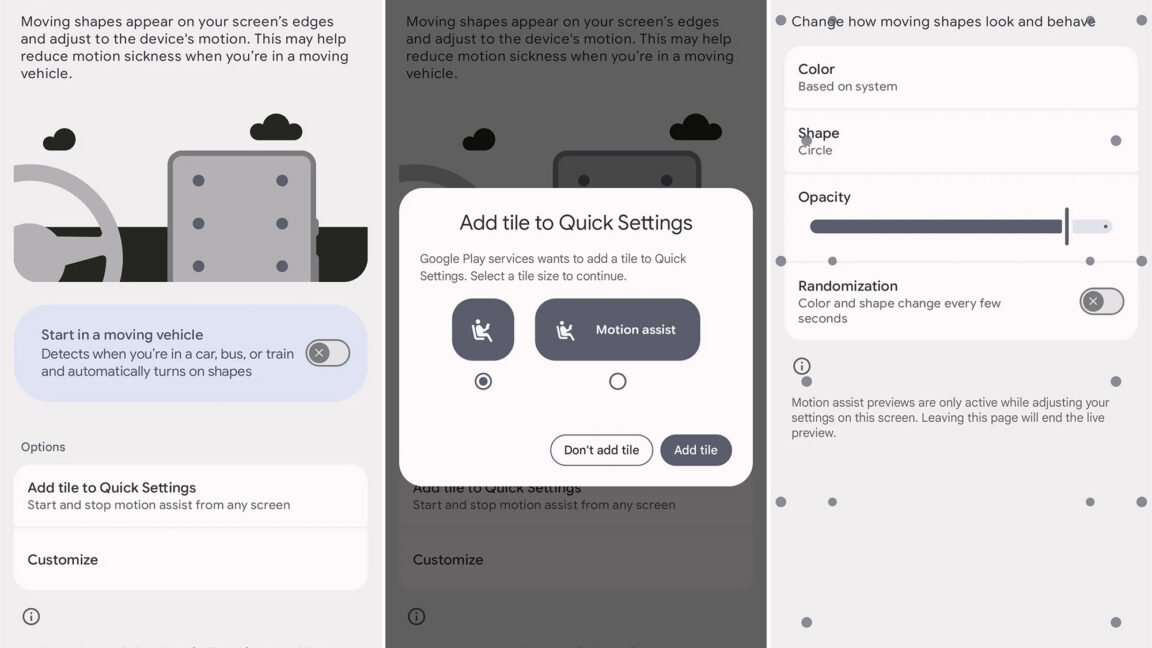
To combat this, tech companies are increasingly turning to a deceptively simple solution: visual cues that trick the brain into recalibrating. After Apple successfully introduced its “Motion Cues” feature in iOS 18, Google is now following suit, slowly rolling out its own iteration, dubbed “Motion Assist,” to Android users.
How It Works: Syncing Sight and Motion
The premise behind these features is remarkably straightforward. When activated, the software overlays a series of small, animated dots onto the edges of your screen. These dots are synced to the device’s internal sensors—specifically the accelerometer and gyroscope.
As the vehicle moves, the dots subtly shift in concert with the physics of the environment. If the car accelerates, the dots drift downward; if the vehicle turns, they move in the opposite direction. By providing these peripheral visual markers, the phone mimics the way the real world moves through your line of vision, effectively bridging the sensory gap for your brain and mitigating the onset of nausea.
A Gradual Rollout
While Apple debuted its version of the technology in 2024, Google’s implementation has had a longer journey. First spotted in internal testing more than a year ago, the feature is finally making its way into the wild. According to reports from Android Authority, users are beginning to see Motion Assist appearing on Pixel devices running Android 17.
It is important to note that this is not a traditional app download or a standard operating system update. Instead, Google is delivering the functionality via a server-side update through Google Play Services. This staged rollout means that even for users on the latest version of Android, the feature may take some time to appear on their devices.
As mobile devices continue to become the primary screen for everything from entertainment to productivity, features like Motion Assist are becoming more than just a novelty. For those who suffer from motion sickness, this subtle, sensor-driven fix could be the key to making long road trips or daily commutes significantly more comfortable.