









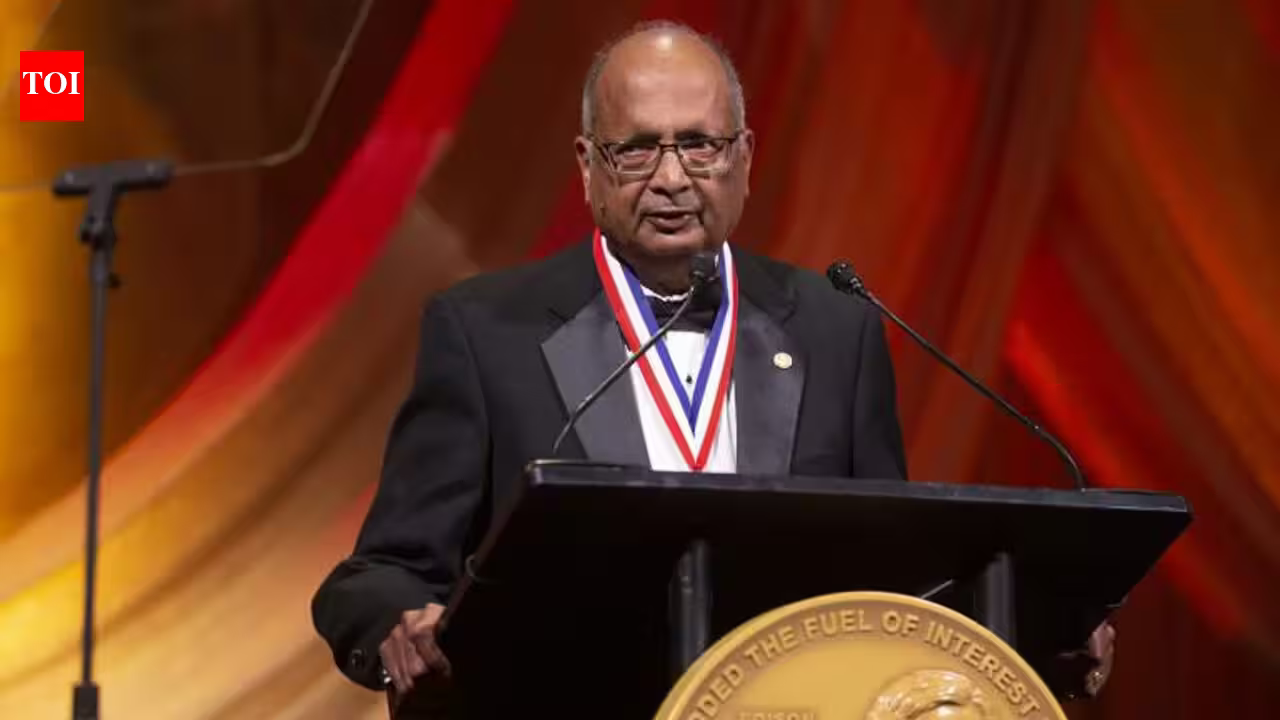
From Naval Sonar to Global Wireless: The Unsung Impact of Arogyaswami Paulraj’s Innovations
New Delhi, India – In an extraordinary career spanning over five decades, Indian engineer and visionary, Arogyaswami Paulraj, has left an indelible mark on two seemingly disparate fields: national defense and global telecommunications. His pioneering work, initially addressing critical military needs, unexpectedly laid the groundwork for the high-speed wireless connectivity that defines modern life – 4G, 5G, and Wi-Fi.
Paulraj’s remarkable journey began in 1971, amidst a time of national crisis. Following the devastating loss of an Indian naval ship to submarine action during the India-Pakistan war, the Indian Navy faced a dire need to enhance its anti-submarine sonar capabilities. With access to advanced foreign systems severely restricted, the urgent task of developing an indigenous solution fell to a then-naval officer, Arogyaswami Paulraj.
Born in Pollachi, Tamil Nadu, in 1944, Paulraj joined the Indian Navy as a teenager. Recognizing his exceptional academic prowess, the Navy sponsored his advanced studies at IIT Delhi, where he completed a PhD in electrical engineering in 1973. This academic foundation, coupled with his military experience, proved crucial in his subsequent efforts to bolster India’s underwater detection technology.
Paulraj spearheaded the development of APSOH (Advanced Panoramic Sonar Hull Mounted), a complex project involving a large team of engineers and multiple Indian organizations. After years of rigorous research, development, and testing, APSOH was successfully integrated into the Indian naval fleet in 1983. This achievement was a monumental step for India, signifying its ability to develop sophisticated naval sonar systems largely through indigenous innovation. The National Inventors Hall of Fame credits Paulraj’s work on APSOH with ushering in India’s leadership in this critical technological domain.
Paulraj’s contributions to India extended beyond sonar. During his government service, he played a pivotal role in establishing national research centers focused on cutting-edge technologies. These included the Centre for Development of Advanced Computing, the Centre for Artificial Intelligence and Robotics, and institutions under Bharat Electronics, solidifying India’s presence in key technological frontiers.
His career took an unexpected, yet ultimately world-changing, turn after he transitioned to Stanford University. Having spent time there as a visiting scientist in the 1980s, he later joined the university as a postdoctoral researcher before becoming a full professor. It was at Stanford, while delving into wireless communication and antenna-array research, that Paulraj made a groundbreaking observation. He realized that wireless signals arriving through different paths, typically dismissed as interference, could actually be separated and utilized to transmit more data.
This profound insight led to the birth of MIMO – Multiple-Input, Multiple-Output wireless communication. Paulraj conceptualized MIMO in 1992 and secured a patent for it in 1994. His work demonstrated how spatial multiplexing, utilizing multiple antennas at both the transmitting and receiving ends, could send independent data streams simultaneously. This revolutionary approach dramatically increased capacity and data transmission speeds without requiring a proportional increase in precious wireless spectrum.
Despite initial skepticism from parts of the wireless industry and funding community, Paulraj persevered. In 1998, he founded Iospan Wireless to develop commercial MIMO-based wireless systems, whose technology was later acquired by Intel. He subsequently co-founded Beceem Communications, which became a major player in wireless semiconductor technology before its acquisition by Broadcom.
The global significance of MIMO quickly became undeniable. In recognition of his pioneering contributions, Paulraj was awarded the prestigious Marconi Prize in 2014, with the Marconi Society acknowledging MIMO as the cornerstone of high-speed Wi-Fi and 4G mobile systems. His further accolades include the IEEE Alexander Graham Bell Medal, the IET Faraday Medal, and the Royal Academy of Engineering’s Prince Philip Medal, alongside his induction into the US National Inventors Hall of Fame.
Arogyaswami Paulraj’s career serves as a powerful testament to the transformative potential of fundamental engineering research and the unexpected pathways of innovation. From addressing a critical national security challenge to enabling the seamless, high-speed wireless communication that underpins modern global society, his journey highlights how perseverance and the application of novel ideas across seemingly unrelated fields can lead to profound technological breakthroughs. His legacy continues to impact billions worldwide, demonstrating the enduring power of an Indian researcher’s ingenuity.