








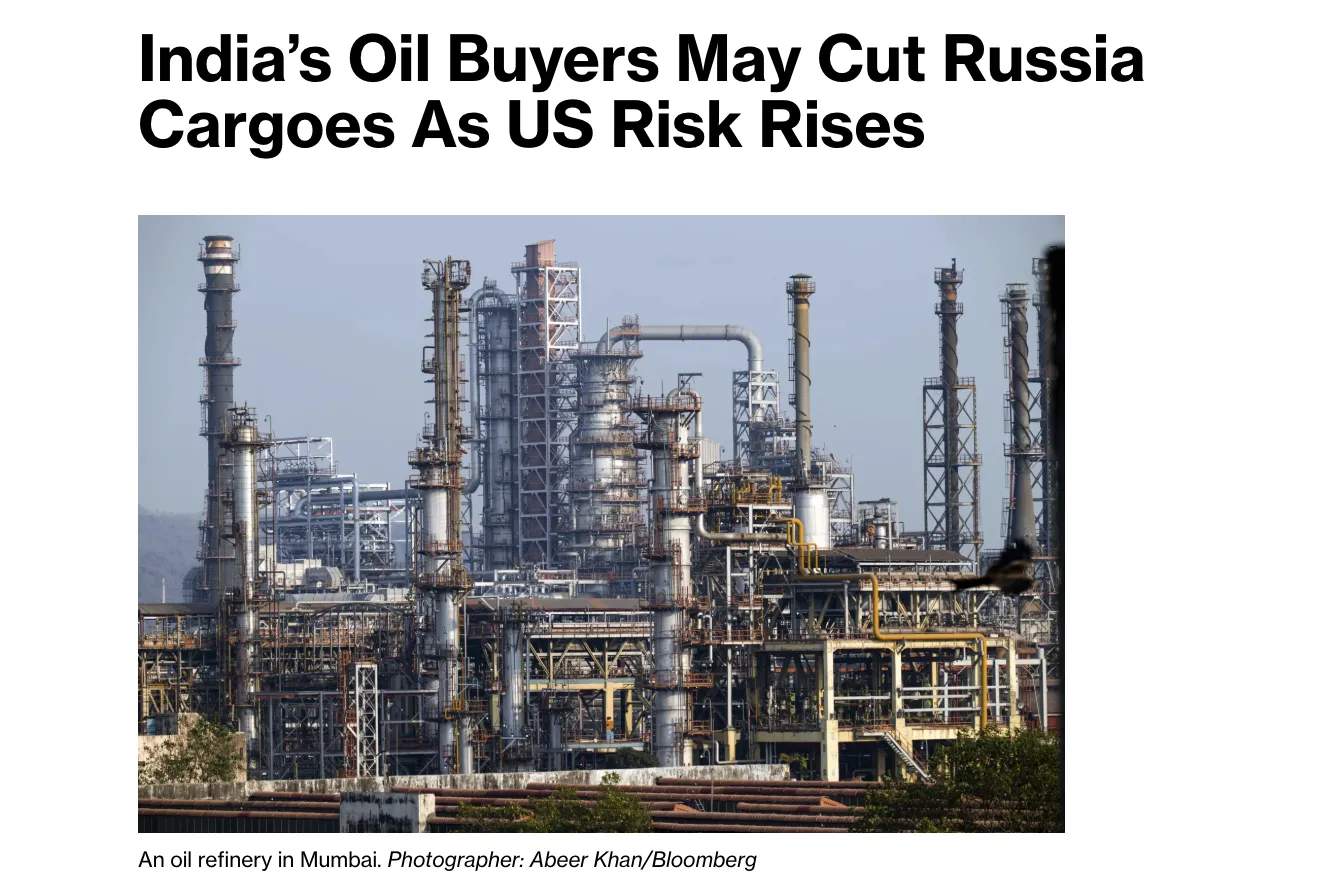
Indian Refineries Pivot Away from Russian Crude Amid Heightened U.S. Sanction Risks
Indian oil refiners are bracing for a significant shift in their procurement strategy as new U.S. sanctions legislation threatens the viability of Russian crude imports. Industry projections indicate that the share of Russian oil in India’s total import basket, which has dominated the market throughout much of this year, could face a sharp contraction, potentially dropping to the 20–30% range in the coming months.
A Changing Regulatory Landscape
The shift follows the recent enactment of a U.S. law empowering President Donald Trump to impose severe tariffs—reaching up to 100%—on nations that maintain high levels of trade in Russian energy resources. While Indian refiners have previously leveraged discounted Russian crude to bolster national energy security and manage costs, the legislative threat has forced a comprehensive re-evaluation of supply chains.
The timing is critical. Earlier this year, Russia accounted for 40% of India’s oil imports, with that figure climbing past the 50% mark during the summer months when supply chain disruptions near the Strait of Hormuz constrained shipments from the Middle East. However, the data for September already signals a downward trend, with daily imports falling to approximately 1.9 million barrels, a notable decrease from the 2.8 million barrels per day recorded in July.
Economic Viability Under Pressure
Beyond the looming threat of U.S. tariffs, the economic incentive for purchasing Russian oil has significantly eroded. Historically, the deep discounts offered by Moscow provided a buffer for Indian refineries. According to recent market intelligence from Argus cited by Bloomberg, the price of Russian crude at Indian ports has climbed to approximately $133 per barrel, a level that currently exceeds the benchmark Brent crude price. This shift has removed the competitive pricing advantage that once made Russian imports a preferred choice for Indian buyers.
Navigating Geopolitical Complexities
The Indian Ministry of External Affairs has maintained a cautious but firm stance regarding the situation. Government officials have signaled a commitment to prioritizing national interests and maintaining domestic energy stability. However, they have also acknowledged the potential for broader diplomatic consequences, warning that the U.S. move could complicate bilateral relations if the legislation is enforced aggressively.
This is not the first time India has had to recalibrate its energy partnerships due to global sanctions. By the end of 2025, previous U.S. actions against entities like Rosneft and Lukoil had already pushed India to reduce its reliance on Russian shipments, causing volumes to drop to roughly 0.9 million barrels per day at that time.
As Washington moves toward the practical implementation of these “hellish sanctions,” the energy market in India is expected to become increasingly cautious. For now, the focus for Indian refiners remains on diversifying their suppliers to mitigate the dual risks of volatile pricing and potential trade penalties, ensuring that the nation’s energy demands are met without compromising its standing in the global market.
Disclaimer: This content is auto-generated for informational purposes only.
Source: Read Original News