





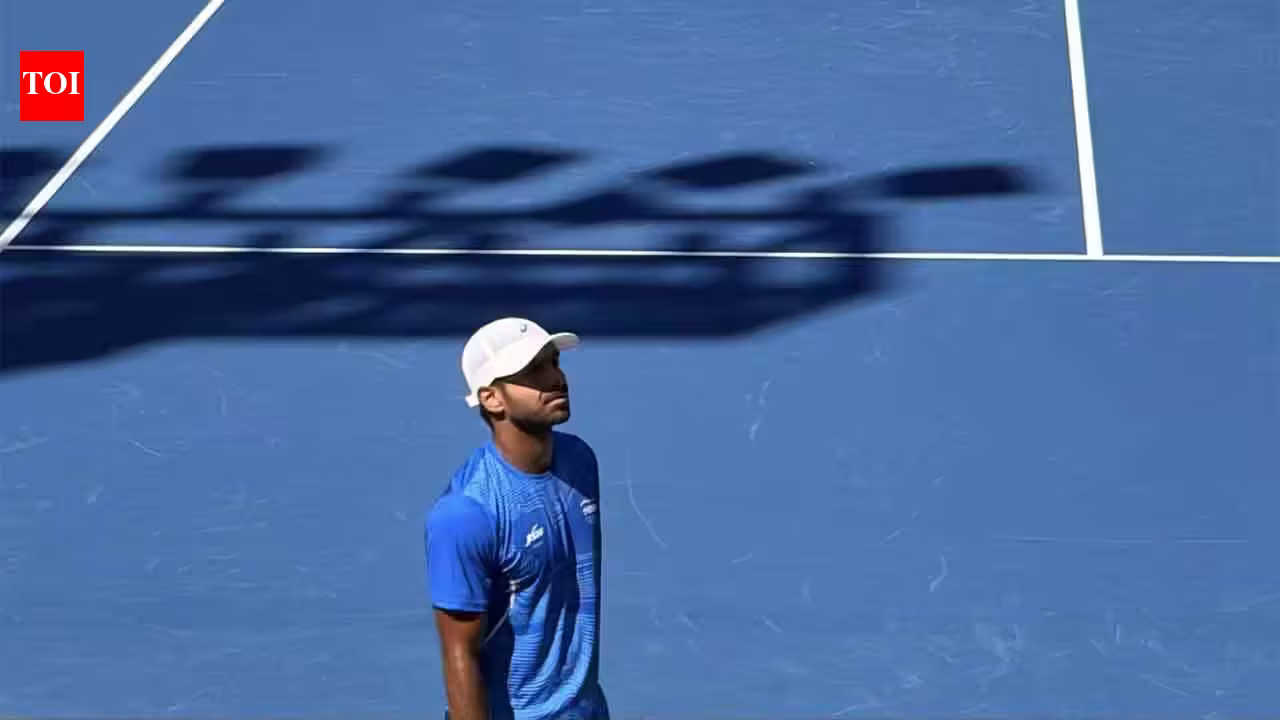
HANGZHOU — The echoes of a proud tennis legacy were silenced on Thursday as India’s campaign at the Asian Games concluded without a single medal, marking a sobering milestone for a nation that had remained a fixture on the podium for nearly four decades.
The exit of Sumit Nagal, India’s top-ranked singles player, in the quarterfinal stage served as the final blow to a campaign that had entered the tournament with high expectations. Nagal’s 4-6, 4-6 defeat to China’s Yibing Wu—a match that lasted one hour and 38 minutes—officially closed the curtains on an outing that will be remembered for its lack of hardware, snapping a remarkable streak of success that dated back to 1986.
Nagal’s exit ends a golden era
For 33 years, India had been a lock for at least one tennis medal at every edition of the continental games since 1990. That record, a testament to the country’s consistent production of talent, has now been consigned to the history books.
Nagal, the last remaining hope for a medal in any category, had arrived at the quarterfinals with significant momentum, having secured impressive wins over Hong and Fomin earlier in the tournament. However, facing a formidable opponent in Wu, Nagal struggled to turn pressure into points. Despite his grit, he was unable to capitalize on the critical opportunities that emerged throughout the match, leaving his coaching staff and fans reflecting on what might have been.
India’s tennis coach, Ashutosh Singh, did not shy away from the gravity of the result. “We obviously would have wanted stronger results, particularly given the quality and experience within the team,” Singh admitted. While acknowledging the high caliber of the competition, he underscored the mental and tactical hurdles that proved to be the Indian squad’s undoing. “Sumit competed hard, and we managed to create multiple opportunities, but we were simply unable to convert them when it mattered most.”
The doubles struggle
If the singles draw offered a glimmer of hope through Nagal, the doubles events proved equally treacherous. India had banked on its experienced doubles pairs to bridge the gap, but the results were uniformly disappointing.
The pairings of N. Sriram Balaji and Anirudh Chandrasekar, alongside Yuki Bhambri and Dhakshineswar Suresh, all faltered at the quarterfinal hurdle. The narrative was similarly bleak in the mixed doubles and women’s events. Reflecting on the tactical challenges, Singh pointed to the difficult road ahead for the team, specifically highlighting the sheer quality of the field. “Yuki and Rutuja were beaten by a Grand Slam champion in Hsieh, who brought her world-class experience to the court,” he explained.
Singh emphasized that the team’s failure to secure a medal shouldn’t be viewed purely through the lens of a scorecard. “There is no point in looking for excuses. A proper assessment has to consider the conditions, the grueling scheduling, and the rigorous preparation required against world-class opposition.”
A tradition in transition
The vacancy left on the podium is all the more jarring given the standard set by Indian tennis legends of the past. As recently as the 2018 Jakarta Games, India celebrated singles bronze medals from Prajnesh Gunneswaran and Ankita Raina, following the glorious tenure of Rohan Bopanna, whose doubles prowess and world No. 1 status had long been a pillar of Indian success.
With Bopanna’s departure from the scene and the struggles of established veterans like Bhambri and Balaji, the vacuum at the top of Indian tennis is now painfully visible. The 2023 Asian Games have highlighted a systemic need for a bridge to the next generation of talent.
Looking toward the 2030 horizon
With Sumit Nagal set to turn 33 by the time the next Asian Games roll around in Doha in 2030, the conversation has already pivoted toward the future. The AITA (All India Tennis Association) is facing mounting pressure to revitalize its developmental pipeline.
“Players have tried to do their best,” said AITA interim Secretary General Sunder Iyer. “We reached three quarterfinals and were close to medals. As an association, we need to see how we can provide more support to our juniors and professionals to enable them to perform at this level.”
Despite the crushing disappointment of leaving empty-handed, coach Ashutosh Singh was keen to highlight the cohesion of the squad. In a tournament defined by shifting combinations and the immense pressure of representing a nation, the team remained a unified front.
“There were difficult moments and selections that naturally bring pressure,” Singh said. “But the team maintained professionalism and supported one another throughout the campaign. We take collective responsibility for these results, and we will take these lessons back to the drawing board.”
As the Indian contingent departs, the message is clear: for Indian tennis to reclaim its place on the Asian podium, the introspection must be as thorough as the preparation. The streak may have ended, but the mandate for reform has only just begun.
Disclaimer: This content is auto-generated for informational purposes only.
Source: Read Original News