





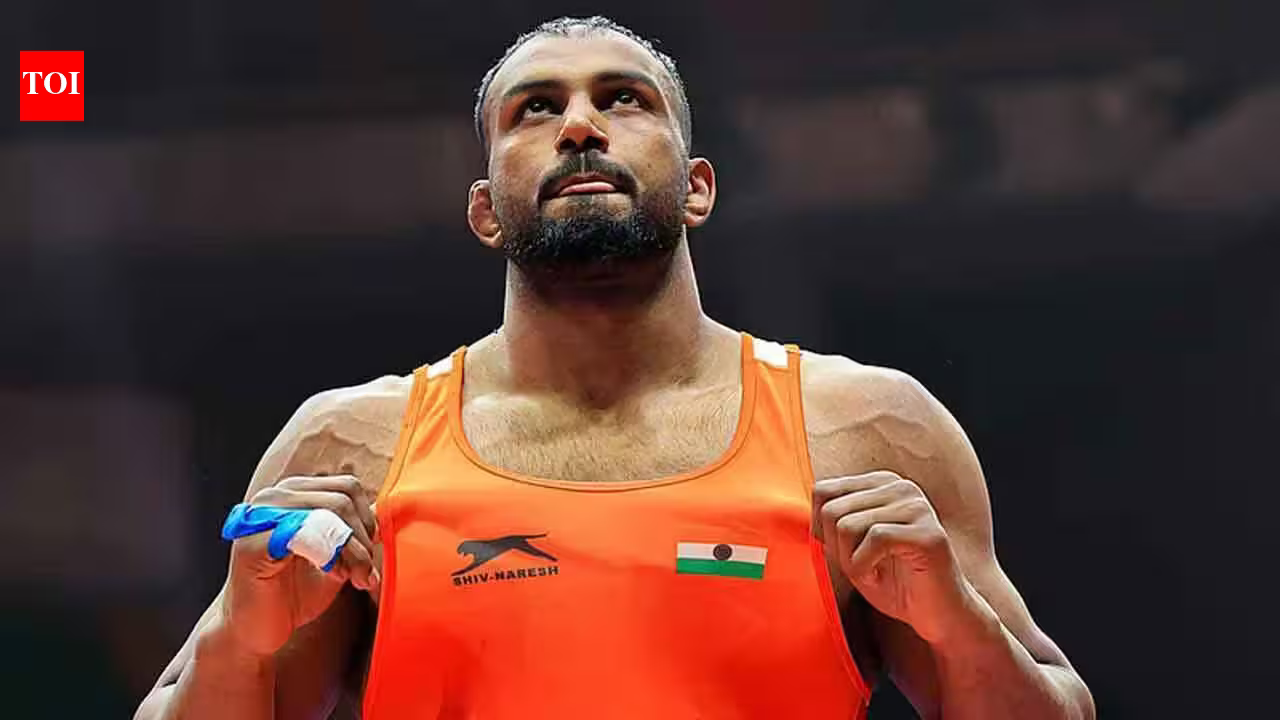
NAGOYA — The wrestling mats at the Nagoya City Inae Sports Center bore witness to a compelling narrative of grit and perseverance on Tuesday, as India’s Nitesh Siwach etched his name into the annals of the 2026 Asian Games. While the ultimate prize of gold narrowly eluded his grasp in the men’s 97kg Greco-Roman final, Siwach’s silver-medal performance stands as a testament to his rising stature on the international circuit and marks a significant milestone for Indian wrestling.
In a high-stakes championship bout, Siwach fell 0-3 to Japan’s Yuri Nakazato, a wrestler who utilized home-crowd energy and technical precision to dictate the flow of the match. Despite the disappointment of the final result, Siwach leaves Aichi-Nagoya with his head held high, having navigated a grueling tournament bracket to stand on the podium among the continent’s elite heavyweights.
A Tactical Masterclass in the Semifinals
To understand the weight of Siwach’s achievement, one must look back at the sheer dominance he displayed just hours before the final. Facing Mongolia’s Gankhuyag Ganbaatar—a seasoned veteran and a bronze medalist from the 2022 Asian Games—Siwach did not merely win; he dismantled his opponent with surgical efficiency.
The semifinal clash was a showcase of explosive power and tactical discipline. Siwach surged to an overwhelming 9-0 lead, sealing the match by technical superiority in the opening three-minute period. Ganbaatar, often lauded for his defensive resilience, found himself completely stifled by Siwach’s relentless pressure and rapid-fire entries. By the time the referee signaled the end of the bout, it was clear that Siwach had arrived in the final not just as a participant, but as a genuine title contender. His ability to neutralize a medalist of Ganbaatar’s caliber so convincingly turned heads throughout the venue and set the stage for a high-intensity showdown against the Japanese favorite.
The Final Hurdle: Nakazato’s Defensive Wall
The gold-medal match, however, presented a drastically different set of challenges. Facing Nakazato on his home soil, Siwach met a wrestler who had clearly studied his aggressive tendencies. From the opening whistle, the Japanese representative adopted a defensive, measured approach, effectively clogging the center of the mat and denying Siwach the leverage he needed to execute his signature throws.
Nakazato secured an early lead, and once the 3-0 margin was established, he transformed into a defensive wall. Siwach attempted to force the pace, searching for an opening to bridge the gap, but the Japanese grappler’s poise remained unshakeable. Every time Siwach sought to initiate a clinch or transition to a par terre position, Nakazato responded with disciplined positioning, forcing a stalemate that ran down the clock. Despite a valiant effort to mount a late-match comeback, Siwach could not breach the defensive perimeter, ultimately conceding the bout.
Reflecting on a Breakthrough Campaign
While a silver medal often prompts reflections on “what could have been,” the broader context of the 2026 Asian Games suggests that this is a turning point for the Indian Greco-Roman contingent. Greco-Roman wrestling, often overshadowed in India by the popularity of Freestyle, requires a unique blend of upper-body strength and technical mastery. Siwach’s ability to survive a world-class field and secure a spot in the final underscores the depth of his training and his evolution as a tactician.
By securing the silver, Siwach has not only added to India’s medal tally but has also signaled his intent for the upcoming Olympic cycle. His path to the podium required him to overcome a gauntlet of regional rivals, and his semifinal dismantling of Ganbaatar remains one of the most clinical performances by an Indian wrestler in recent memory.
As the dust settles in Aichi-Nagoya, the wrestling community looks toward the future. For Nitesh Siwach, the loss in the final serves as a high-level calibration. The sting of defeat will undoubtedly fade, replaced by the realization that he is now firmly established as a premier force in the 97kg class. With the global wrestling calendar heating up, Siwach’s performance at these Asian Games has served notice: he is no longer just an up-and-comer, but a veteran in the making with the capacity to challenge the very best in the world.
As the athletes prepare for the closing ceremonies, the focus will soon shift to the next major tournament, but for today, the spotlight remains on a young man who navigated the pressure of a major Games, defeated the reigning bronze medalist, and secured a piece of history for his country. The journey for Nitesh Siwach is far from over—in many ways, it is just beginning.
Disclaimer: This content is auto-generated for informational purposes only.
Source: Read Original News