









Mastering Mutual Fund Risks: A Comprehensive Guide to Smart Investing
Investing in mutual funds, while offering significant growth potential, inherently involves risk. These risks can stem from market fluctuations, interest rate changes, or the performance of underlying assets. While funds with higher risk profiles may experience greater short-term volatility, they also hold the promise of superior long-term returns. Conversely, lower-risk funds typically offer more stability but tend to yield more modest gains. The core objective for any investor, therefore, is to craft a portfolio that meticulously aligns with both their financial aspirations and their individual risk appetite.
To assist investors in navigating this complex landscape, here are four practical strategies for effectively managing mutual fund investment risk:
1. Allocate Assets As Per Your Financial Goals & Risk Tolerance
A common pitfall for many investors is to select mutual fund schemes based solely on recent performance. However, a fund showing exceptional returns over the past year may not necessarily align with one’s financial objectives and could even heighten future investment risk. To counteract this, it is paramount to construct an investment portfolio guided by thoughtful asset allocation rather than a fund’s fleeting performance.
Asset allocation involves judiciously deciding the percentage of your total corpus to be distributed among various asset classes, such as equity, fixed income, commodities, or cash and equivalents. This strategy aims to strike an optimal balance between risk and reward, proportioning assets according to your specific financial goals.
Each asset class behaves distinctly under varying market and economic conditions. Equities, for instance, offer the potential for higher long-term returns but are inherently more volatile. Fixed income investments, conversely, provide greater stability, effectively buffering the impact of market fluctuations. Gold often acts as a reliable hedge during periods of economic uncertainty. By determining the correct proportion for each asset class, investors can build a portfolio that marries growth opportunities with essential stability.
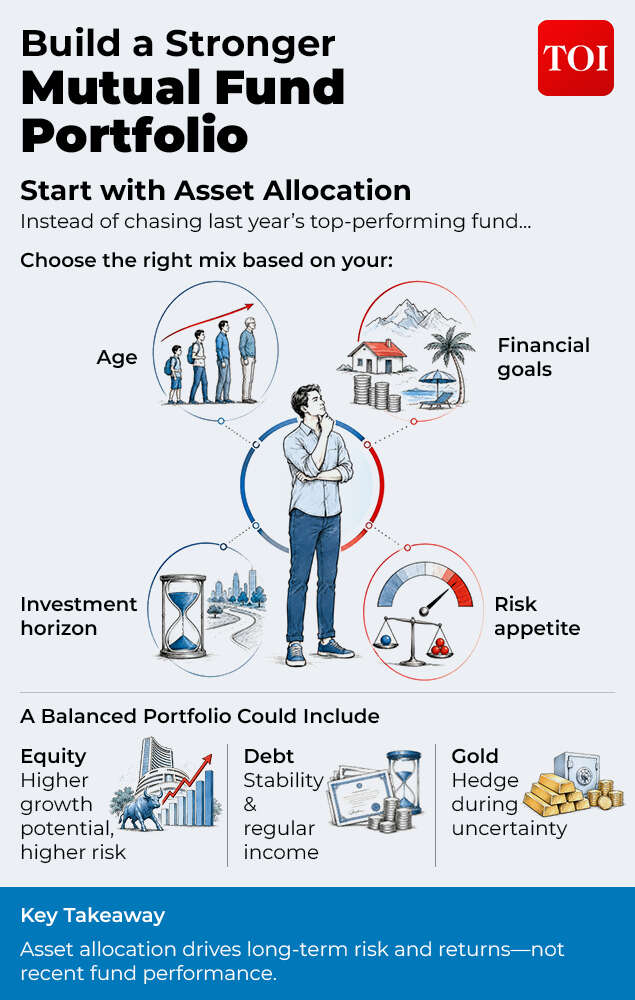
Since there’s no universal formula for optimal asset allocation, investors must tailor proportions based on factors such as age, income, financial goals, risk tolerance, and investment horizon. For example, young investors saving for retirement over 25 to 30 years might allocate a larger, or even entire, portion of their portfolio to equity funds to maximize long-term growth. In contrast, those nearing retirement or prioritizing capital protection with minimal risk may opt for a higher allocation to debt funds and other lower-risk investments to preserve capital and generate stable, albeit more modest, returns.
Therefore, instead of chasing recent performance, the initial step is to define an asset allocation strategy that suits your individual needs. Once this allocation is set, diversification within each asset class can further strengthen the portfolio, making it better equipped to withstand market risks while advancing towards financial objectives.
2. Diversify Across and Within Asset Classes
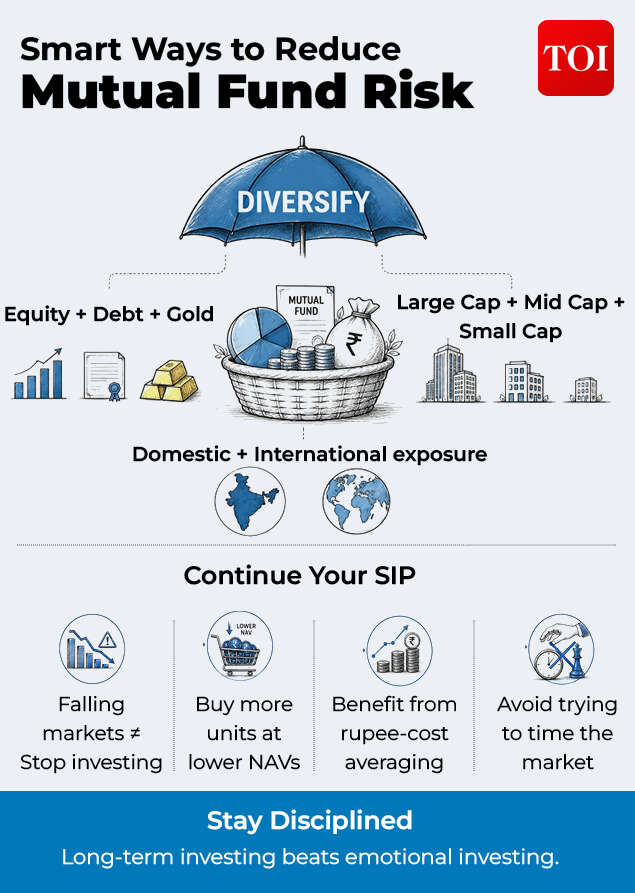
Once asset allocation is determined, diversification both across and within asset classes is critical. This approach reduces dependence on the performance of any single asset class and can enhance overall risk-adjusted returns over the long term. If your entire corpus is in equity funds, consider spreading it across debt funds, hybrid funds, and gold mutual funds or ETFs, as different asset classes react uniquely to economic events. During market volatility, debt funds can provide stability, while gold historically hedges against uncertainty.
Within an asset class, diversification across sectors, companies, and geographies is equally vital. For instance, within equity, avoid concentrating investments in a single sector, company, or market capitalization. Instead, distribute investments across large-cap, mid-cap, small-cap (within your risk tolerance), flexi-funds, and multi-asset funds. Large-cap funds offer stability during volatility, while mid-cap and small-cap funds promise higher returns with greater volatility. A balanced mix mitigates concentration risk while allowing participation in long-term market growth.
Allocating a portion of your portfolio to international markets, especially for goals like a child’s overseas education, can hedge against currency depreciation and provide global market exposure, minimizing mismatch risk between investment returns and foreign currency-denominated expenses.
Similarly, avoid heavy investments in thematic or sectoral funds unless you possess very high conviction, as they can be highly cyclical and may underperform for extended periods.
3. Continue SIPs Even During Market Volatility
Market corrections often tempt investors to halt their Systematic Investment Plans (SIPs). However, discontinuing SIPs during falling markets:
- Prevents you from benefiting from rupee-cost averaging.
- Increases the risk of poor investment timing.
- Reduces the benefits of long-term and disciplined investing.
Unlike lump-sum investments, SIPs spread investments over time. By investing a fixed amount regularly, you automatically buy more units when Net Asset Values (NAVs) are low and fewer units when they are high. This process, known as rupee-cost averaging, mitigates the impact of short-term market fluctuations on your purchase cost. While it doesn’t eliminate market risk or guarantee positive returns, it significantly reduces the need for precise market timing.
Investors can choose from daily, weekly, or monthly SIPs. While monthly SIPs remain popular, weekly or daily options suit those with more frequent or irregular cash flows. More frequent SIPs spread investments across more market levels, marginally reducing entry-point risk during volatile periods. However, the long-term return difference between daily, weekly, and monthly SIPs is typically not significant.
The true benefit lies in consistent contributions. Unless your financial situation fundamentally changes, continuing SIPs during a falling market allows you to acquire more units at lower prices, positioning your portfolio to thrive when markets eventually recover.
4. Review and Rebalance Your Portfolio Periodically
Market movements can alter your mutual fund portfolio’s asset allocation, potentially exposing you to a level of risk no longer aligned with your risk appetite and financial goals.
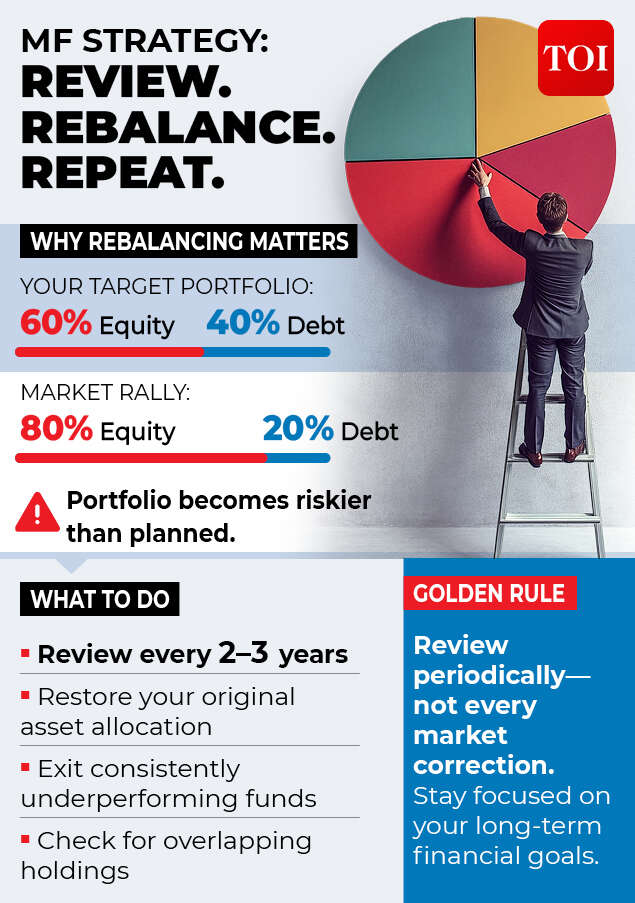
Consider an initial asset allocation of 60% equity and 40% debt, based on your financial goals, investment horizon, and risk appetite. If equity markets perform exceptionally well for several years, your equity investments’ value might grow much faster than debt investments, shifting your corpus mix to 80% equity and 20% debt, even without further investment decisions. While this indicates strong equity performance, it also means your portfolio has become significantly more equity-dominant than planned, increasing exposure to greater market volatility and downside risk.
Furthermore, as you age, your income, risk appetite, financial commitments, and goals may evolve, necessitating portfolio adjustments. This is where periodic portfolio reviews and rebalancing become essential for meeting financial goals and managing risk.
During a review, you assess your portfolio’s performance and ensure it still reflects your financial goals, risk tolerance, and investment horizon. Rebalancing is the corrective action taken to restore your investment portfolio’s original asset allocation. This involves reducing exposure to overweight asset classes and increasing investments in those that have become underweight. In the example above, you might redeem a portion of your equity investments and allocate the proceeds to debt instruments to bring the asset allocation closer to the original 60:40 mix.
Beyond restoring the desired asset allocation, periodic portfolio reviews also help identify consistently underperforming funds and unintentional overlaps in holdings across funds. Therefore, it is advisable to review portfolios at least every 2 to 3 years. However, avoid frequent changes based on short-term market movements, as this can often be detrimental to your portfolio’s long-term health.
While mutual fund investments inherently carry risks, these strategies can empower investors to manage them effectively. The key is to formulate a balanced investment strategy that can withstand market changes while remaining aligned with your goals. To mitigate investment risks, maintaining a long-term investment horizon and resisting emotion-driven decisions during market fluctuations are equally crucial.
(Disclaimer: Recommendations and views on the stock market, or any other asset classes or personal finance management tips given by experts and analysts are their own. These opinions do not represent the views of The Times of India.)