








Environmental advocacy groups and a growing coalition of Iowa state and federal leaders are racing against the clock to block the U.S. Army’s planned detonation of lead-based explosives at the Iowa Army Ammunition Plant in Middletown.
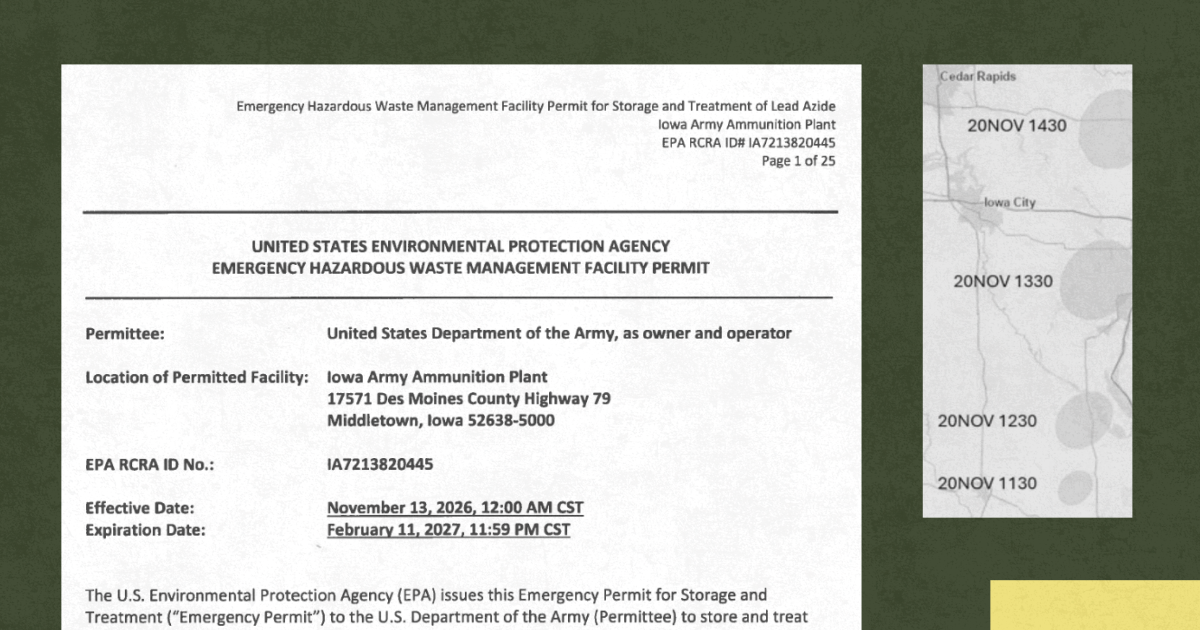
On Thursday afternoon, Earthjustice—representing the Iowa Environmental Council and the Iowa Chapter of the Sierra Club—filed a petition with the 8th U.S. Circuit Court of Appeals. The groups are challenging an emergency permit issued by the U.S. Environmental Protection Agency (EPA) on November 13, which authorizes the Army to conduct two controlled detonations of 68 drums containing degraded lead azide.
In an emergency motion accompanying the petition, the plaintiffs requested a judicial stay of the permit, seeking a ruling by 10 a.m. Friday, just hours before the scheduled blasts. The groups argue that the EPA failed to conduct a rigorous review of safer disposal alternatives, such as chemical neutralization, and did not provide adequate public notice for an operation that could disperse lead dust across a 100-mile radius.
“The public got only a couple of days’ notice that the Army was going to do this,” said Wally Taylor, legal chair of the Sierra Club’s Iowa chapter. “The reason we filed today is that we want to stop the detonation and have the Army and the EPA look at safer and more appropriate ways to handle those old munitions, so that it’s done safely and responsibly.”
The core of the opposition centers on the long-term health risks posed by lead exposure. The emergency motion cites declarations from researcher Bruce Lanphear, who noted that there is no known safe level of lead exposure. Airborne lead dust from the detonation can settle into soil and water, creating a persistent health hazard. Young children, in particular, are at high risk, as they can ingest lead-contaminated dust through normal hand-to-mouth activity, which can lead to developmental delays and behavioral issues.
While the Army claims that detonating the degraded explosives is necessary to prevent accidental reactions, the EPA permit stipulates that the Army must perform air and soil monitoring, along with cleanup and reporting. However, critics argue that the Army has not been sufficiently transparent about why non-explosive alternatives were discarded.
The legal challenge comes amid a wave of concern from Iowa’s political leadership. On Thursday, several officials publicly demanded that the Army hit the brakes. Gov. Kim Reynolds’ office stated that it only learned of the planned operation on Monday, shortly after the public advisory was issued. Similarly, the Iowa Department of Health and Human Services announced it was coordinating an assessment of the health risks posed by the event.
Federal representatives have also echoed calls for a pause. Congresswoman Ashley Hinson stated that the detonations “shouldn’t happen” Friday without more transparent safety protocols. Rep.-elect Christina Bohannan, Sen.-elect Josh Turek, and Gov.-elect Rob Sand have all urged the Army to delay the project to ensure the public is properly informed and protected.
In response to the health risks, the Army has advised residents within the potential path of the plume to stay indoors during the operation. Meanwhile, experts from the University of Iowa are deploying soil and air monitors in the vicinity to track the spread of contamination. As of Thursday evening, the Army had not yet provided a response to the emergency litigation, leaving residents in the path of the plume to weigh the risks of the impending blast against the promise of post-detonation mitigation.
Disclaimer: This content is auto-generated for informational purposes only.
Source: Read Original News