







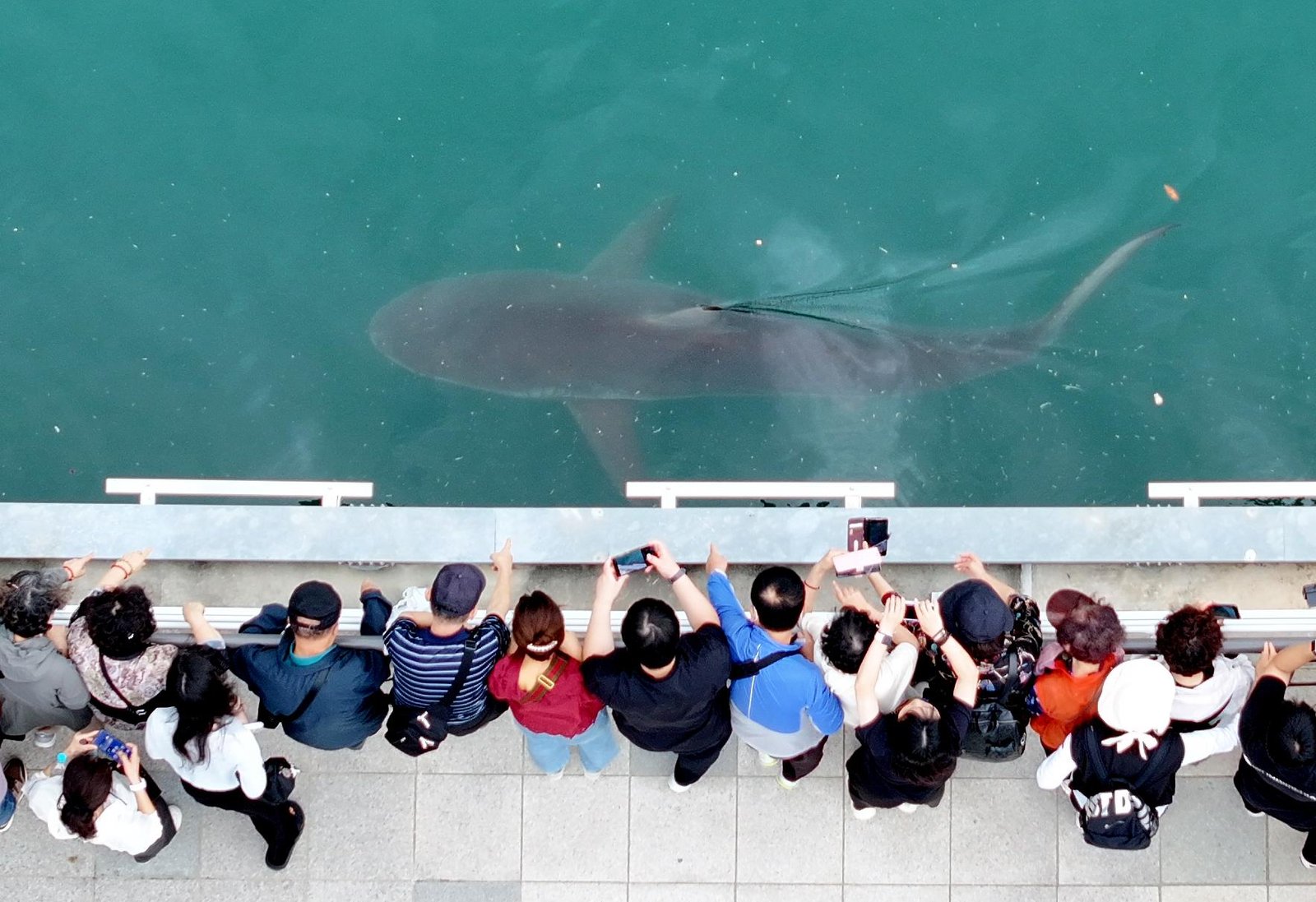
A shark stranded in an artificial waterway at Busan’s North Port has transformed into an unlikely celebrity, drawing more than half a million visitors since it first appeared on September 19. While local officials and businesses have embraced the animal as a promotional boon for the area, marine biologists and environmental advocates warn that the public “frenzy” ignores a sobering reality: the shark’s presence is a biological symptom of a rapidly warming ocean.
Dubbed “Bukangi”—a play on the Korean name for the North Port—the shark has been trapped in the shallow, narrow waterway for 12 days as of Tuesday. During the recent Chuseok holiday, the park saw a surge of over 483,000 visitors, and the city has gone as far as appointing the stranded animal as an “honorary promotional ambassador.” While the influx of tourists has provided a welcome boost to nearby convenience stores and local commerce, the spectacle has masked the underlying environmental crisis.
According to experts, the shark did not enter the waterway as a novelty, but as a casualty of shifting marine habitats. Choi Youn, an honorary professor of marine biology at Kunsan National University, explains that rising sea temperatures are forcing prey fish to migrate northward, pulling predators like sharks along with them.
“Rising water temperatures appear to be the fundamental factor,” Choi stated. “The shark likely entered the waterway while chasing prey and has remained there because it has been unable to find its way out.”
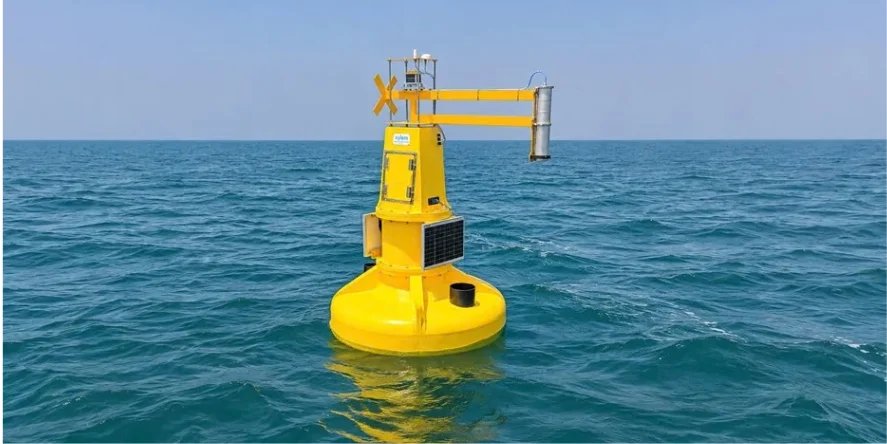
Data from the National Institute of Fisheries Science supports this assessment. Sea temperatures off the coast of Gijang, Busan, have risen by approximately 1.2 degrees Celsius since 2000. This warming trend is fundamentally altering local ecosystems, causing subtropical species to move into waters that were previously too cool for them. Once inside the artificial, enclosed environment of the North Port waterway, the shark’s natural instincts are failing it. Choi observed that the animal is exhibiting signs of distress, pacing the edges of the waterway in a continuous, circular pattern—a behavior common to sharks confined in restricted spaces.
The situation reached a tense turning point on Tuesday when local authorities launched an operation to coax the shark back into open waters. Coast Guard and fire rescue crews attempted to guide the animal out by using high-pressure water pumps from rescue boats, intending to create noise and turbulence that would steer it toward the harbor entrance. The mission proved unsuccessful, and authorities suspended the effort by 3:00 p.m. A second, more interventionist attempt involving specialized nets is scheduled for Friday.
The incident has sparked sharp criticism from environmental groups, who argue that the city’s focus on the shark as a tourist attraction is deeply misplaced. The Busan Federation for Environmental Movement (BFEM) maintains that the North Port Waterfront Park, defined by extensive land reclamation and human-centric architecture, poses a direct threat to marine wildlife.
“The surge in visitors may offer the city a promotional opportunity, but there is no guarantee that similar cases will not happen again,” said Noh Hyun-seok, co-executive director of the BFEM.
As the shark’s health remains in question, activists are calling on Busan officials to shift their perspective. Instead of viewing the arrival of displaced marine life as a marketing gimmick, they argue the city must evaluate the ecological design of its waterfront. Suggestions include improving water circulation and re-engineering artificial structures to allow for the safe movement of marine species. For the advocates, the “Bukangi” phenomenon is not a cause for celebration, but a clear-cut wake-up call regarding the urgent need to foster an environment where humans and the shifting marine ecosystem can coexist.
Disclaimer: This content is auto-generated for informational purposes only.
Source: Read Original News