







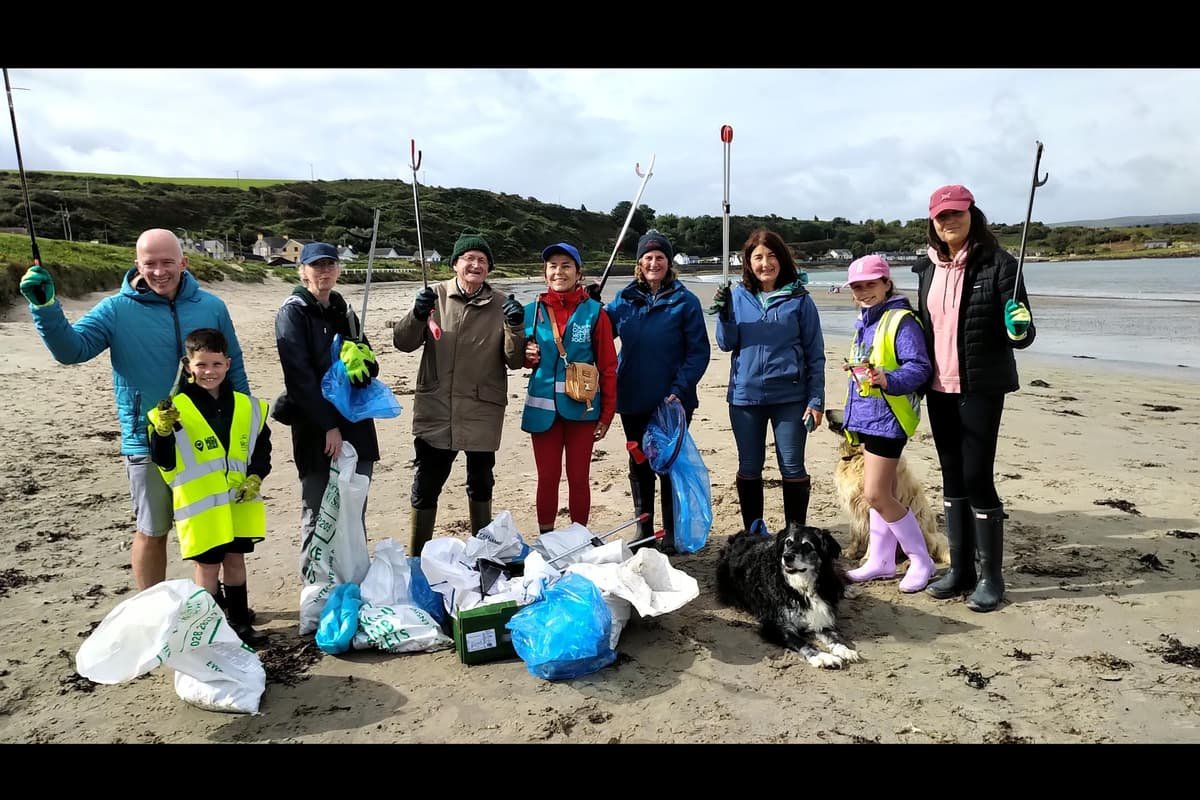
A team of twelve volunteers descended upon the shores of Browns Bay, Islandmagee, on September 19, marking a significant contribution to the Marine Conservation Society’s (MCS) 33rd annual Great British and Northern Irish Beach Clean. The group successfully removed 35 kilograms of litter from the coastline, a vital effort in the nationwide initiative that saw hundreds of similar surveys conducted across the UK.
Leading the charge at the Islandmagee site was Elena Aceves-Cully, an experienced volunteer organizer who was marking her 20th consecutive year coordinating the event. Despite the relatively low volume of waste collected this year—a result attributed to a proactive cleanup performed by a local resident just the day before—the team still cataloged 303 individual items over a 100-meter stretch of sand.
The composition of the waste highlighted ongoing environmental concerns. Plastic items, including bottles, caps, wrappers, and microplastics, dominated the haul, accounting for 64 percent of the total. The findings also included significant remnants of human recreational activity, such as burnt wood from barbeques (24 percent), rubber from a damaged tennis ball (8 percent), metal caps (6 percent), and broken glass from discarded beverage bottles (3 percent). Notably, volunteers also discovered seven instances of dog faeces, six of which were left encased in plastic bags.
The impact of the litter on local wildlife was underscored by the discovery of a deceased Guillemot among the debris, alongside 11 cigarette stubs. According to the data, 20 percent of the pollution originated directly from the public.
“Our volunteers found plenty of evidence of recent barbeques on the beach where, instead of taking away their rubbish, people had buried glass bottles, burned wood, and other materials into the sand,” said Aceves-Cully. “This creates waste and pollution which may harm our wildlife and also other beach users. I am calling for people to take more consideration for this beautiful beach and not to have open fires.”
The meticulous documentation of each piece of litter is not merely a cleanup exercise; it serves as a critical data-gathering operation for the Marine Conservation Society. This information is submitted to the charity, which utilizes the statistics to lobby for legislative change. Previous data collected by such volunteers has been instrumental in the implementation of landmark environmental policies, including the introduction of plastic bag charges, improved labeling on wet wipes, and the advocacy for taxes on single-use plastic items.
Clare Trotman, Beachwatch Officer at the Marine Conservation Society, praised the efforts of the volunteers who endure the elements to protect the coastline. “We wouldn’t be able to do the work we do at the Marine Conservation Society without the support of our volunteers heading out to the coast to remove harmful litter from beaches and collect vital information on what’s polluting our seas,” Trotman said.
Aceves-Cully extended her gratitude to the local partners who facilitated the event, including the Mid and East Antrim Borough Council’s recycling department, which provided equipment and managed the post-event waste disposal, as well as the local Stable Stop Café for supporting the volunteers. As environmental groups continue to push for cleaner oceans, the work at Browns Bay serves as a stark reminder of the persistent impact of human activity on the natural world and the power of grassroots efforts in driving policy reform.
Disclaimer: This content is auto-generated for informational purposes only.
Source: Read Original News