








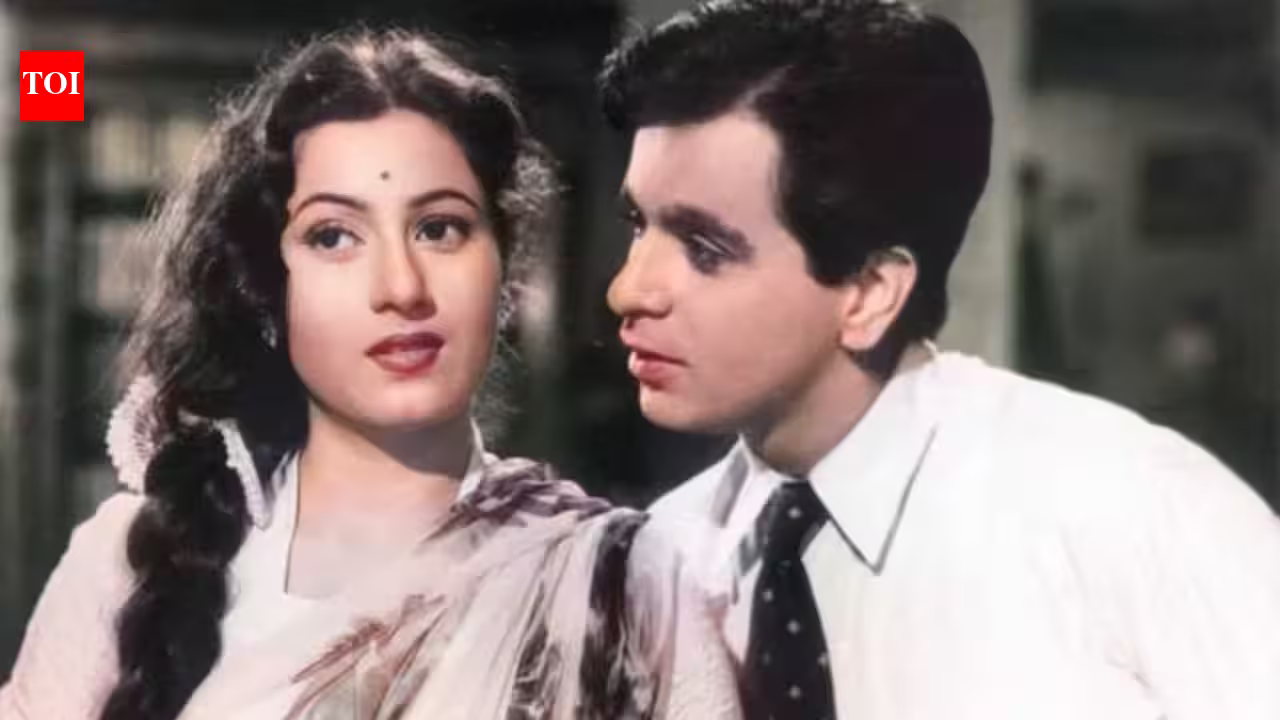
In the golden annals of Indian cinema, few narratives possess the haunting, star-crossed allure of the romance between Madhubala and Dilip Kumar. For decades, the public has been obsessed with the “why” behind their separation. Was it a tragic health crisis? A clash of egos? The heavy hand of a protective patriarch? Recently, the embers of this decades-old fire have been stirred once more, as contradictory accounts from industry veterans and family members have forced us to re-examine the legend behind the iconic faces.
A Legacy of Rumors
The conversation was reignited by none other than veteran actress Mumtaz, who suggested in a recent interview that Dilip Kumar ended the relationship upon discovering the severity of Madhubala’s heart condition—specifically her inability to bear children. It was a narrative that fit the tragic, cinematic mold often associated with the era: a beautiful starlet, a heartbroken hero, and a medical diagnosis that became an insurmountable wall.
However, Madhubala’s sister, Madhur Bhushan, has stepped forward to dismantle this version of events with striking clarity. In a recent conversation, she firmly labeled Mumtaz’s claims as “completely wrong.” According to Bhushan, the timeline of the romance and the timeline of the illness are two distinct threads that have been erroneously woven together by revisionist history.
The Truth About the Timeline
“Dilip Kumar was nowhere in the picture,” Bhushan asserted, insisting that her sister’s heart condition had not yet surfaced during the height of her relationship with the legendary actor. By her account, the romance ended in 1957, during the tumultuous production of Mughal-E-Azam. While the world has long speculated that the breakup was a clinical decision, Bhushan maintains that the primary wedge was, and had always been, the volatile relationship between Dilip Kumar and their father, Ataullah Khan.
In his own autobiography, The Substance and the Shadow, Dilip Kumar corroborated the nature of these tensions, noting that the relationship soured over business disputes and personal interference from Khan. The film set of Mughal-E-Azam famously became a stage for their real-life drama, where the two stars were forced to deliver iconic, passionate dialogues while, in reality, they had ceased speaking to one another entirely.
The Physical Toll of a Hidden Illness
If the breakup was fueled by family friction rather than health, when did the true tragedy of Madhubala’s illness begin? Bhushan’s account reflects the confusion and terror the family felt as they watched the “Venus of Indian Cinema” slowly fade. She recalled early warning signs during the filming of Bahut Din Huwe in 1954, where the actress fainted and vomited blood—an image that would later haunt her public persona.
It was during these years that the diagnosis of a “hole in the heart” (a ventricular septal defect) was finally confirmed. At the time, medical technology in India was unable to provide a cure, leading the family to seek help abroad. Madhur Bhushan’s descriptions of these later years are devastating: a woman who refused to believe the diagnosis because she still possessed the vitality to dance and work, followed by the heartbreaking reality of being bedridden before she even turned thirty. The iconic, defiant image of Madhubala—chained and dancing in the song “Jab Pyar Kiya To Darna Kya”—now carries a heavier weight, knowing that the actress was physically collapsing behind the scenes.
The Final Resting Place
Perhaps the most poignant detail to emerge from these interviews is the physical proximity of the two legends in death. “They are buried very close to each other,” Bhushan revealed, noting that at the Juhu Muslim Kabrastan, only five to ten meters separate the graves of Madhubala and Dilip Kumar.
It is a detail that feels almost scripted, a final act of irony for a couple whose lives were defined by an immense, unbridgeable distance in their final years. In death, they remain neighbors in the quiet earth of Juhu, a final, silent footnote to a love story that arguably sustained its intensity precisely because it was never allowed to grow old or mundane.
The Complicated Role of Kishore Kumar
While Dilip Kumar remains the primary figure in the narrative of her romance, the later years of Madhubala’s life were entwined with singer and actor Kishore Kumar. Their marriage, however, was far from the fairy-tale conclusion the public might have hoped for. When questioned about the period of her sister’s life spent with Kishore, Madhur Bhushan was noticeably reticent.
“I have been taught to let the dead be in peace,” she said, choosing to remain silent on the behavior of her sister’s husband during her final, agonizing years. We do know, from historical records and Kishore Kumar’s own admissions, that he was aware of the gravity of her illness when they married. Whether that was an act of profound devotion or a complicated companionship born of circumstance remains a subject that the family clearly wishes to keep veiled.
Why the Myth Persists
Why does this story continue to haunt us decades after the principals have passed? Perhaps it is because Madhubala represents the ultimate archetype of the tragic heroine—the woman who had everything, yet was betrayed by her own body. Or perhaps it is because Dilip Kumar and Madhubala represented a sophistication and raw, unfiltered emotional honesty that feels missing from today’s sanitized celebrity culture.
Madhur Bhushan’s intervention serves as a necessary reminder that the truth behind the lens is often far more complex than the headlines suggest. While we may never fully reconcile the various accounts of their breakup, one thing is certain: the myth of Madhubala is not just built on her beauty or her films, but on the enduring mystery of her life. As we look back, we aren’t just remembering a star; we are acknowledging the fragile, human heart that beat underneath the glitter, finally at rest just a few meters away from the man who once held it.
Disclaimer: This content is auto-generated for informational purposes only.
Source: Read Original News