







Ever since wrestling made its Asian Games debut at the 1954 Manila Games, the continental arena has served as the definitive battleground where India’s ancient combat tradition found its modern voice. For centuries, the sport lived in the country’s collective pulse, nurtured in the rustic intimacy of earthen akharas. When Manila opened its doors, that raw, mud-stained passion was thrust onto the global stage.
Over the seven decades that followed, the Asian Games became the grand mirror of Indian wrestling—reflecting its heartaches, its periodic renaissances, and an enduring legacy that today boasts a staggering 65 medals: 11 gold, 15 silver, and 39 bronze.
From Mud to Mat: A Golden Heritage
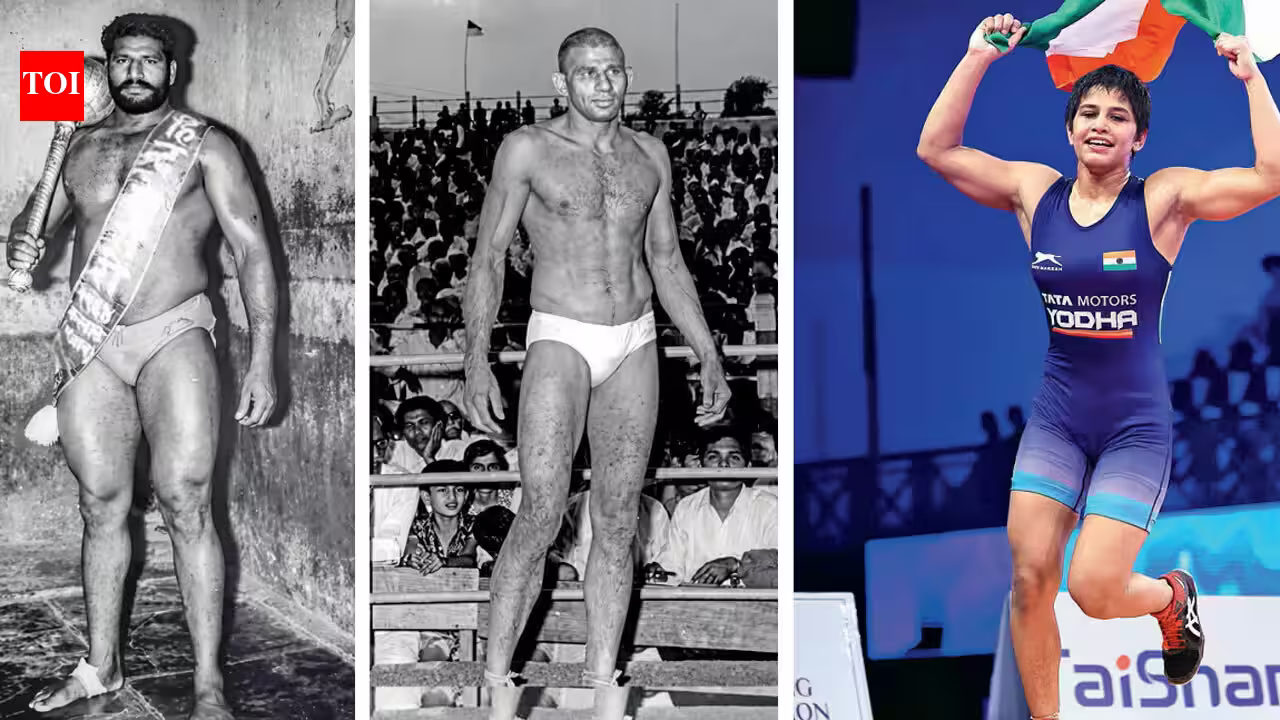
The golden thread of Indian wrestling has run largely unbroken through the decades, binding icons of the past to the prospects of the present. Eight years after the Manila debut, the 1962 Jakarta Games served as a watershed moment. The legendary Maruti Mane steamrolled his way to gold in the men’s 97kg freestyle division, with Malwa Singh and Ganpat Andalkar securing further golds in Greco-Roman. Finishing with 12 total medals, India signaled to the world that it had arrived as a wrestling powerhouse.
As the years progressed, individual brilliance defined the era. In 1970, ‘Master’ Chandgi Ram unleashed his heavyweight fury in Bangkok, while the late 70s and 80s belonged to the indomitable Kartar Singh. Dominating the 90kg class in 1978 and securing the 100kg gold in 1986, Kartar cemented his status as India’s only two-time Asian Games gold medallist. This lineage of excellence continued into the modern era, fueled by the impassioned charge of Yogeshwar Dutt in 2014 and the dazzling, synchronized gold-medal sweep by Bajrang Punia and Vinesh Phogat in 2018.
The Hangzhou Transition: Evolution Over Dominance
By the time the Indian contingent arrived in Hangzhou for the 2022 Asian Games, the sport had undergone an epochal shift. The emphasis had decisively moved from traditional endurance to world-class technical precision. While the haul of six medals—one silver and five bronze—spoke to a consistent level of competitiveness, the absence of a top-tier gold medal was a jarring deviation from the script.
Deepak Punia displayed immense grit to secure silver, while Sunil Kumar shattered a 13-year drought for Greco-Roman success with a hard-fought bronze. Meanwhile, the emergence of 19-year-old sensation Antim Panghal, who claimed bronze with breathtaking audacity, proved that the future of Indian women’s wrestling is in capable hands. Yet, as the dust settled in China, the mission for the next cycle became clear: to reclaim the summit.
Aichi-Nagoya: The Path to Redemption
The upcoming 2026 Asian Games in Aichi-Nagoya, Japan, represent more than just another tournament; they are a critical junction. The event serves as the ultimate proving ground to correct the shortcomings of Hangzhou, all while keeping a steady eye on the 2028 Los Angeles Olympics.
Following intense trials held on May 30 and 31, the Wrestling Federation of India (WFI) meticulously crafted an 18-strong squad. To bolster their chances, the men’s freestyle group was dispatched to Armenia for high-altitude training, while the Greco-Roman team sought specialized exposure in the heartland of the sport, Uzbekistan.
The Shadow of the Dope Net
Just as the momentum began to build, the sport was dealt a harsh blow. A series of doping violations sent shockwaves through the national camp, threatening to dismantle the foundation of the squad. Three wrestlers—Deepanshu (130kg Greco-Roman), Mukul Dahiya (86kg freestyle), and Deepak (67kg Greco-Roman)—returned positive tests, forced out of the competition in disgrace.
The WFI has expressed relief that the women’s contingent remained untainted by the controversy, allowing the female squad to focus entirely on their preparations. Now pruned to fifteen, the Indian team carries a heavy burden of expectation as they head to Japan.
Leading the Charge
The revised squad features a blend of veteran poise and youthful hunger. Olympic bronze medallist Aman Sehrawat, competing in the 57kg freestyle, headlines a men’s roster that includes the tactical acumen of Sujeet Kalkal (65kg), Sagar Jaglan (74kg), Deepak Punia (97kg), and Rajat Ruhal (125kg).
The Greco-Roman side remains anchored by Sunil Kumar (87kg), supported by Sumit Dalal (60kg), Aman Baroniya (77kg), and Nitesh Siwach (97kg). On the women’s side, the focus will be squarely on Antim Panghal (53kg), whose growth continues to be a highlight, alongside a talented core of Dipanshi (50kg), Manisha Bhanwala (57kg), Mansi Ahlawat (62kg), Nisha Dahiya (68kg), and Priya Malik (76kg).
For these athletes, the road to Aichi-Nagoya is paved with the weight of expectation. After the doping crisis threatened to cast a pall over the entire program, the fifteen wrestlers bound for Japan have a singular opportunity: to silence the skeptics and re-establish the pride of a nation that has spent seventy years defining its spirit on the mat. The goal is simple, but the challenge is immense—a return to gold, and a return to the standard set by the legends of the past.
Disclaimer: This content is auto-generated for informational purposes only.
Source: Read Original News