








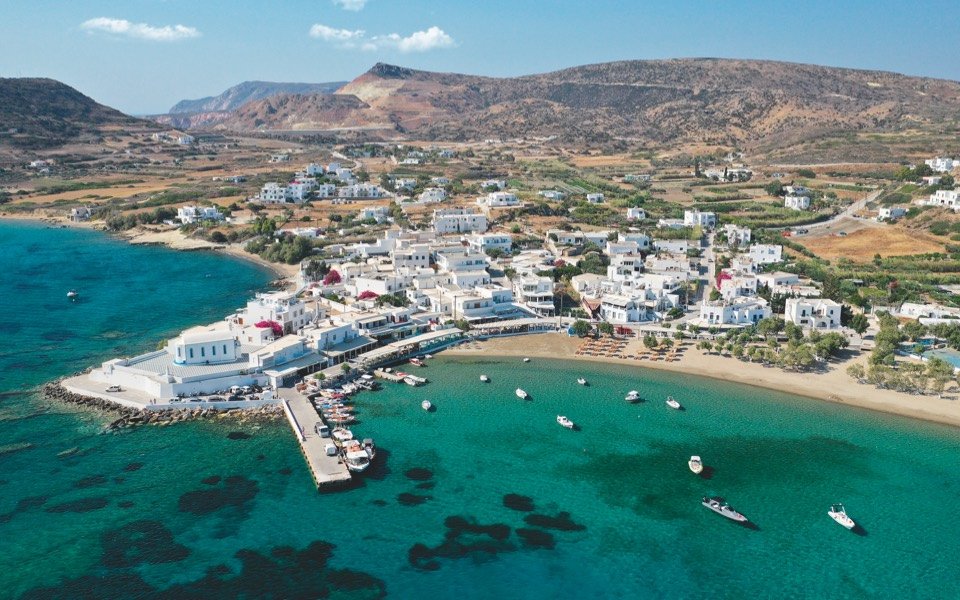
A Piraeus appeals court has issued a temporary injunction halting the construction of a luxury five-star hotel complex on the Greek island of Milos. The ruling marks a significant victory for local environmental activists who have long contended that the project, slated for the scenic Pachaina area, threatens the island’s ecological integrity and violates land-use regulations.
The court’s decision serves as a stay of construction until a full judicial review of the project’s main appeal can be conducted. The legal challenge was spearheaded by two prominent organizations: the Hellenic Society for Environment and Culture and the Milos Mountain and Sea Friends Group.
At the heart of the petitioners’ argument is a technical but critical dispute regarding land accessibility and zoning compliance. The environmental groups assert that the plot designated for the development lacks the required frontage on a recognized public road, a prerequisite for obtaining legal building permits for commercial hospitality projects in such areas. Beyond the procedural hurdles, the groups have voiced deep concerns regarding the environmental impact of the development. They argue that the planned construction would necessitate an extensive alteration of the natural landscape, a move they deem unacceptable given that the site is situated within a protected wildlife refuge.
The project, backed by the developer S Althaia, was granted a permit in October 2025. Plans for the site included a significant expansion of the island’s high-end tourism infrastructure, comprising 16 separate buildings that would occupy a total of approximately 5,000 square meters. The complex was designed to feature 23 rooms with a total capacity of 46 beds, situated on a 4.95-hectare plot directly overlooking the Aegean Sea. Proponents of the project have previously touted its potential for economic growth, while critics maintain that such developments prioritize short-term profit over the preservation of Milos’ fragile biodiversity and rugged coastline.
The intervention by the Piraeus court is part of a broader, intensifying scrutiny of construction practices on Milos. The issue of land development has become a flashpoint for administrative tension, as evidenced by a recent move from the national Environment Ministry. In a related development, the ministry declined to conduct an internal review of 30 additional building permits on the island, citing a lack of jurisdictional authority. Instead, the ministry referred the matter to the local Milos planning office, a decision that highlights the ongoing struggle to balance regional oversight with municipal planning responsibilities.
Meanwhile, legal battles are broadening elsewhere on the island. The owner of the White Coast hotel, V Tourism, has publicly challenged findings released by the National Transparency Authority, which had flagged irregularities in the property’s development. Management at the resort has vowed to utilize every available legal avenue to defend their operations and contest the authority’s conclusions.
As the legal proceedings in the Pachaina case continue, the temporary suspension stands as a barometer for the evolving relationship between Greece’s tourism-driven economy and its environmental protection mandates. With local groups becoming increasingly organized in their efforts to monitor construction developments, the case is likely to set a precedent for how future high-end hospitality projects are scrutinized in protected zones across the Cyclades. For now, the machinery remains idle, leaving the future of the Pachaina development to the courts.
Disclaimer: This content is auto-generated for informational purposes only.
Source: Read Original News