






NanoCo Transforms Slack into a Digital Hub with Persistent, Self-Assembling AI Agent Teams
Adding AI agents to enterprise messaging platforms has often proven to be a clunky, friction-filled experience for IT departments and end users alike. While the promise of automated assistance is clear, the reality of managing disparate bot identities and complex integrations has historically fallen short of seamless.
Now, NanoCo—the team behind the popular open-source, enterprise-friendly autonomous AI harness NanoClaw—is aiming to solve this with a new Slack integration that allows users to spin up entire teams of specialized agents directly from a single chat prompt.
The Rise of the AI Manager
"In the next 12 to 18 months, everyone on a team will be a manager of agents," said Gavriel Cohen, CEO and co-founder of NanoCo, in an exclusive interview with VentureBeat.
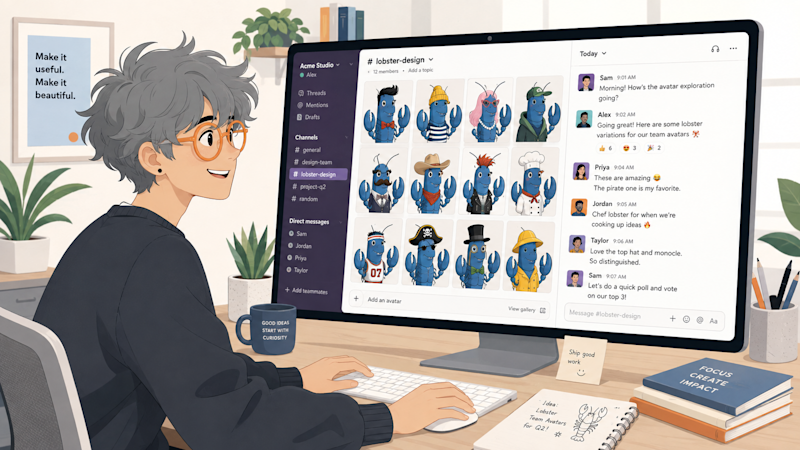
The new NanoClaw integration is designed to move beyond the "one-size-fits-all" chatbot model. By assigning each agent its own unique identity, avatar, and specialized toolset, NanoCo enables users to build out a virtual department. Developers and managers can, for instance, request a product manager agent, a code reviewer, and a testing agent, each operating with specific permissions and memory context.
Unlike standard bots that act as ephemeral sub-processes, these agents are persistent colleagues. They can collaborate within shared Slack Canvases, communicate with one another, and even be reached across other platforms like Telegram and WhatsApp while maintaining a unified workspace context.
Recursive Provisioning: A New Paradigm
The technical innovation behind this release is "recursive provisioning." Once an organization performs a one-time workspace authorization, the lead agent—equipped with a Model Context Protocol (MCP) tool—can create additional, independently addressable teammates.
"Your agent in Slack, you can say, ‘Create me another agent to handle my code reviews,’" Cohen explained. "And then your agent can create new agents, and they just pop up in the sidebar and send you messages."
This approach fundamentally changes the workflow for enterprise teams. Rather than navigating complex developer consoles or administrative interfaces for every new automation requirement, employees can delegate the creation and management of workflows to their existing agents.
Security and Self-Hosting
Despite the ease of use, NanoCo maintains its commitment to security and user autonomy. The system remains self-hosted, meaning the agent runtime, memory, and sensitive credentials stay on the organization’s own infrastructure—whether on a local machine or a private cloud VM.
NanoCo does not store Slack tokens or private message data. By utilizing Socket Mode, the agents communicate directly with Slack while the organization retains full control over the underlying containerized architecture. This aligns with NanoCo’s broader mission, established in early 2026, to provide a secure, sandbox-first environment for AI agents.
A Growing Ecosystem
The announcement arrives as Slack—now under the Salesforce umbrella—intensifies its focus on AI agents. With the launch of the Slack Agent Kit and the recent promotion of third-party integrations like Vercel, Lovable, and now NanoClaw, the platform is rapidly evolving into a host for persistent, cross-platform digital workers.
While competitors like Anthropic’s "Claude Tag," OpenAI’s "ChatGPT Workspace Agents," and Salesforce’s own "Agentforce" offer powerful ways to deploy AI, NanoClaw carves out a distinct niche. It prioritizes a self-hosted, open-source model that grants users the freedom to fork the code, swap out underlying Large Language Models (LLMs), and define their own custom infrastructure.
As NanoCo continues to see massive traction—surpassing 250,000 downloads and 30,000 GitHub stars—the company remains focused on its open-source roots. According to Cohen, the new Slack integration is free for the community, reflecting a philosophy that long-term value is built by empowering the developer ecosystem rather than monetizing every touchpoint.
For enterprises grappling with the shift toward agentic workflows, the question is no longer whether they will use AI agents, but how they will govern the sprawling digital teams that arise once those agents begin working in concert. With NanoClaw, the goal is to ensure that while the agents are autonomous, the control remains firmly in the hands of the humans who manage them.