








The Integration of AI Assistants into Kernel Development
The Linux kernel development process, long characterized by manual peer review and meticulous C programming, is experiencing a shift in methodology. Linus Torvalds, the creator and primary maintainer of Linux, has publicly confirmed the use of large language model (LLM) tooling to accelerate development tasks. Specifically, Torvalds has begun utilizing Claude Code to assist in architecting and refining kernel sub-systems. This development marks a transition where artificial intelligence is no longer restricted to peripheral script generation but is actively influencing the core memory management architecture of the world’s most significant operating system kernel.
Recent activity in the primary Linux repository has unveiled a new experimental branch: noref-filemap-read-with-llm. The existence of this branch is notable not only for its experimental nature but for the explicit acknowledgement from Torvalds that the underlying code, testing suites, and even the associated documentation were generated through iterative collaboration with an AI coding assistant. This shift underscores a pragmatic view of technology where AI serves as a force multiplier for complex architectural changes that might otherwise be slowed by the overhead of writing boilerplate code or manual test iterations.
Addressing Bottlenecks in Memory Management
The technical focus of the noref-filemap-read-with-llm branch centers on the page cache, a fundamental component of the Linux kernel’s memory management system. Within the Linux kernel, a “folio” represents a physical memory page that can be tracked and managed. Historically, every read operation from the page cache necessitated an increment and decrement of the folio’s reference count. While this mechanism ensures memory safety, it introduces significant contention when multiple threads attempt to read from the same file simultaneously.
In high-concurrency environments, such as database servers or high-throughput storage systems, this reference counting process creates a bottleneck. Because every thread must update the same atomic reference counter, the CPU spends substantial time coordinating cache-line coherency between cores rather than performing actual data retrieval. The work initiated in this new branch seeks to optimize this interaction by enabling reads from the page cache without requiring these reference count updates. By removing the need for frequent atomic operations on the folio, the kernel can achieve higher parallelism, effectively allowing multiple threads to access data concurrently without locking or stalling one another.
Performance Gains and Scalability
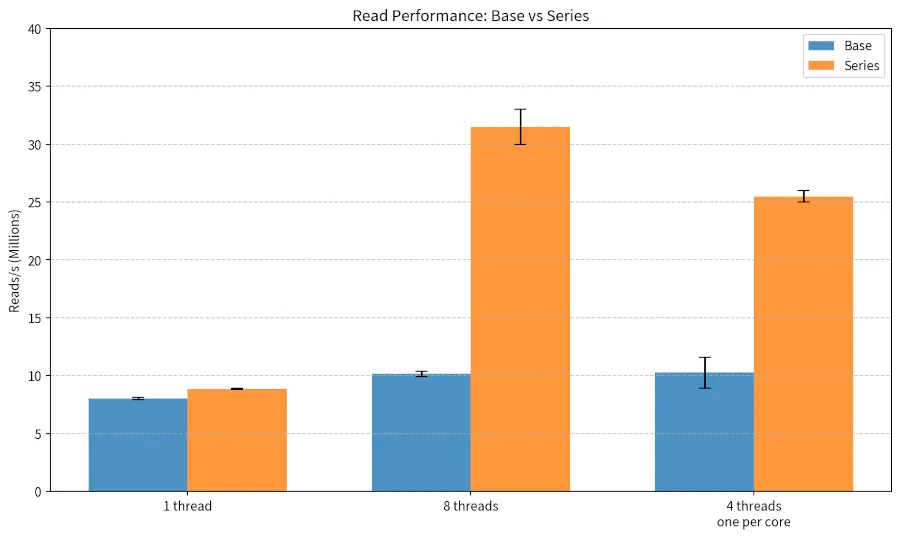
The performance implications of the proposed changes are substantial. Early measurements provided by Torvalds indicate a marked improvement in throughput for read-heavy workloads. By eliminating the reference counting overhead, the system demonstrates an ability to scale linearly across multiple CPU cores, which is a critical requirement for modern server-grade hardware.
Under test conditions, the implementation demonstrates a significant reduction in latency for small, random-access read operations. This is particularly relevant for modern NVMe storage drives, where the bottleneck is often no longer the physical hardware, but the software overhead of the kernel stack managing the data flow. By optimizing the page cache path, the patch set enables the kernel to keep pace with the massive input/output capabilities of contemporary storage solutions. This improvement is not merely an incremental gain; it represents an structural optimization that could fundamentally change how the kernel manages file I/O for high-performance applications.
The Role of Claude Code in Kernel Engineering
The involvement of Claude Code in this project highlights a new paradigm for how complex systems are engineered. Torvalds has utilized the AI not to automate the final decision-making, but to handle the heavy lifting of drafting implementation code and constructing test environments. By delegating the creation of test programs to the model, Torvalds was able to conduct rapid cycles of verification to ensure that the removal of reference counting did not introduce memory leaks or use-after-free vulnerabilities.
This collaborative model—where a human maintainer provides the technical direction and architectural oversight while the AI handles the iterative implementation and debugging—is likely to become a template for future kernel work. Torvalds noted that the AI’s ability to assist in the initial draft of the cover letter and the review documentation proves that such tools can manage both the logic and the auxiliary communication tasks required to shepherd a patch through the rigorous Linux review process.
Future Implications for the Linux 7.4 Merge Window
The creation of the noref-filemap-read-with-llm branch has sparked discussion regarding the future of kernel maintenance as the Linux 7.4 merge window approaches. The Linux community has traditionally relied on a human-centric review process, and the introduction of AI-assisted code raises questions regarding long-term maintenance and security vetting. However, the performance metrics observed thus far suggest that the benefits to system efficiency may outweigh the potential concerns surrounding the method of creation, provided the code continues to meet the project’s strict quality and stability requirements.
As the kernel moves toward a future where AI assistance becomes commonplace, the focus remains on the integrity of the code. Torvalds’ involvement and his public endorsement of the process serve as a signal that, under strict human guidance, AI is a valid and efficient instrument for optimizing complex kernel systems. The coming months will determine whether these patches reach a level of stability sufficient to be merged into the mainline kernel. If successful, this project will likely go down as a milestone in the history of software engineering, marking the moment when the kernel repository officially moved from traditional development toward a human-AI collaborative model.
Disclaimer: This content is auto-generated for informational purposes only.
Source: Read Original News