








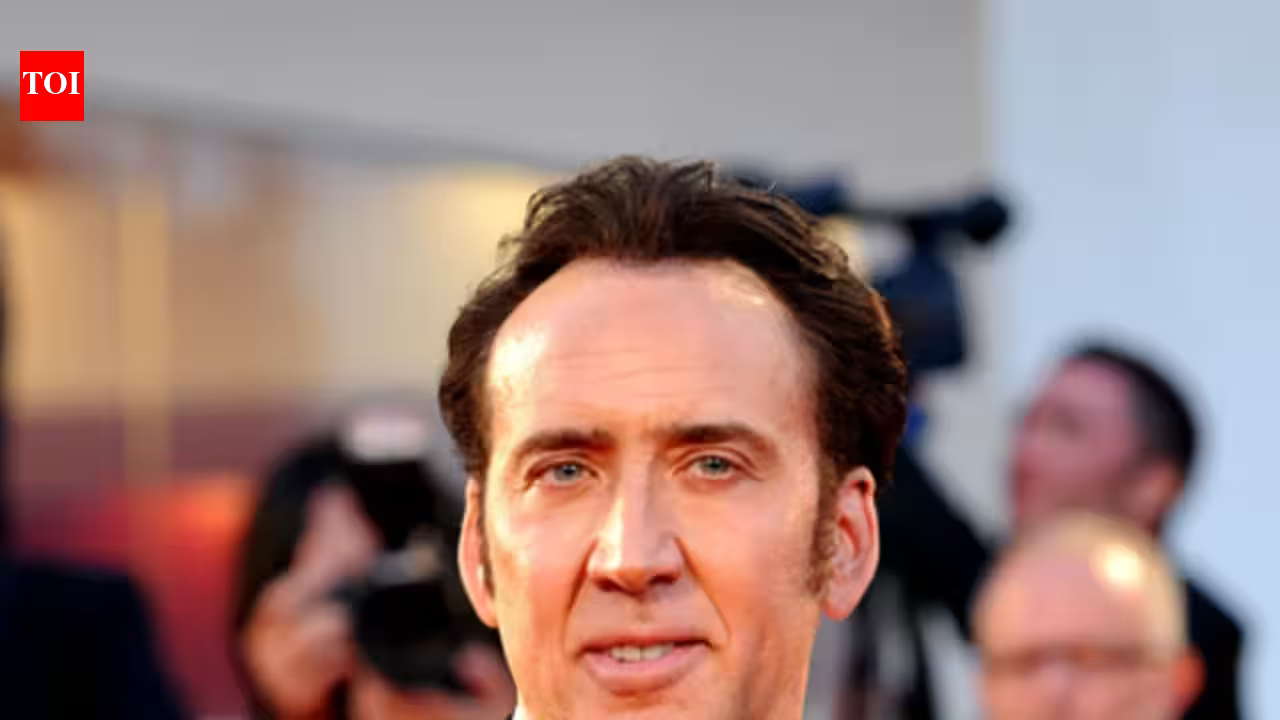
The glitz of Hollywood is rarely as blinding as the neon-soaked backlots of a Marvel set, but for industry veteran Nicolas Cage, the shine has officially started to peel. In a candid, eyebrow-raising moment at Fan Expo Dallas this week, the Oscar-winning enigma didn’t just offer a critique of the modern blockbuster machine—he delivered a diagnosis. For Cage, the Marvel Cinematic Universe (MCU), once the gold standard of interconnected storytelling, has devolved into something far less imaginative: a “well-funded and glorified WWE.”
It is a stinging assessment, particularly coming from a man whose own career has been defined by his eclectic commitment to the weird, the wild, and the wonderful. Cage, who has donned the leather jacket of Ghost Rider twice and most recently stepped into the trench coat of Ben Reilly for the neo-noir series Spider-Noir, isn’t coming from a place of ignorance. He is an insider who knows exactly how the sausage is made, and frankly, he’s tired of the constant, adrenaline-fueled spectacle.
From Marvelous Storytelling to Muscle-Bound Monotony
To understand why Cage’s comments carry such weight, one has to look back at the MCU’s “Phase One” era. For Cage, those early years weren’t just successful—they were artful. “It started out, in my view, terrific,” he told the crowd in Dallas. “Some of the early stories were marvelous. The way that they wove all the threads together and told the different character stories and backstories.”
There was a genuine sense of discovery in 2008 when Robert Downey Jr. first clanked around in that makeshift armor. The stakes felt character-driven; the humor felt organic; the world-building felt like a daring experiment. Cage hit on a universal sentiment among genre enthusiasts: we fell in love with these people, not just their brawls. Somewhere along the line, however, the balance shifted. The intricate tapestry of human (or super-human) emotion began to fray, replaced by a relentless obsession with the next set-piece, the next multiversal collision, and the next CGI-heavy punch-up.
The “WWE” Effect: When Choreography Outpaces Character
The most striking part of Cage’s critique wasn’t just his comparison to professional wrestling; it was his observation of the actors themselves. “Lately, I do say this with love, when I see these 50-plus and otherwise intelligent and remarkably gifted thespians putting on these ridiculous outfits and getting ready for the fight, let’s face it, it’s all cutting to the fight,” he remarked.
There is a tragedy in that observation—the idea of world-class performers being relegated to stunt-doubles-in-waiting. Cage, a man who built his career on eccentric, Method-adjacent performances that lean heavily into the psychological, clearly finds the current reliance on “action-above-all” to be a creative cul-de-sac. When the script’s primary directive is to bridge the gap between two explosions rather than two character beats, the “story” effectively disappears. It becomes a spectacle of physics-defying wrestling, where the plot is merely the “promos” between the main event matches.
The Case for the Detective: Why Spider-Noir Worked
If Cage sounds like he’s picking on the MCU, he is quick to clarify that he isn’t asking for the end of the franchise—he’s asking for its soul to be rescued. His own recent foray into the Marvel fold serves as his personal lighthouse. Spider-Noir, which placed him in the role of a down-on-his-luck private investigator in a 1930s New York City, provided the one thing he feels the cinematic universe is currently lacking: mystery.
“One of the things I liked about Spider-Noir was it wasn’t cut into the fight,” Cage noted. “It was a detective story. There was a mystery there.”
In an era where “stakes” usually mean the total destruction of a major metropolis, a grounded mystery feels revolutionary. By stepping out of the spandex and into the fedora, Cage tapped into a vintage noir aesthetic that allowed for nuance, atmosphere, and—crucially—pacing. He believes that if the MCU wants to regain its lost sheen, it needs to stop being so afraid of silence. It needs to stop worrying that a fifteen-minute stretch without a laser blast will cause the audience to check their phones.
Is Hollywood Listening to the Cage?
Nicolas Cage has always occupied a strange space in the industry—half-mainstream A-lister, half-cult-cinema icon. Because of this, his words hold a unique tension. He isn’t a bitter ex-employee; he’s an active participant who is essentially telling his bosses that they’re boring the audience.
Will Marvel pivot? The studio has been struggling with its identity since the departure of the original Avengers and the lukewarm reception of several recent projects. While Deadpool & Wolverine proved that audiences are still hungry for the brand, that success relied heavily on nostalgia and meta-humor—it didn’t necessarily solve the fundamental issue of “story fatigue.”
If the MCU continues to double down on the “glorified WWE” model, they may keep selling tickets in the short term, but they risk losing the very actors—and by extension, the audience members—who prioritize craft over chaos. Cage is essentially challenging the brass at Disney and Marvel to treat their stars like actors rather than wrestlers.
The Future of the Superhero Genre
Whether or not the powers-that-be take the advice to heart, Cage has successfully articulated what many critics have been hinting at for years: we have reached the saturation point of mindless action. As the dust settles on the post-Endgame era, the demand for genre-bending, character-first storytelling is louder than ever.
We don’t need another sky-beam. We don’t need another CGI army rushing toward another CGI army. We need the mystery. We need the detective work. We need the performances that made these characters worth caring about in the first place. Nicolas Cage may be known for his wild unpredictability, but in this instance, his take on the MCU is perhaps the most grounded and rational assessment we’ve heard in years. If the superhero genre hopes to survive the next decade, it might just need to put down the folding chair, stop playing to the crowd, and start telling a story again.
Disclaimer: This content is auto-generated for informational purposes only.
Source: Read Original News