








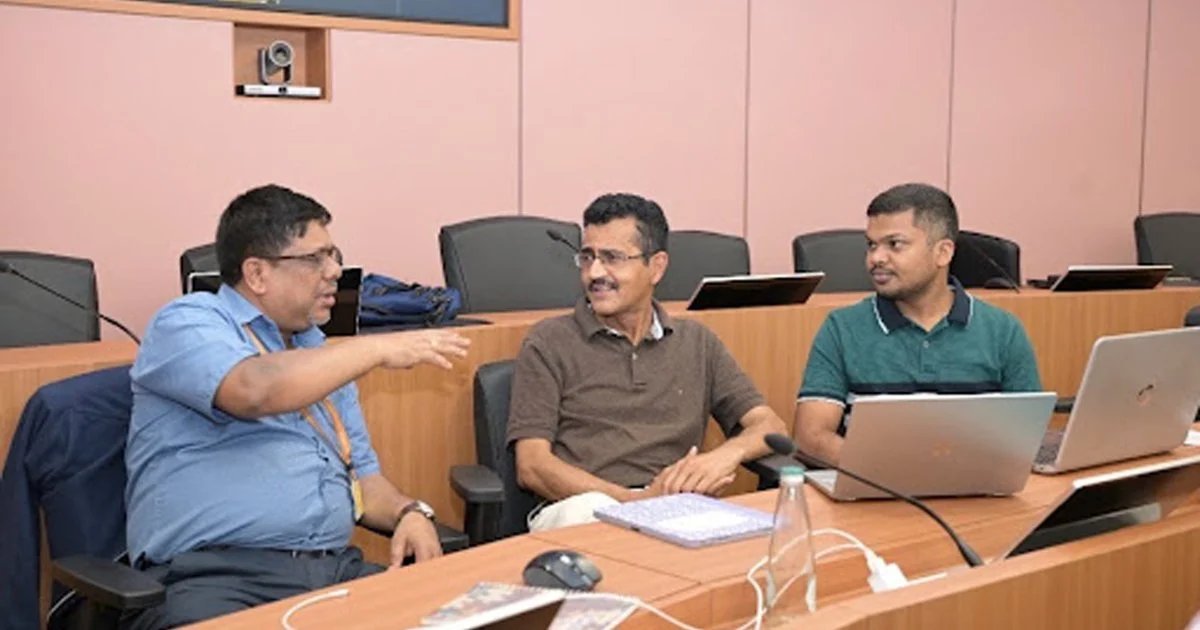
A significant collaborative effort between scientists from NOAA/AOML, the Indian National Center for Ocean Information Services (INCOIS), the India Meteorological Department (IMD), the National Centre for Medium Range Weather Forecasting (NCMRWF), the National Institute of Technology (NIT) Rourkela, the University of Texas (UT) at Austin, and various other partner institutions recently convened to assess the advancements made and strategize the future trajectory for India’s next-generation coupled forecasting system.
A standout accomplishment from this gathering was the successful deployment of the coupled IOLA system into an experimental operational mode at IMD, INCOIS, and NCMRWF. This innovative system is also being actively utilized for extensive research and development at NIT Rourkela and UT Austin, thereby forging a direct link between pioneering scientific discoveries and their practical application in operational forecasting.
The IOLA system stands out due to its unparalleled capacity to deliver seamless, multi-scale coupled forecasts. These forecasts span a wide range, from large-scale ocean-atmosphere interactions across entire basins to localized, severe weather phenomena. By meticulously integrating advanced atmospheric, oceanic, and land-surface processes within a cohesive framework, IOLA has emerged as a trailblazer. It is one of the initial regional multi-scale coupled forecasting systems specifically engineered to support predictions across diverse scales, encompassing everything from tropical cyclones and monsoon depressions to extreme rainfall events and even hurricane-strength storms.
The development of the IOLA system is a testament to over a decade of dedicated collaboration between NOAA and India’s Ministry of Earth Sciences (MoES). This partnership initially commenced with the implementation of NOAA’s Hurricane Weather Research and Forecasting (HWRF) model, which was crucial for predicting tropical cyclones over the Indian Seas. Building upon this foundational success, IOLA has significantly broadened forecasting capabilities beyond just tropical cyclones. It now encompasses a comprehensive spectrum of high-impact weather events, including the crucial monsoon rainfall, severe storms, and intricate air-sea interaction processes throughout the entire Indian Ocean region.
Scientists at NIT-Rourkela presented encouraging findings from the inaugural application of a moving-nest coupled IOLA configuration specifically for monsoon prediction. Concurrently, researchers at UT Austin leveraged another configuration of the IOLA system to gain deeper insights into the catastrophic rainfall event that affected North Carolina due to Hurricane Helene. The substantial computational resources required for developing this advanced framework were generously provided by UT Austin.
The moving-nest framework, initially conceived for tracking and forecasting tropical cyclones, has been ingeniously adapted to monitor and predict evolving monsoon systems and areas prone to heavy rainfall. Preliminary assessments have already indicated notable improvements in rainfall forecasts when compared to traditional methodologies, underscoring the immense potential of scale-aware coupled modeling for predicting high-impact weather events across the region.
Following the meeting, Sundararaman “Gopal” Gopalakrishnan, NOAA’s principal scientist for the IOLA project, visited NIT Rourkela. During his visit, he engaged with collaborators to establish key priorities for the subsequent phase of model development. Discussions primarily revolved around enhancing coupled prediction capabilities, advancing AI-enabled forecasting applications, and expanding avenues for collaborative research and workforce development under the overarching NOAA–MoES partnership.
Dr. Sundararaman Gopalakrishnan, AOML Senior Meteorologist and principal scientist for the IOLA project, emphasized the profound impact of this international collaboration, stating, “The progress achieved through IOLA demonstrates the power of sustained international collaboration. By bringing together operational forecasting centers, academic institutions, and research laboratories, we are building a forecasting system capable of addressing some of the most challenging weather problems affecting the region and will lay the foundation for a unified coupled modeling system across scales.”
This ongoing collaboration offers NOAA invaluable regional forecast verification data, crucial operational feedback, and extensive observational datasets. These resources are instrumental in enhancing the evaluation of coupled model performance for tropical cyclones, monsoon systems, and extreme rainfall events. Furthermore, it strengthens the vital transition of research findings into operational applications and reinforces the enduring partnership between NOAA and MoES.
As the IOLA system continues its transition from the research phase to full operational implementation, the partnership between NOAA and MoES remains steadfast in its commitment to delivering improved forecasts. These enhanced forecasts are vital for supporting disaster preparedness, safeguarding human lives and property, and bolstering resilience to extreme weather phenomena across one of the world’s most densely populated and climatically vulnerable regions.