






Plaud Enters the Earphone Market With AI-Powered Hardware for Note-Taking
The race to dominate the AI-driven note-taking space has moved from pendants and wristbands to the ears. Plaud, a rising star in the hardware sector with over 2.5 million users, has officially unveiled its latest innovation: Plaud One, a pair of AI-integrated earphones designed to bridge the gap between seamless audio and automated productivity.
A New Form Factor for AI
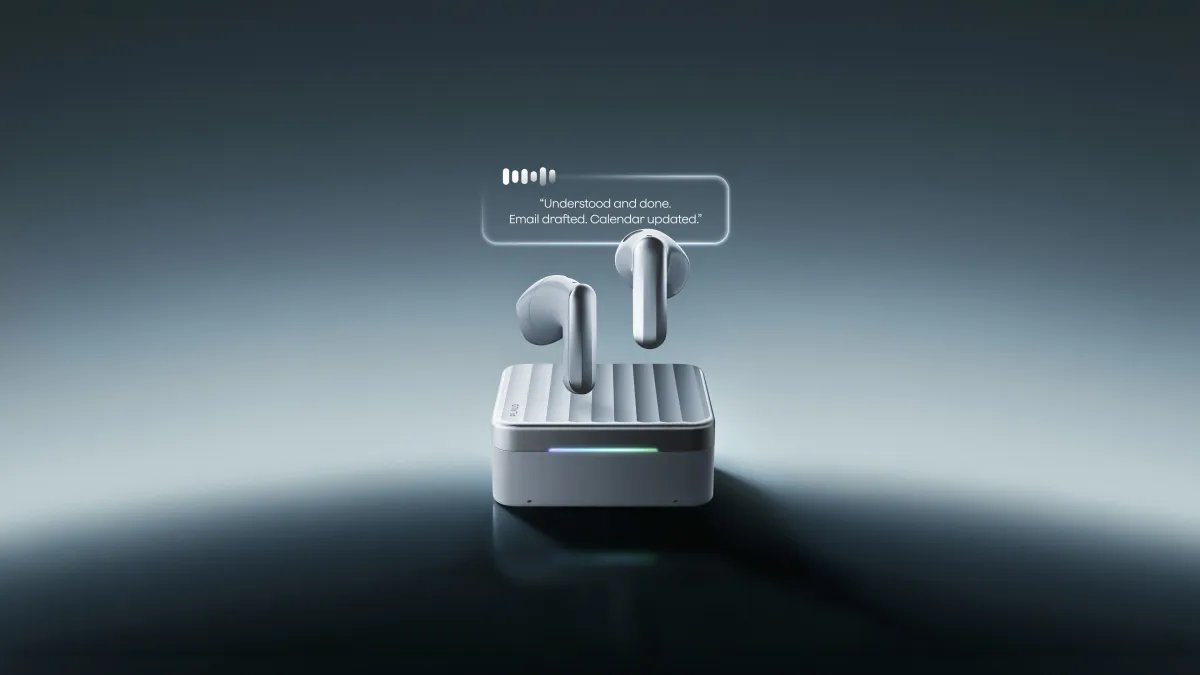
While the market is currently saturated with “puck-style” recorders, pens, and wearables, Plaud is pivoting toward a more familiar form factor. Resembling the sleek, minimalist design of Apple’s AirPods, the Plaud One allows users to record phone calls directly, while its charging case doubles as a high-fidelity microphone for capturing in-person meetings.
Plaud is not the first to explore this segment; competitors like Viaim and Anker have already introduced similar hardware. However, Plaud is banking on a more robust software ecosystem to gain an edge. Once a conversation is transcribed, the device’s AI agent can integrate directly with major platforms like Slack, Notion, Gmail, and Google Calendar. This allows the system to autonomously draft follow-up emails, generate meeting minutes, or outline presentations based on the discussion.
Standing Out: The eSIM Advantage
While software-driven note-takers like Read AI, Fathom, and Granola offer similar workflow automation, Plaud is differentiating its hardware with an unconventional feature: the charging case includes built-in support for an eSIM card.
This connectivity allows the device to function independently of a phone or computer, enabling users to interact with and instruct Plaud’s AI agents remotely. “For AI, we need to have a wearable and an always-ready interface, one that people love to wear, is socially acceptable and, most importantly, private by design,” explained Plaud CEO Nathan Xu during a press briefing.
Specifications and Availability
Beyond its AI capabilities, the Plaud One features:
- Audio Quality: 12mm drivers and Active Noise Cancellation (ANC).
- Recording Range: The case can capture clear audio from up to five meters away.
- Battery Life: Users get six hours of in-person recording or three hours of call recording on a single charge, with a total of up to 25 hours provided by the case.
The company is employing a “freemium” model, offering 300 minutes of free monthly transcription. Beyond that, users can opt for plans starting at $8.33 per month (billed annually). Additionally, buyers will receive $200 in credits for the company’s upcoming “agentic” capabilities, which are scheduled to launch in an update later this year.
The Challenge Ahead
Despite a successful business run—having recently reached $100 million in annual run-rate revenue—Plaud faces a crowded and competitive landscape. Companies like YC-backed Pocket, as well as established tech giants, are all vying for a slice of the AI-wearable market.
Plaud faces the difficult task of convincing consumers to ditch their premium daily drivers—such as standard AirPods or Galaxy Buds—in favor of a dedicated AI-recording earphone. Xu, however, remains optimistic, noting that the goal is not to displace standard audio brands but to normalize the “meeting-recording” workflow within a device format that users already find comfortable.
The Plaud One is available for pre-order now at $249, with shipping expected to commence in the fourth quarter of 2026. Given the limited initial production run, the launch appears to be a calculated test of the market’s appetite for AI-native audio hardware.
When you purchase through links in our articles, we may earn a small commission. This doesn’t affect our editorial independence.