






Navigating the Global Energy Volatility Landscape
The contemporary global energy market is characterized by extreme unpredictability, primarily driven by persistent geopolitical instability. For India, a country that imports nearly 89% of its crude oil requirements, this volatility presents a profound macroeconomic challenge. Recent data reveals a stark divergence between domestic retail fuel price management and the surging national expenditure on energy imports. While the Indian government has successfully shielded the domestic consumer from the full force of international price hikes, the fiscal pressure on the broader economy and state-run energy enterprises remains a critical point of concern for policymakers.
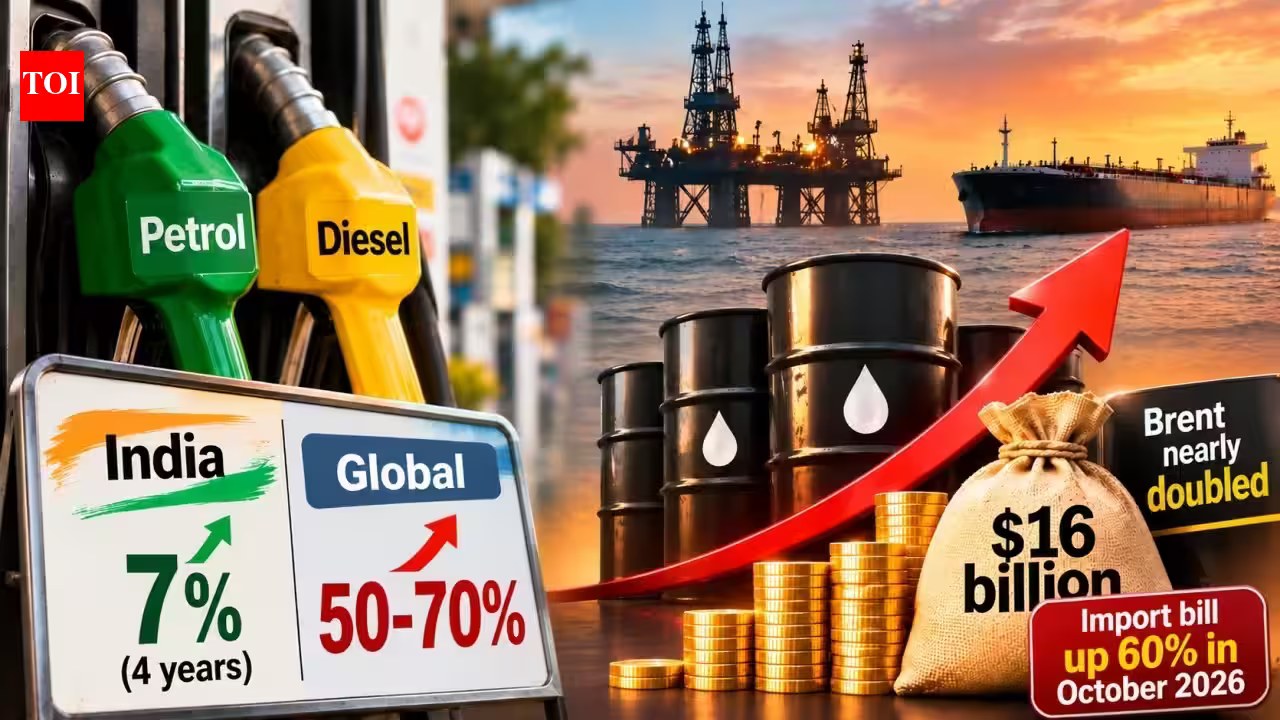
Market analysts observe that India’s strategic approach to fuel pricing is distinct. By leveraging a combination of central excise duty reductions and corporate absorption of losses by public sector oil marketing companies (OMCs), the government has managed to keep domestic petrol and diesel price hikes significantly lower than global benchmarks. In a period where many nations witnessed price surges in the range of 50% to 70%, India’s increase was contained to approximately 7%. This policy choice reflects a conscious effort to temper inflationary pressures on transportation and logistics, which are essential for maintaining the momentum of the domestic economy.
The Fiscal Implications of Rising Import Costs
While retail consumers have been largely insulated, the macroeconomic reality of the energy sector tells a different story. India’s net expenditure on oil and gas imports surged by 60% year-on-year in October 2026, reaching $16 billion. This sharp increase is directly attributable to the doubling of Brent crude prices on the international market. The Petroleum Planning and Analysis Cell (PPAC) reports that while the actual volume of crude oil imports grew by a modest 11%, the total cost ballooned significantly. This discrepancy highlights the vulnerability of the Indian economy to external price shocks.
For the April-October period, the cumulative net import bill reached $97.7 billion, up from $70.3 billion in the previous year. Even with only a 2.7% rise in import volumes for crude oil during this seven-month window, the total expenditure on these imports jumped to $111 billion. This indicates that a vast portion of India’s foreign exchange reserves is being channeled into settling energy import bills. The reliance on imported energy is not merely a logistical challenge but a structural economic bottleneck that impacts the trade deficit and, by extension, currency stability.
The Role of Public Sector Oil Marketing Companies
A key pillar of India’s strategy to control retail inflation has been the role played by state-owned oil marketing companies, including BPCL, IOCL, and HPCL. Under government guidance, these entities have acted as buffers, absorbing substantial financial losses during periods of peak international crude prices. By choosing to operate at a deficit rather than passing the entirety of the import cost inflation to the end user, these companies have performed an essential, albeit costly, role as responsible corporate citizens.
However, this practice raises questions about the long-term sustainability of such business models. Continuous absorption of losses impacts the capital expenditure capabilities of these OMCs. As they prioritize national price stability, their capacity to invest in refining infrastructure, green energy transitions, and exploration and production activities may face constraints. In a competitive global energy market, the financial health of these entities is synonymous with the country’s energy security, making the balancing act between consumer protection and corporate solvency an increasingly complex task for the ministry.
Changing Consumption Patterns and Domestic Realities
The energy landscape within India is also undergoing subtle but significant shifts. Recent data shows a contraction in the domestic consumption of Liquefied Petroleum Gas (LPG), with a decrease in the number of active domestic consumers. This trend is notable given the previous push for widespread LPG penetration. Whether this represents a saturation point in the market, a return to traditional fuels, or the effect of persistent pricing levels remains a subject of analysis. Conversely, the market for auto LPG has seen growth, suggesting that alternative fuel segments are carving out a niche as consumers look for cost-effective alternatives to conventional petrol and diesel.
Furthermore, domestic crude production remains relatively modest compared to the country’s massive appetite. With domestic production contributing roughly 2.1 million tonnes toward the 24.1 million tonnes processed by Indian refineries in October, the dependency on foreign sources remains deep-rooted. While refineries have increased their processing capacity by 7.1%, the structural reliance on imported crude—covering nearly 89% of consumption—means that India remains a “price-taker” in the global market, heavily exposed to the decisions of OPEC+ and the geopolitical tensions in major oil-producing regions.
Geopolitical Uncertainty and Future Outlook
The Minister for Petroleum and Natural Gas, Hardeep Singh Puri, has highlighted that the current challenges are inextricably linked to ongoing international conflicts. The protracted war in Ukraine, coupled with persistent instability involving key players in the Middle East, ensures that the global supply chain for crude oil remains fragile. The current average price of the Indian crude basket—which rose sharply to nearly $120 per barrel in October—is a testament to how quickly regional instability can inflate national costs.
Looking ahead, the policy framework must focus on balancing short-term relief with long-term security. While excise duty cuts have served as effective emergency levers, they represent a reduction in government revenue that could otherwise be utilized for developmental infrastructure. The long-term solution lies in diversifying energy sources, increasing domestic exploration through policies like the Hydrocarbon Exploration and Licensing Policy (HELP), and accelerating the adoption of electric vehicles and biofuels. By reducing the volume of crude needed, India can mitigate the financial impact of price spikes. Until such structural changes reach maturity, the Indian market will continue to navigate a delicate path, carefully managing the trade-off between retail affordability and the fiscal impact of a volatile energy import bill. The ability of the state to shield the economy while maintaining the health of the oil marketing sector will be a defining feature of India’s economic management in the coming years.
Disclaimer: This content is auto-generated for informational purposes only.
Source: Read Original News