








The wait is finally over, and for millions of fans across the globe, the anticipation has just hit a fever pitch. In a masterstroke of timing, the team behind Nitesh Tiwari’s magnum opus, Ramayana, chose the auspicious occasion of Ganesh Chaturthi to kick off their musical journey. By dropping the first official poster and teasing the premiere of their debut track, “Jai Jai Ram,” the makers haven’t just announced a movie—they have signaled the beginning of a cultural event.
For a project that has been shrouded in immense secrecy, the unveiling of this new visual identity feels like a breath of fresh air. It offers the first real glimpse into the aesthetic language of what is arguably the most ambitious film production in contemporary Indian cinema.
A Tender Glimpse Into the Divine
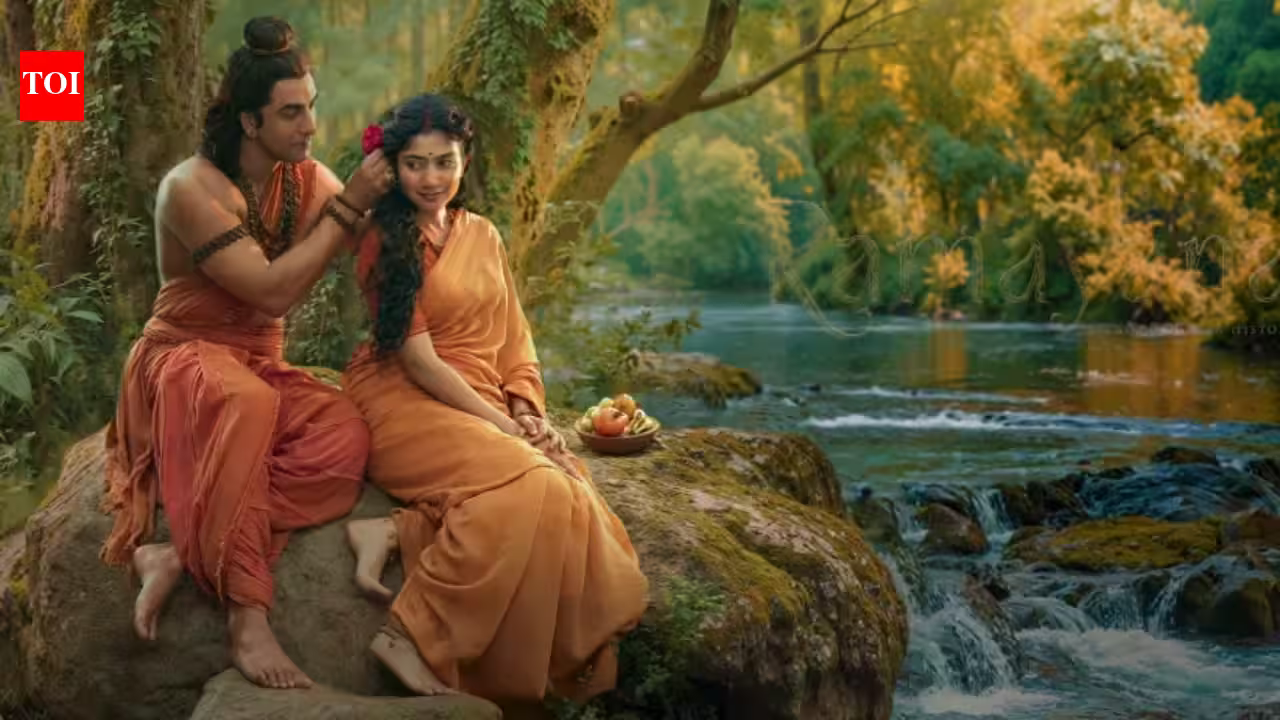
The newly released poster is a study in quiet intensity. Featuring Ranbir Kapoor as Lord Rama and Sai Pallavi as Sita, the image abandons the loud, CGI-heavy bombast one might expect from a mythological epic in favor of something far more intimate. They are depicted seated on a rock beneath the canopy of a tree, a scene that grounds these celestial figures in a very human, palpable reality.
The detail of Rama gently placing a flower in Sita’s hair is a poignant narrative choice. It strips away the armor and the regalia, presenting them instead in the soft, vulnerable context of their forest exile. For fans of the epic, this frame serves as a bridge between the historical grandeur of the Ramayana and the personal chemistry of its protagonists. It suggests that while the film will undoubtedly deliver on the scale, it is equally invested in the interior lives of its characters. This is the calm before the storm—a frozen moment of domestic peace before the inevitable tragedy of the abduction and the subsequent war.
The Maestro’s Touch: A Triple-Threat Musical Offering
If the poster provides the visual anchor, the music serves as the soul. Bringing together the legendary A.R. Rahman with the powerhouse vocals of Arijit Singh and Shreya Ghoshal is a statement of intent. In an industry where background scores often lean on repetitive motifs, a collaboration of this magnitude suggests that the soundscape of Ramayana will be orchestral, expansive, and deeply emotive.
A.R. Rahman has a storied history of elevating epic storytelling, and “Jai Jai Ram” is expected to be the spiritual heartbeat of the film. By releasing this track as the first official musical offering, the makers are signaling that they want the audience to connect with the film on a meditative level before they are pulled into the high-octane action sequences that the later parts of the epic will surely deliver. With Arijit and Shreya—the two most recognizable voices in modern Indian music—the song is positioned to become a classic, transcending the silver screen to become a staple in household playlists.
Nitesh Tiwari’s Vision for a Two-Part Epic
Director Nitesh Tiwari, best known for his ability to handle heart-tugging narratives like Dangal and Chhichhore, faces his greatest challenge yet. Ramayana is not just a film; it is a cultural touchstone. Splitting the narrative into two parts is a bold, necessary move. It allows the screenplay the room to breathe, ensuring that the characters are not just tropes, but fully realized people whose decisions have weight and consequence.
The decision to release the first part this November suggests a confidence in the post-production work that has been meticulously kept under wraps. By framing it as a two-part epic—with the first installment arriving this year and the second slated for 2027—the production house is mirroring the structural success of global franchises like Dune or Lord of the Rings. This serialized approach ensures that the audience stays invested in the long-form storytelling, providing a massive cliffhanger that will keep the conversation alive for the next three years.
The Global Strategy: A Diwali Gift
There is a calculated strategy behind the release dates, too. By positioning the film for a Diwali release, the makers are leaning into the festival’s inherent connection to the return of Lord Rama. It is a homecoming in every sense of the word. Furthermore, the international rollout on November 5 and 6, followed by the Indian release on November 8, highlights the film’s ambition to compete on a global stage.
Ramayana is clearly aiming to be an export-grade product, one that carries the weight of Indian heritage while utilizing the best of international production standards. Whether it is the casting of Yash as Ravana, which promises a formidable, layered antagonist, or the careful curation of the musical score, everything points to a project that refuses to cut corners.
The Path Ahead
As we look toward the November release, the excitement is palpable. The transition from the “announcement phase” to the “active promotion phase” is always a critical moment for any big-budget film. The team behind Ramayana has managed to navigate this transition with grace, choosing tradition and melody over noise and flash.
The success of a project like this hinges on the balance between spectacle and sincerity. If the first song and the delicate, evocative poster are any indication, Nitesh Tiwari and his team understand that while audiences might come for the epic scale of the Ramayana, they will stay for the emotional truth of the relationship between Rama and Sita. As the musical journey officially begins, the audience is no longer just waiting for a movie—they are waiting for an experience. And if this first chapter is anything to go by, that experience is going to be unforgettable.
Disclaimer: This content is auto-generated for informational purposes only.
Source: Read Original News