









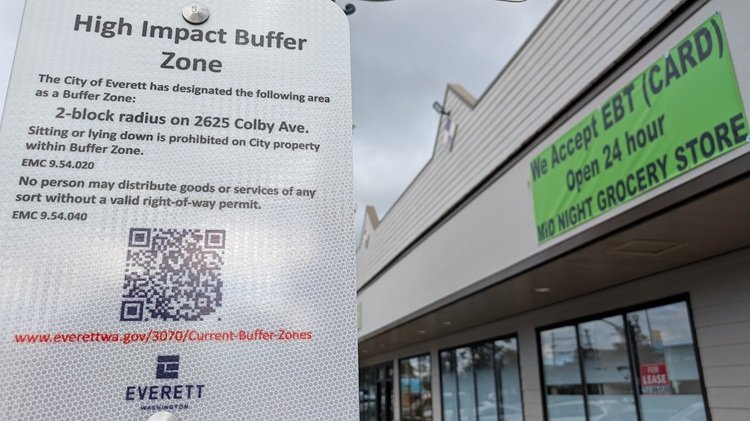
EVERETT — As Everett continues to refine its approach to urban management, local business owners in the city’s downtown corridor are reporting a noticeable shift in street-level safety following the implementation of new “no sit, no lie” buffer zones. The ordinance, which prohibits individuals from obstructing public rights-of-way with furniture, sleeping bags, or personal belongings, is part of a broader, data-driven initiative to stabilize areas plagued by high volumes of emergency service calls.
## A Data-Driven Approach to Public Safety
The city’s decision to designate the 2600 block of Colby Avenue and surrounding areas as a protected zone is not arbitrary. Under current municipal code, an area must document at least six incidents of public disturbance—ranging from trespassing and drug offenses to physical assaults and encampment-related safety hazards—within a six-month period to qualify for the designation.
This administrative shift reflects a growing trend in municipal management where local governments are increasingly leveraging data analytics and AI-integrated reporting systems to identify “hot spots” for public safety incidents. By aggregating 911 call data and real-time incident reporting, officials can deploy resources more effectively, targeting specific city blocks that require intervention rather than applying blanket policies that may be less efficient. This approach mirrors how modern tech platforms utilize predictive modeling to anticipate service bottlenecks, allowing for proactive, rather than reactive, policy enforcement.
## Business Owners Report Gradual Improvement
For the merchants operating within the newly designated 2600 block of Colby, the change is palpable. Todd Stiger, the owner of Abbey Carpet of Everett, notes that the persistent issue of doorway obstruction—where individuals would frequently sleep in the sheltered egress points of his building—has significantly decreased over the past few years.
“At the moment, it seems to be okay,” Stiger remarked, acknowledging that while the situation is improving, the ongoing challenges surrounding mental health and homelessness remain complex issues that are deeply felt by the local business community. He noted that while the “no sit, no lie” policy has mitigated loitering, his focus has shifted toward emerging urban concerns, such as the rise of high-speed e-bikes and property-related issues like graffiti, which represent new challenges for storefront maintenance and pedestrian safety.
Nancy Erickson, the proprietor of Erickson’s Jewelers located at 2625 Colby Ave, shared a similar perspective. Reflecting on the period before the implementation of the new measures, she described the environment as “pretty scary for a while.” However, she confirmed that the current atmosphere on the block is markedly better, emphasizing that the increased sense of security is vital for the viability of local retail.
## Technology and the Future of Urban Management
As cities like Everett experiment with these buffer zones, the role of digital infrastructure becomes increasingly prominent. The visible deployment of signage and the rapid update of municipal geographic information systems (GIS) to reflect these new “no sit, no lie” zones are essential for public awareness.
Moreover, the intersection of city planning and technology continues to evolve. While traditional policies like the “no sit, no lie” ordinance focus on physical behavior, the future of urban safety may eventually rely on sophisticated smart city tools. From AI-powered security monitoring to improved digital interfaces for reporting property concerns like graffiti and bike safety, Everett is navigating a landscape where physical policy is increasingly supplemented by digital optimization.
For now, the merchants on Colby Avenue are experiencing the immediate benefits of a focused, data-backed policy. While business owners remain cautious about the long-term nature of these urban challenges, the current downward trend in emergency call incidents suggests that the buffer zone strategy is serving as an effective tool for maintaining public order in a changing downtown environment.
Disclaimer: This content is auto-generated for informational purposes only.
Source: Read Original News