




Hollywood’s Frontline: Susan Sarandon and the Cost of Dissent
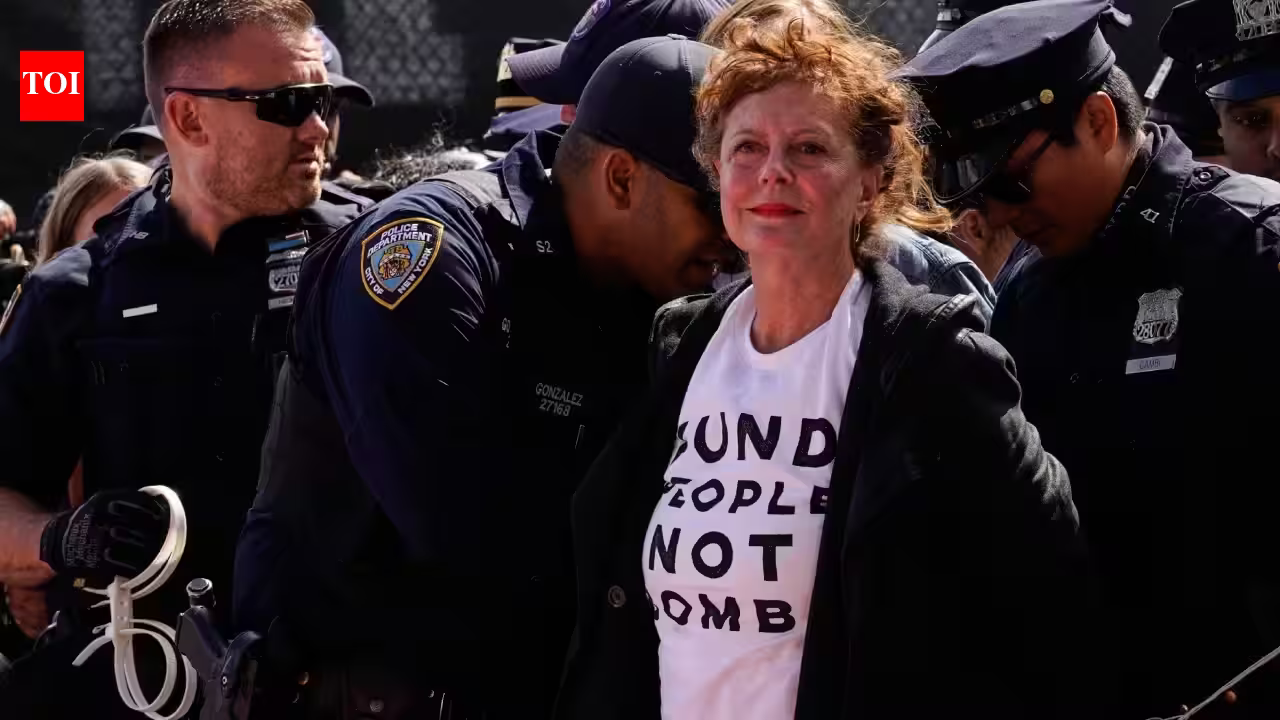
In the high-stakes arena of celebrity activism, few figures are as polarizing or as persistent as Susan Sarandon. On Thursday, the Oscar-winning actress found herself at the center of yet another storm, not on a film set, but on the asphalt of First Avenue, just steps away from the United Nations headquarters in New York City. As Prime Minister Benjamin Netanyahu prepared to address the General Assembly, a vocal coalition of actors, politicians, and activists turned the street into a theater of civil disobedience. Among them, Sarandon was lead-billed, quite literally, as she was taken into custody by the NYPD, her hands bound in zip ties as she was escorted toward a waiting police bus.
The scene was a stark reminder that for stars like Sarandon, the boundary between “Hollywood elite” and “political agitator” is not just blurred—it’s been completely erased. Joined by Hacks star Hannah Einbinder, comedian Caleb Hearon, and city officials like council member Chi Ossé, Sarandon became the visual anchor of a protest that sought to turn the world’s eyes toward the humanitarian crisis in Gaza before the global political establishment could shift its gaze elsewhere.
The “Fund People, Not Bombs” Movement
The protest, orchestrated by the activist group Jewish Voice for Peace, saw around 200 demonstrators clad in uniform white T-shirts. The messaging was blunt, unadorned, and impossible to ignore: “Fund people, not bombs,” “No war,” and “Free Palestine.” This was not a soft-spoken call for diplomacy; it was an act of tactical disruption. By blocking traffic and refusing to vacate the pavement despite repeated warnings via police loudspeakers, the protesters forced the NYPD to engage in a methodical, one-by-one removal of the group.
For those watching from the sidelines—including fellow actress Cynthia Nixon, who attended the rally but notably avoided arrest—the images of high-profile figures being zip-tied by bicycle-bound officers served as a visceral symbol of the growing friction within the entertainment industry. The message from the group was clear: their platforms are not just for selling movie tickets; they are for challenging the state-sanctioned narratives of the world’s most powerful leaders.
A History of High-Stakes Activism
If there is a veteran of this particular battlefield, it is undoubtedly Susan Sarandon. At 79, her presence at the UN protest is not an anomaly; it is a continuation of a decades-long commitment to radical protest that has frequently put her at odds with the status quo. Her arrest on Thursday follows a similar incident just three years ago at the New York state Capitol in Albany, where she was also detained for her participation in climate and labor protests.
However, the stakes feel significantly higher this time. Since 2023, Sarandon has been a lightning rod for controversy. Her vocal, uncompromising pro-Palestine stance led to what many in the industry describe as a “blacklisting” or, at the very least, a severe “cancellation” by major studios and talent agencies. In an industry built on brand management and corporate safety, Sarandon’s refusal to calibrate her tone has effectively turned her into a radioactive asset. But if the events at the UN proved anything, it’s that she is seemingly unbothered by the potential professional repercussions. She isn’t just speaking out; she is leaning into the confrontation.
The Generational Shift in Hollywood Activism
What made Thursday’s demonstration particularly intriguing was the presence of a new generation of talent. Hannah Einbinder, the breakout star of HBO’s Hacks, represents the newer, younger guard of Hollywood who are far less tethered to the traditional “star image.” Unlike the stars of yesteryear who might have donated to a cause and kept a discreet distance, Einbinder and fellow comedian Caleb Hearon have been consistently loud about their political convictions.
This suggests a broader trend in the entertainment industry: the “shut up and act” era is dead. Young stars are realizing that their digital followings—often larger than those of major media conglomerates—grant them an unprecedented ability to bypass traditional PR filters. By showing up in the streets, getting arrested, and appearing in viral videos with zip ties around their wrists, they are forcing their fans to confront the same geopolitical realities they are facing. It’s an aggressive, grassroots approach that doesn’t wait for permission from agents or publicists.
Netanyahu’s Visit and the Clash of Narratives
The protest outside the UN was a tactical maneuver designed to clash with the arrival of Benjamin Netanyahu. As the world’s press gathered to cover the Prime Minister’s speech, the protesters made sure that the narrative wasn’t entirely centered on the halls of power. By turning their arrest into a spectacle, they ensured that the sound of the chants—”Netanyahu go to hell”—would reach the ears of both the media and the international community.
The NYPD’s heavy response served only to amplify the visibility of the protest. As officers cycled into the crowd and dismantled the sit-in, the optics of dragging award-winning actors into buses created a powerful, disruptive visual that dominated social media feeds throughout the afternoon. It highlighted the friction between the protestors’ demands for peace and the state’s demand for order ahead of a major diplomatic event.
What Comes Next for the Hollywood Dissenters?
As the sun set on the protest, the activists were processed and released, but the fallout has only just begun. For Sarandon, Einbinder, and their peers, the arrest is more than just a legal headache; it is a badge of honor in an increasingly polarized culture. While the industry may whisper about “career risks,” these actors are operating on a different metric. They have moved past the goal of “likability” and have firmly embraced the role of the agitator.
The question remains: will this trend of direct action by celebrities actually influence policy, or is it destined to remain a performative exercise that merely creates content for the digital age? Regardless of the answer, the events at the United Nations made one thing crystal clear. The era of the silent, cautious movie star is effectively over. In an age of global upheaval, the intersection of Hollywood and the front lines is only going to get more crowded, more intense, and significantly more difficult to ignore.
Disclaimer: This content is auto-generated for informational purposes only.
Source: Read Original News