




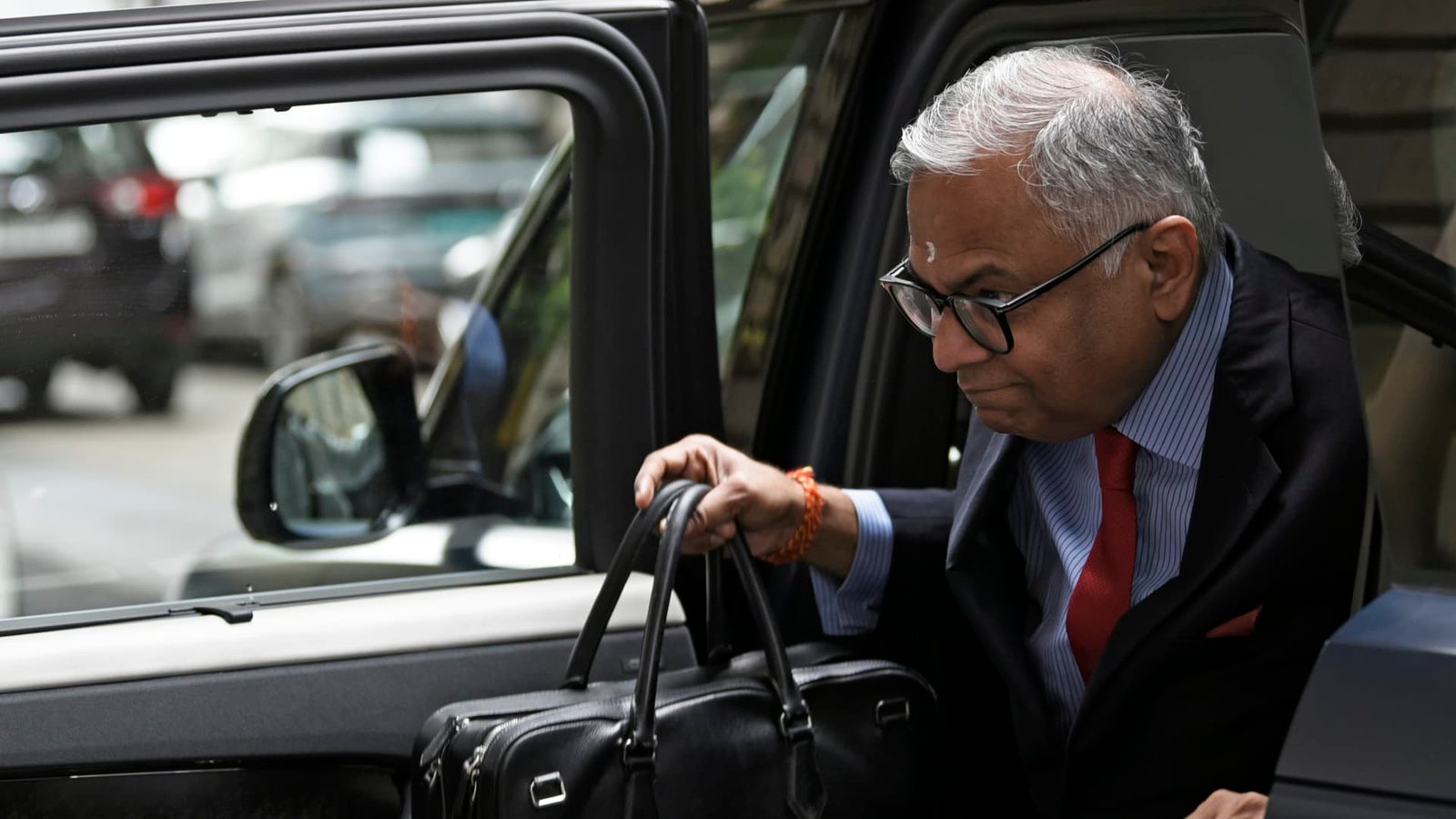
The unexpected resignation of N. Chandrasekaran as Chairman of Tata Sons has cast a significant shadow over several ambitious and high-stakes projects within the vast Tata Group, particularly those crucial to India’s burgeoning technological aspirations. Chandrasekaran’s departure, announced on August 13, 2026, has introduced considerable uncertainty regarding the future of India’s first semiconductor plant, an $11 billion venture established in collaboration with Taiwan’s Powerchip Semiconductor Manufacturing Corp. This project is central to India’s strategic goal of establishing itself as a significant player in global chip manufacturing. Furthermore, Chandrasekaran’s exit jeopardizes the group’s efforts to position India as a major alternative to China in the supply chain for tech giant Apple, a strategy that saw Tata acquire Wistron and Pegatron to commence iPhone production, reportedly surpassing even Foxconn’s India unit as Apple’s largest supplier in the country.
Under Chandrasekaran’s stewardship, Tata Group embarked on what he termed “largest capital commitments,” which he outlined in his latest letter to shareholders as fundamental building blocks for India’s journey to becoming a developed nation by 2047. Beyond the chip and iPhone manufacturing initiatives, these commitments also included the significant acquisition of the beleaguered national carrier Air India in 2022. These endeavors, spanning from semiconductors to aviation and consumer electronics, represent substantial, long-term investments that are currently in their nascent stages and are not yet generating profits. The decision to pursue such bold, capital-intensive ventures, even at the risk of initial losses, appears to have created a significant rift between Tata Sons and its principal shareholder, Tata Trusts, particularly as the group’s traditional profit engine, Tata Consultancy Services, grapples with the transformative impact of artificial intelligence on the information technology sector.
Industry experts, including Ruchir Khare, chief investment officer at Two X Capital, point to growing boardroom tensions as the core reason for Chandrasekaran’s departure. Khare suggests that the “struggle” between Tata Trusts and Tata Sons primarily revolves around the allocation of capital to businesses that are currently operating at a loss. The impending change in leadership inevitably raises critical questions about the Tata Group’s sustained commitment to these large-scale, long-term investments. Chandrasekaran was widely regarded as the “professional successor” chosen by the late Ratan Tata, and his exit, according to Khare, implies a fundamental disagreement between the two major power centers within the group regarding the future strategic direction of Tata Sons.
The formal process to find Chandrasekaran’s replacement began swiftly after he announced his decision not to seek another term, expressing his dissatisfaction over the prolonged delay in finalizing his reappointment for an additional five years. Sir Dorabji Tata Trust, a key entity within the trusts that collectively hold a 66% stake in Tata Sons, issued a statement acknowledging and respecting Chandrasekaran’s decision, while also assuring full support for a smooth and orderly transition of leadership. In his resignation letter, Chandrasekaran revealed that his proposed term extension had been pending for six months and was ultimately not approved due to the lack of support from one of the Board Members. Local media reports further suggest that disagreements with Noel Tata, chairman of Tata Trust, regarding declining profitability and the allocation of capital to loss-making ventures, played a pivotal role in this internal strife.
Financial reports underscore the challenges faced by the group. For the financial year ending March 2026, Tata Sons’ consolidated net profit witnessed a substantial 35% decline, plummeting to 266 billion rupees (approximately $2.78 billion). This significant drop was primarily attributed to accumulating losses from Air India, Tata Digital, and Tata Electronics, as detailed in Tata Sons’ latest annual report. While these loss-making entities are unlisted, the market capitalization of Tata Group’s listed companies also fell by 12% during the same period, notably with shares of its IT services giant, TCS, correcting amid concerns over its long-term growth prospects. CNBC’s requests for comments from Tata Sons went unanswered, and Tata Trusts did not address questions concerning capital allocation. Anil K. Sood, professor and co-founder of the Mumbai-based Institute of Advanced Studies in Complex Choices, suggests that Tata Trusts, heavily reliant on income generated by Tata Sons, is advocating for a more conservative approach to capital allocation, especially at a time when its primary cash-generating IT services business is under considerable pressure.
Sood highlights the Air India acquisition as a particular point of contention, arguing that it is not only a drain on capital but also potentially “damaging” the venerable Tata brand due to frequent operational issues. He further criticized the investment strategy, noting that a cash-rich, high-margin IT services business is facing disruption from AI, while investments are being channeled into what he terms “commoditized” businesses. Experts contend that in this internal power struggle, Tata Trusts holds a distinct advantage, effectively playing the role of a kingmaker by dictating leadership at Tata Sons.
This enduring dichotomy of dual power centers within the Tata Group is not unprecedented. A decade prior, it led to the controversial ousting of another Tata Sons Chairman, Cyrus Mistry, in 2016, following public disagreements with Ratan Tata, who then headed Tata Trust. Ramesh Vaidyanathan, managing director at BTG Advaya, an Indian law firm specializing in corporate dispute and transactional law, observes the current situation with a sense of irony. He recalls that Mistry’s focus was on “maximizing return on equity” and adopting a “clinical” approach to cutting investments, whereas Ratan Tata at that time championed bolder strategic bets. Vaidyanathan notes that in the present boardroom conflict, these roles appear to have reversed.
While the Tata Group has historically navigated this inherent tension between its two power centers, experts emphasize that the current dispute between Tata Trusts and Tata Sons is particularly critical, given that the business is deeply embedded in a significant and challenging investment cycle. Chandrasekaran’s successor will face an unenviable task: to implement the course correction desired by Tata Trusts while simultaneously assuring the markets that the group is well-prepared to tackle the upcoming wave of global economic and technological challenges. Tata Sons is scheduled to hold its annual shareholder meeting on August 18, where the board is widely expected to address the critical issue of succession, as Chandrasekaran’s term officially concludes in February of the following year.