








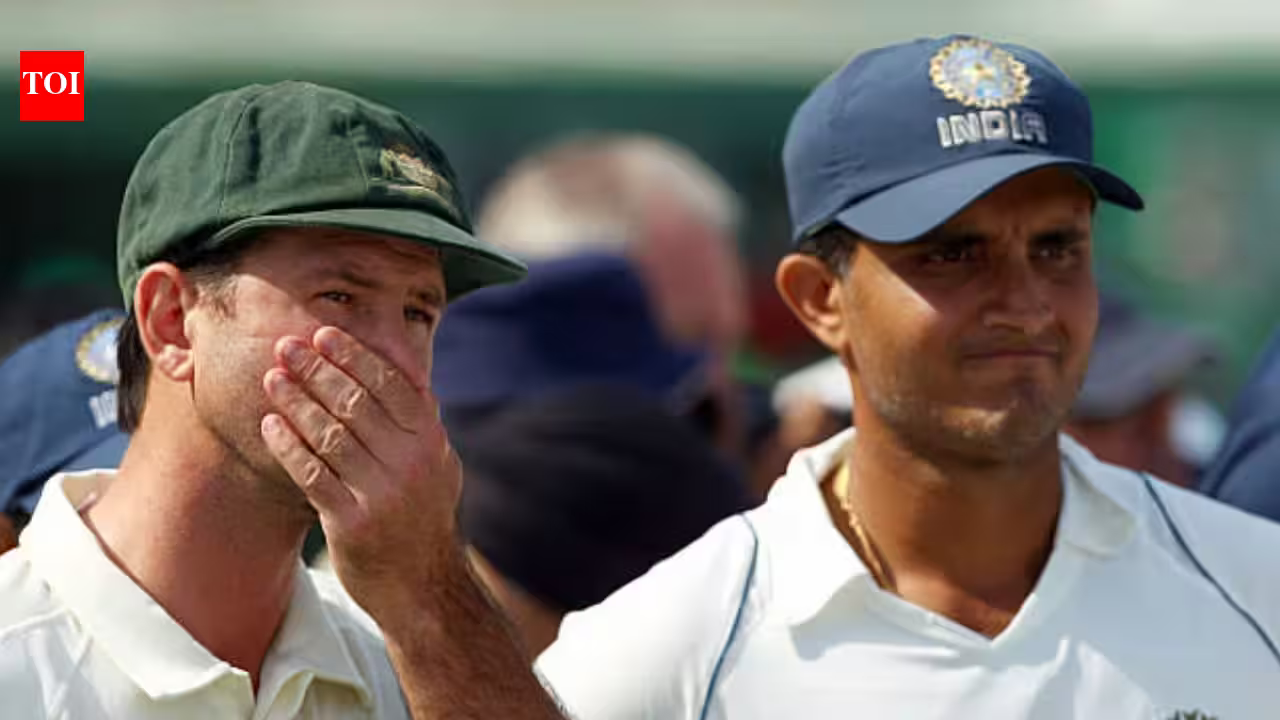
“Heads-Tail,” Sourav Ganguly reportedly quipped as the silver coin spun high into the sweltering Indian sky. Before Ricky Ponting, arguably the most focused and intense captain in Australian cricket history, could even process the absurdity of the dual-call, the coin had thudded onto the turf. By the time the legendary Australian skipper looked down, Ganguly was already turning on his heel, signaling his intent with a dismissive wave. “We’ll bat,” the Prince of Kolkata declared, leaving a bewildered Ponting standing in the middle of the pitch, trying to reconcile the breach of protocol with the reality of the situation.
This anecdote, recounted by former Australian captain Michael Clarke in Boria Majumdar’s book Eleven Gods and a Billion Indians, serves as a quintessential snapshot of the psychological warfare that defined the rivalry between India and Australia in the early 2000s. While history often focuses on the tactical brilliance and the heated exchanges between these two cricketing giants, this particular moment highlights the sheer audacity that Sourav Ganguly brought to the leadership role.
The Prince of Kolkata and his Mind Games
Sourav Ganguly’s captaincy was never defined merely by runs or wickets; it was defined by attitude. He took a team that was often viewed as passive and transformed it into a unit that looked the mighty Australians in the eye without blinking. From his infamous decision to make Steve Waugh wait at the toss—a breach of decorum that rattled the Australian skipper—to his iconic shirtless celebration on the hallowed Lord’s balcony, “Dada” thrived on discomforting his opposition.
Clarke’s recollection of the “Heads-Tail” incident paints a picture of a captain who understood that cricket matches are often won long before the first ball is bowled. According to Clarke, the call was made at “the speed of lightning.” It was a classic piece of gamesmanship, designed to fluster a meticulous planner like Ponting. Ponting, a man who prided himself on his control and preparation, found himself completely paralyzed by the sheer spontaneity of the maneuver. By the time he regained his composure, the decision had been made, the toss had been “won,” and the momentum had already swung in favor of the hosts.
Fact vs. Folklore: The Mystery of the Missing Toss
While the story is one of the most entertaining pieces of cricketing lore to emerge from that era, it is not without its historical discrepancies. Michael Clarke himself admits that he cannot pinpoint the specific match or series in which this occurred.
Statistical analysis of the Ganguly-Ponting era reveals an interesting wrinkle: records indicate that Ganguly won five tosses against Ponting, all of which took place outside of India. Twice during the high-pressure environment of the 2003 World Cup and three times during the 2003-04 VB Series in Australia, the coin fell in Ganguly’s favor.
In India, of course, the visiting captain is the one who tosses the coin, meaning the scenario described by Clarke—where Ponting is holding the coin and Ganguly makes the call—would necessitate a match on Indian soil. Whether Clarke misremembered the location or the incident took place in a tour match or a setting not captured in official international records, the essence of the story remains a testament to the respect and fear Ganguly commanded.
A Legacy Beyond the Scorecard
The significance of this story lies not in the legality of the toss, but in what it reveals about the power dynamic between two eras of cricket. Under Ganguly, Indian cricket shed its “gentlemanly” exterior in favor of a grit that could handle the aggression of the Australians. Whether it was refusing to walk after a disputed catch or engaging in verbal sparring with Shane Warne, Ganguly’s tenure was marked by a refusal to be intimidated.
For Ricky Ponting, who eventually became one of the most successful captains the world has ever seen, these moments were perhaps the most frustrating aspect of facing India during that transition period. He was accustomed to dictating the flow of the game, yet here was an opponent who refused to play by the established rhythm of the sport.
As we look back on the careers of these icons, it is these humanizing, chaotic, and often hilarious moments that define them. Michael Clarke’s recollection may be geographically hazy, but its cultural accuracy is sharp. It captures the spirit of a time when the toss was not just a formality, but a battleground. And if there is one thing that everyone who played against Sourav Ganguly agrees on, it is this: when Dada was at the crease, or at the toss, nothing was ever quite as simple as it seemed. Whether it was “Heads” or “Tails,” Ganguly usually found a way to come out on top.
Disclaimer: This content is auto-generated for informational purposes only.
Source: Read Original News