







The Lunar Mechanics of the Hunter’s Supermoon
The celestial phenomenon known as the Hunter’s Moon is set to grace the night sky this October, marking the beginning of a rare sequence of three consecutive supermoons to conclude the 2026 calendar year. A supermoon occurs when a full moon coincides with perigee, the point in the lunar orbit where the moon reaches its closest proximity to Earth. During this phase, the moon appears significantly larger and more luminous than a standard full moon, providing an ideal window for both amateur skywatchers and professional researchers to observe lunar geography with enhanced clarity.
The term “Hunter’s Moon” is a traditional designation for the first full moon following the Harvest Moon. Historically, this lunar event signaled the time when crops had been gathered from the fields and the low-hanging light provided hunters with extended visibility to prepare for the coming winter. From a modern astronomical perspective, the event is defined by the moon’s position relative to the elliptical orbital plane of Earth. As the moon reaches perigee, its apparent diameter can increase by approximately 14 percent, and its brightness can escalate by nearly 30 percent compared to an apogee full moon.
Technical Parameters and Observational Timing
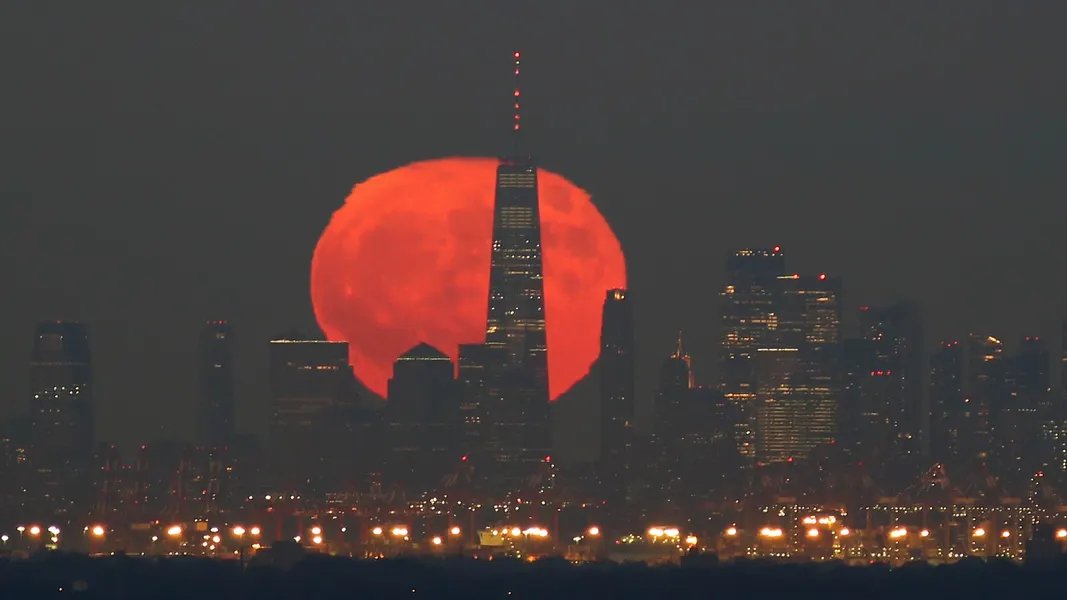
For those intending to observe this event, precise timing is essential. The moon’s visual impact is at its peak during moonrise, when the phenomenon of the “moon illusion” occurs. This psychological effect causes the moon to appear larger when situated near the horizon, framed against terrestrial landmarks like trees or buildings. Astronomers note that the most effective observation period occurs just as the moon breaches the horizon at dusk.
In October 2026, the peak illumination is expected to reach near-total capacity, providing a high-contrast environment. For northern hemisphere observers, the moon will maintain a high trajectory across the sky, allowing for extended observation periods throughout the night. Because the moon will be situated closer to Earth than its annual average distance of 238,855 miles, the surface details—specifically the dark volcanic plains known as maria and the lighter, crater-dense highland regions—will be visible with standard optical aids, such as binoculars or small-aperture telescopes.
Analyzing the Sequence of Three Supermoons
This October event serves as the initiator of a rare “supermoon trilogy.” The sequence continues through November and December 2026, creating a unique opportunity for longitudinal studies in lunar luminosity. This triple-event occurrence is a result of the synchronization between the moon’s synodic month—the time it takes to cycle through its phases—and its anomalistic month, which measures the time taken to orbit from perigee to perigee.
When these cycles align in this manner, it allows for repeated high-resolution observation periods within a single quarter. This is a significant event for lunar scientists who utilize these moments to map lighting conditions on the lunar surface. Because the moon’s libration—a slight wobble in its orbit—exposes slightly different sections of its far side over the course of these three months, the trilogy allows for a more comprehensive visual cataloging of the lunar crust than a single event would provide.
Impact on Earth’s Geophysical Systems
Beyond the visual spectacle, supermoons exert a measurable physical influence on Earth. The increased gravitational pull caused by the moon’s proximity to our planet results in higher-than-average tidal variations. Known as perigean spring tides, these events lead to more pronounced high tides and lower-than-average low tides. Coastal regions often experience tidal surges during these periods, a factor that maritime planners and environmental engineers monitor closely to mitigate potential flooding in vulnerable low-lying districts.
While the gravitational difference between a standard full moon and a supermoon is relatively minor, the cumulative effect over the course of a three-month sequence can impact local water tables and coastal erosion patterns. Researchers often leverage these weeks to study the interaction between lunar gravity and terrestrial ocean dynamics, using satellite altimetry to track how the extra distance reduction affects sea level height across different ocean basins.
Optimizing Observation Equipment and Techniques
Capturing or observing the Hunter’s Supermoon requires an understanding of light pollution and atmospheric interference. Because the moon is at its brightest during this phase, it can overwhelm sensitive imaging equipment if not properly calibrated. Digital sensors should be set to a low ISO to prevent overexposure, while those using telescopes should utilize neutral density filters to balance the high lunar albedo.
For those without specialized equipment, the event remains accessible. The human eye is well-suited to observing the lunar transition from the horizon into the night sky. Choosing a location with minimal light pollution and a clear view of the eastern horizon will yield the most impactful results. Observers should look for the moon shortly after local sunset, as the light scattering caused by the Earth’s atmosphere during the rising phase often imparts a golden or amber hue to the lunar disc. As the moon rises higher into the atmosphere, the light scattering decreases, and the lunar surface shifts to its characteristic bright, silvery-white appearance.
As the 2026 calendar draws to a close, this series of supermoons acts as a reminder of the consistent, rhythmic precision of our solar system. By tracking these intervals, we gain a deeper technical understanding of the orbital mechanics that dictate the relationship between Earth and its satellite, proving that even the most well-documented natural phenomena continue to offer scientific value and educational utility.
Disclaimer: This content is auto-generated for informational purposes only.
Source: Read Original News