








Death Toll Surges as “Liquid Concrete” Flash Floods Devastate Nepal-Tibet Border
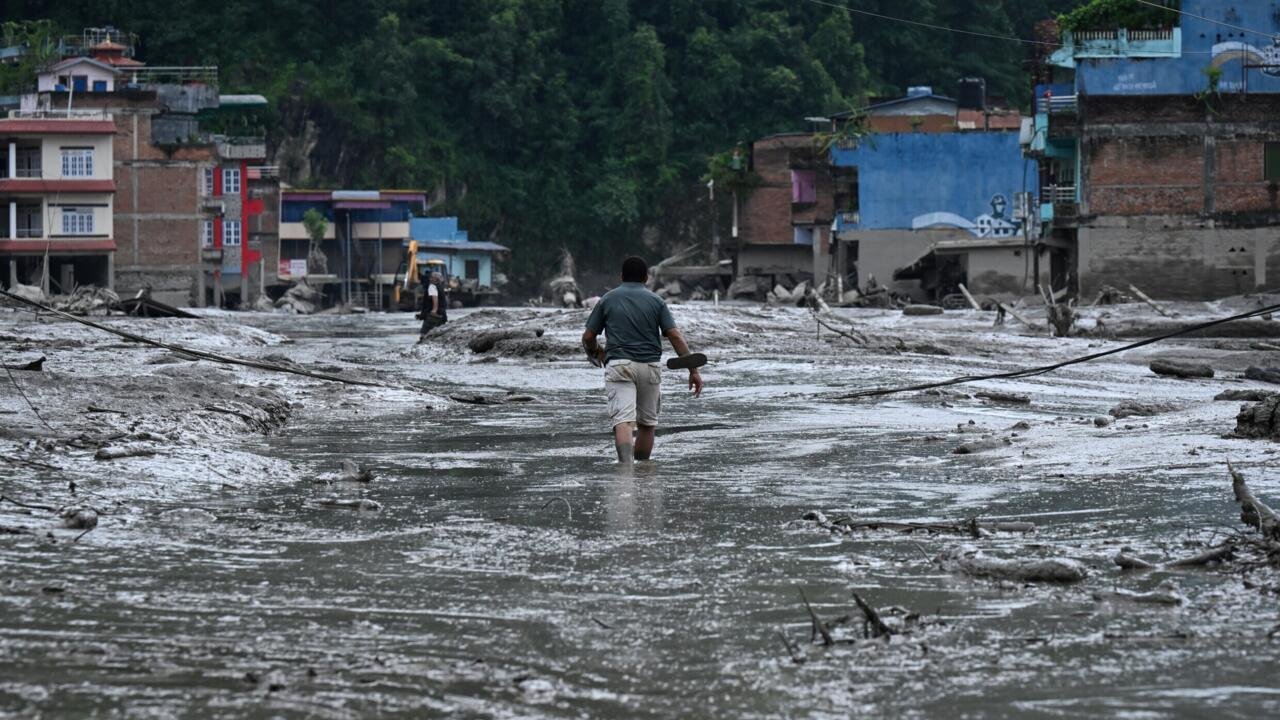
A catastrophic flash flood, described by experts as hitting with the force of “liquid concrete,” has left at least 160 people dead and hundreds more missing along the border between Nepal and Tibet. The disaster, which unfolded on Wednesday morning, swept away entire buildings and vehicles, leaving behind a trail of destruction that rescuers are struggling to navigate.
Video footage captured from the Chinese side of the border depicts a terrifying wall of mud and debris barreling through a multi-story building, reducing homes and infrastructure to rubble in seconds.
A Natural Disaster Beyond Prediction
While authorities initially suspected an earthquake triggered the destruction, the U.S. Geological Survey (USGS) clarified that the seismic signals detected—initially reported as a magnitude 4.4 tremor—were actually the result of a massive landslide.
“We believe a rock-ice avalanche occurred in Nepal, blocking the Lhende river and causing the cascading flood event,” said Sarthak Shrestha, a researcher at the International Centre for Integrated Mountain Development (ICIMOD).
Experts note that this specific event poses unique challenges for public safety. Hatim Sharif, a hydrologist at the University of Texas at San Antonio, highlighted the terrifying lack of warning signs. Unlike typical flood events preceded by heavy rain, this disaster occurred during a period of drought, rendering standard early-warning systems useless.
“By the time you see the mud flow coming, it is too late,” Sharif said, adding that attempting to flee by vehicle is futile. “Running will not help. You are looking at a lethal combination that moves like liquid concrete.” The only survival strategy in such high-speed debris flows, he suggested, is to gain at least 20 feet (six meters) of elevation immediately.
The Role of Climate Change
While scientists emphasize that it is too soon to draw a definitive link between this specific event and global warming, the disaster fits into a broader, worrying pattern in the Himalayas. The region is increasingly prone to environmental causes, including glacial retreat, permafrost degradation, and the increased risk of glacial lake outburst floods (GLOFs).
“We do know what climate change trends look like in the Himalayas,” explained Dorothy Heinrich, a researcher at the University of Reading. “The high confidence of more heatwaves, glacial retreat, and permafrost reduction are the sorts of things that drive landslides and catastrophic floods.”
Looking Ahead
As search-and-rescue operations continue, experts remain concerned about the possibility of secondary disasters. Qianggong Zhang of ICIMOD has warned that a blockage remains upstream, posing a risk of further flooding.
In the long term, researchers are calling for improved mitigation strategies, such as real-time river-level gauges capable of providing residents with a critical 20-to-30-minute window to seek higher ground. For now, the international community watches the “Roof of the World,” where the combination of extreme topography and a warming climate continues to present an unpredictable and deadly threat to mountain communities.
(Reported by FRANCE 24 with AFP)