









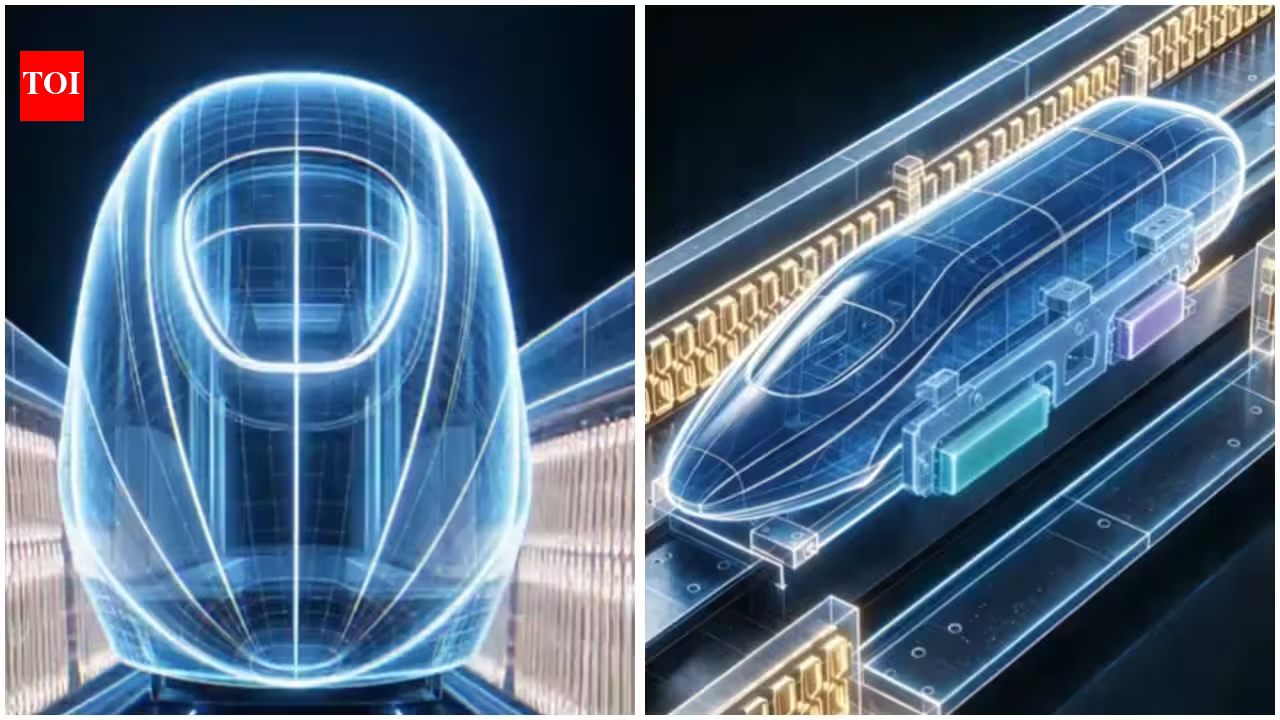
China has once again demonstrated its unwavering commitment to pushing the boundaries of transportation technology, achieving a remarkable feat with an experimental maglev train car. This groundbreaking maglev vehicle, developed at the esteemed Donghu Laboratory, recently shattered its own records by accelerating to an astounding 800 kilometers per hour in a mere 5.3 seconds on a brief one-kilometer test track located in Hubei. This marks the third global record set by the 1,110-kilogram test vehicle within a span of just six months, showcasing rapid advancements in the field.
However, it’s crucial to understand that the primary objective of these astonishing experiments is not to introduce passenger trains traveling at such extreme velocities. Instead, the innovative technology has far broader implications, with potential applications stretching into diverse sectors such as rocketry, military aircraft, unmanned aerial vehicles (drones), and industrial transport. In these domains, the ability to achieve exceptionally rapid acceleration could prove to be incredibly valuable and transformative.
The fundamental principle behind China’s experimental maglev system, much like other maglev technologies, lies in its reliance on powerful magnetic forces. Unlike conventional trains that depend on physical contact between wheels and tracks, maglev vehicles utilize electromagnetic systems to either lift the vehicle entirely off the guideway or significantly reduce friction, thereby enabling unprecedented speeds. These same electromagnetic forces are also responsible for propelling the vehicle forward. While China already operates a commercial maglev service, the Fuxing system, which boasts a top speed of approximately 349 kilometers per hour (217 mph), the Donghu Laboratory’s experimental vehicle operates at more than double that speed, highlighting the immense progress being made.
The recent test, conducted on the one-kilometer track in Hubei, utilized a system akin to a giant slingshot. Magnetic forces were employed to propel the vehicle forward with immense power, effectively eliminating the friction that typically impedes conventional rail travel. This particular test vehicle has consistently broken its own short-distance acceleration records. Its initial public demonstration in June 2025 saw it reach about 650 kilometers per hour (404 mph) in 7.1 seconds. Subsequent engineering refinements further boosted its speed to approximately 697 kilometers per hour (433 mph) before it achieved a near-496 mph (798 kmph) milestone in November, culminating in its latest 800 kmph achievement.
Achieving such extraordinary speeds presents a formidable engineering challenge. At velocities approaching 800 kilometers per hour, even minuscule deviations in the track alignment can have significant consequences. The experimental system, for instance, necessitates track alignment to be maintained within an incredibly precise tolerance of 0.5 millimeters. Furthermore, sophisticated control systems are paramount, needing to simultaneously manage the vehicle’s precise position, its levitation, and the electromagnetic propulsion, all while ensuring unwavering stability during incredibly rapid acceleration. Given that the vehicle weighs approximately 1,110 kilograms, an immense amount of energy and force is required to accelerate it to such high speeds within mere seconds. These rigorous trials have also provided invaluable opportunities for researchers to test and refine technologies related to high-power energy delivery, advanced levitation control, precise positioning, electromagnetic propulsion, and critical emergency braking systems.
The long-term significance of these experiments extends far beyond conventional rail travel. Passenger trains operating at such speeds would necessitate not only exceptionally expensive infrastructure but also colossal energy inputs. Moreover, the intense acceleration levels observed in these tests would be entirely unsuitable for the comfort and safety of typical commuter travel. Consequently, researchers are actively exploring the potential for adapting this electromagnetic acceleration technology for other applications, specifically rockets, drones, and military aircraft. Imagine a ground-based launch system capable of providing a substantial initial boost to a rocket or aircraft, thereby dramatically reducing the amount of fuel it needs to carry for takeoff. This could revolutionize space travel and aviation. Similar technological advancements could also find practical applications in specialized industrial transport systems and advanced elevator designs. While business applications of such technology are still in their nascent stages, the underlying principles are paving the way for unprecedented innovation. For now, this technology remains in its experimental phase. Although China’s existing commercial maglev systems already demonstrate the viability of high-speed passenger transport via magnetic levitation, the leap from those systems to a 800-kilometer-per-hour experimental vehicle represents a distinct and profoundly challenging engineering endeavor.