









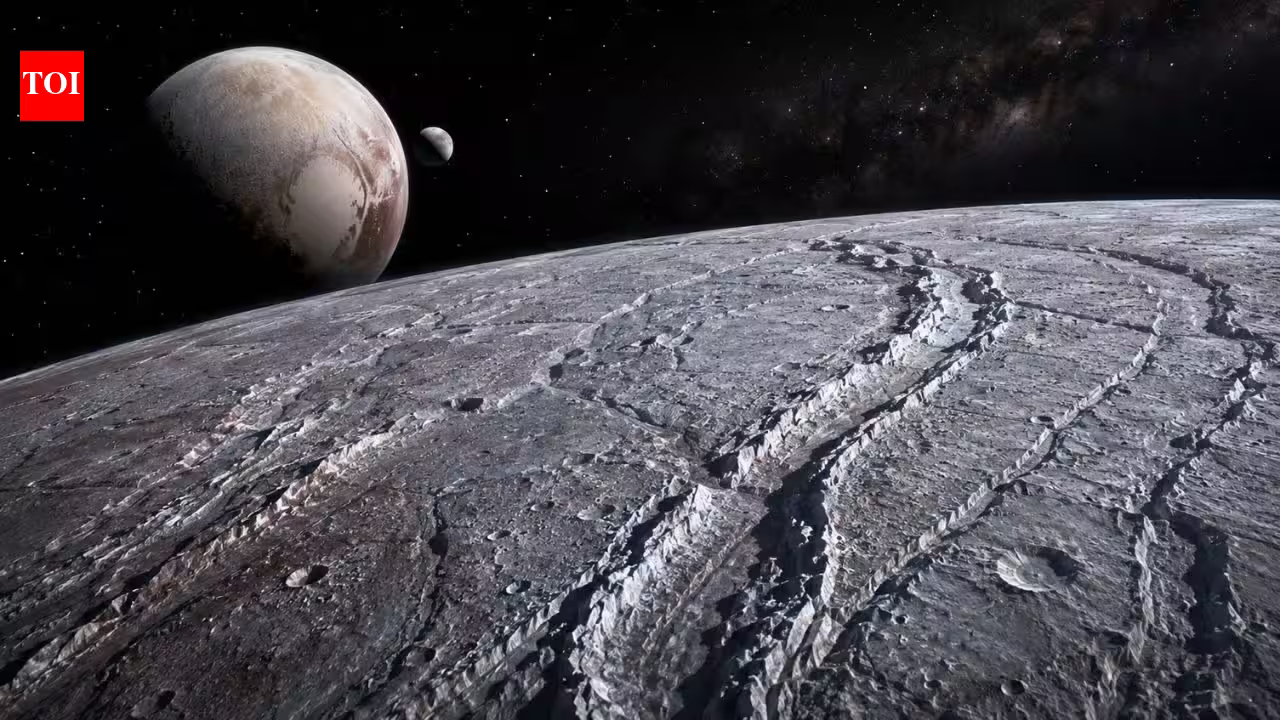
Two Decades Later, the “Plutokiller” Stands by His Controversial Decision
For generations of students, the solar system was a stable, predictable lineup: Mercury, Venus, Earth, Mars, Jupiter, Saturn, Uranus, Neptune, and the distant, icy outpost of Pluto. That narrative was shattered on August 24, 2006, when the International Astronomical Union (IAU) reclassified Pluto as a “dwarf planet,” effectively ending its decades-long reign as the ninth planet.
Two decades later, the debate remains one of the most polarizing topics in modern science. Mike Brown, the Caltech astronomer whose pioneering discoveries triggered this historic demotion, has revisited the controversy in a new piece for Scientific American. Despite the lingering public outcry, his stance remains resolute: Pluto’s demotion was not only correct—it was inevitable.
The Catalyst: The Discovery of Eris
The shift in Pluto’s status began not with a desire to dismantle childhood memories, but with the discovery of Eris. When Brown and his team identified this distant object beyond Neptune, they realized Eris was more massive than Pluto. This discovery forced a difficult question upon the scientific community: If Pluto is a planet, why isn’t Eris? And how many other similar objects might be hiding in the vast Kuiper Belt?
To provide a consistent framework, the IAU established three criteria for planetary status:
- The object must orbit the Sun.
- It must have sufficient mass to assume a nearly spherical shape.
- It must have “cleared the neighborhood” around its orbit.
While Pluto checks the first two boxes, it fails the third. It shares its orbital path with a swarm of other icy bodies in the Kuiper Belt, making it one of many rather than a dominant planetary force.
The Moon Argument: A Simple Test of Consistency
In his retrospective, Brown proposes a thought experiment to silence the critics: “Is the Moon a planet?”
Supporters of Pluto often cite its geological complexity, round shape, and atmospheric characteristics as proof of its planetary status. However, Brown points out that if those criteria alone were enough to make a planet, Earth’s Moon—which is larger than Pluto and geologically rich—would also have to be classified as a planet.
“If the Moon is not a planet, Pluto isn’t one either,” Brown argues. He insists that dynamics, not just physical appearance, must dictate classification. Because the Moon orbits the Earth rather than the Sun, and because Pluto has not gravitationally dominated its orbital neighborhood, both fail the technical requirements that define the eight primary planets.
The “Planet Inflation” Problem
Some have called for a looser definition that would restore Pluto’s status. However, Brown warns that this would lead to a “planet inflation” crisis. If the standard were lowered, astronomers would be forced to categorize numerous moons, asteroids, and dozens of Kuiper Belt objects as planets.
While that might technically make Brown the most prolific discoverer of planets in history, he argues it would render the word “planet” scientifically meaningless.
Science vs. Nostalgia
Brown acknowledges that much of the pushback against the 2006 decision stems from deep-seated nostalgia. He, too, grew up with solar system posters that featured Pluto as a permanent member of the planetary family.
However, he maintains that scientific classification cannot be driven by emotion. He continues to view Pluto as an “extraordinary and fascinating world”—worthy of study for its nitrogen glaciers and complex moon system—but insists that “fascinating” does not equal “planet.”
As the scientific community continues to explore the outer reaches of our solar system, the Pluto debate serves as a reminder that our understanding of the universe is ever-evolving. Twenty years later, Brown’s blunt assessment remains the standard for the IAU: Pluto simply did not fit the criteria, and the solar system is better understood for it.
Disclaimer: This article is based on an opinion and analysis piece published by Scientific American and publicly available information on Pluto’s 2006 reclassification. The views and arguments expressed by Mike Brown are his own and do not necessarily represent the views of TOI Education.