







Ancient Echoes: Researchers Reconstruct Neolithic Reed Boat to Unlock Secrets of Prehistoric Seafaring
In a remarkable feat of experimental archaeology, researchers from the University of Haifa have launched a full-scale replica of a Neolithic reed boat off the Carmel coast, aiming to solve a long-standing mystery regarding how ancient coastal societies navigated the eastern Mediterranean.
For four decades, archaeologists have uncovered numerous Neolithic settlement sites along the Israeli coastline, stretching from Haifa to Ma’agan Michael. These settlements, which date back between 7,000 and 10,000 years, now lie submerged under 2 to 12 meters of water due to rising sea levels following the last Ice Age. While the discovery of fishhooks, net weights, and fish bones confirms that these ancient inhabitants were expert mariners who exploited marine resources and even colonized Cyprus, no actual remains of their watercraft have ever been found.
To bridge this archaeological gap, master’s student Shay Niv, working under the university’s Department of Maritime Civilizations, spearheaded a project to determine how such populations moved across the water. “We know they sailed into deeper waters and transported plants and animals across the sea,” explained Prof. David Friesem of the university’s School of Archaeology and Maritime Cultures. “We wanted to see what kind of vessel they could realistically have constructed.”
From Theory to Water
The research team took a systematic approach. They analyzed historical depictions of ancient craft—including clay models, reliefs, and literary descriptions—and assessed the raw materials available to Neolithic settlers along the Carmel landscape. Their findings pointed toward the reed boat as the most plausible vessel for the period.
Before committing to a full-size construction, the team conducted a workshop led by Prof. Deborah Cvikel, an expert in ancient maritime technology. “It was important for us to first build a small-scale model with the students to test buoyancy and sailing capability,” Cvikel noted.
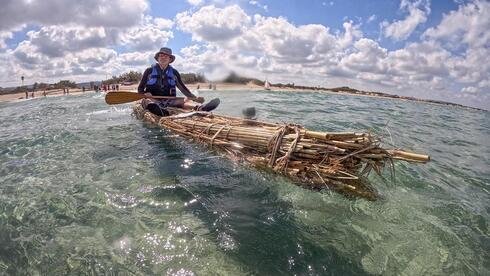
Once the feasibility of the concept was established, the team moved to full-scale production. They harvested and prepared approximately 1,600 reeds, binding them into bundles and weaving them using patterns that incorporated diagonal tension. This technique ensured structural integrity, allowing the 4-meter vessel to remain stable while carrying a human passenger.
A Symbolic Launch
The boat was recently launched at Neve Yam beach, a location chosen for its proximity to the submerged Neolithic settlements. As Shay Niv paddled the vessel, he successfully demonstrated that such a craft could indeed function as a viable, seaworthy vehicle.
“It’s like fulfilling a dream: starting with a theoretical idea and ending with a full-size boat that is tangible and real,” said Niv.
The experiment serves as a crucial case study in human adaptation. While the team acknowledges that this replica is not definitive proof of exactly what prehistoric boats looked like, it validates the theory that the coastal environment provided everything necessary for early humans to master the sea.
“The success of the experiment shows that a reed boat represents an optimal use of the natural resources available in the coastal environment,” Prof. Friesem concluded. The project provides a rare, hands-on window into the lives of ancient people, offering a deeper understanding of how they flourished and connected with one another across the eastern Mediterranean thousands of years ago.