








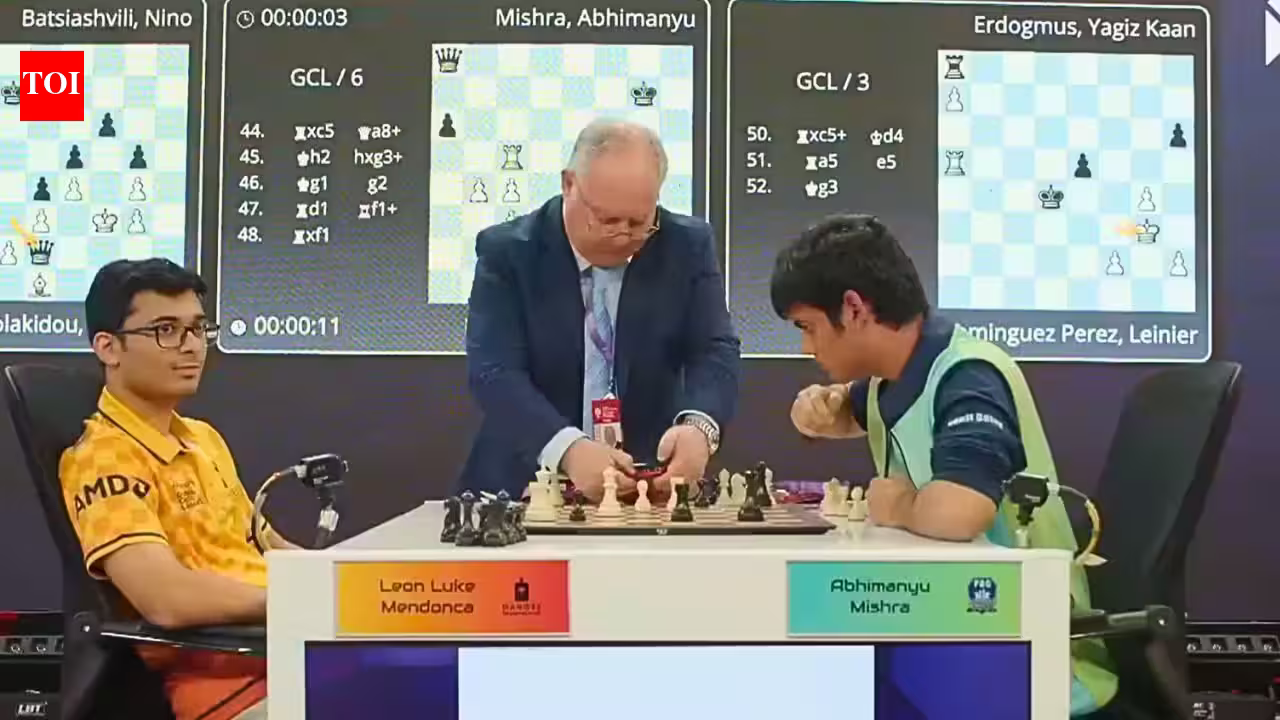
BENGALURU: In the high-stakes arena of the 2026 Global Chess League, the difference between a triumphant victory and a crushing defeat is often measured in milliseconds. On Day 4, that margin proved fatal for the Alaskan Knights, as a bizarre procedural blunder on the prodigy board turned a near-certain win for Abhimanyu Mishra into a catastrophic loss, ultimately fueling the Ganges Grandmasters’ 12-8 match victory.
The match, which carried significant weight for the Alaskan Knights’ standing, devolved into one of the most debated sequences in recent tournament history. As the clock ticked toward zero in the endgame, the tension inside the venue was palpable. Mishra, the wunderkind who had successfully navigated a complex, drawn position to engineer a winning attack against Leon Luke Mendonca, appeared to have reached the promised land. However, the closing seconds of the encounter would spiral into a chaotic scene of dropped pieces, arbiter intervention, and a heartbreaking collapse.
The Anatomy of a Procedural Meltdown
With only seconds remaining on his clock, Mishra executed a precise sequence: capturing on f1 before initiating a promotion to a queen. It was the definitive move that would have secured the point for the Knights. Yet, in the frantic scramble to commit the move and punch his clock, disaster struck.
In his haste, Mishra’s hand fumbled the execution. While he successfully placed the new queen on the board, he accidentally dropped the captured rook, leaving both pieces cluttering the promotion square. Under the strict laws of chess applied in high-pressure rapid formats, a move is not considered “complete” until the piece is properly placed and the player’s hand has released it—and crucially, the clock must be pressed.
The arbiters, observing the scramble, deemed the sequence an incomplete and illegal move. The penalty was swift and unforgiving: the officials stripped Mishra of his increment time, forcing him to rectify the position on the board. With a mere second remaining, and the physical state of the board in disarray, Mishra attempted to complete the promotion a second time, but the clock—the silent, relentless adversary of every professional chess player—ran out. He was flagged, and the point was conceded to the Ganges Grandmasters.
“It Really Sucks”: The Aftermath of a Fluke
The mood in the aftermath of the game was somber, reflecting the gravity of the missed opportunity. Mishra, visibly gutted by the turn of events, addressed the media with a mix of frustration and resignation.
“I saw the entire line… I won the queen,” Mishra said, still processing the sequence. “When I promoted, I took the queen and put it on the square, but somehow the rook was still in that area. The move wasn’t entirely completed. I had to retry with one second left, and I flagged.”
The heartbreak was compounded by the knowledge that this individual failure directly impacted the team’s collective fate. “If I won this game, we would’ve won the match as well,” Mishra added. “It was a very drawn position earlier, and I managed to start an attack. It really sucks. It hurts. What can I say?”
The sportsmanship displayed in the immediate aftermath served as a testament to the respect shared between the competitors, even in the heat of a high-pressure blunder. According to Mishra, Mendonca was far from jubilant, recognizing that the victory was an administrative quirk rather than a tactical outplay. “He was apologizing,” Mishra noted. “This is not how anyone wants to win a game.”
A Strategic Perspective on Clock Chaos
The incident drew immediate commentary from veteran stalwarts of the game, including Ganges’ own Levon Aronian. Offering a seasoned perspective on the officiating, Aronian highlighted the complexity of maintaining order when the clock is rapidly depleting.
“The confusion was that his opponent made an illegal move and pressed the clock… so they had to remove the two seconds from him,” Aronian explained, dissecting the sequence for the press. “He tried to promote to a queen on one second, and he didn’t manage. He lost on time.”
Aronian’s comments underscore the unforgiving nature of the Global Chess League’s format. In a game governed by precision, the clock acts as an equalizer that can dismantle even the most brilliant tactical planning.
For the Alaskan Knights, the loss is a bitter pill to swallow, leaving them to reflect on what could have been a standout performance from their prodigy. For the Ganges Grandmasters, the 12-8 scoreline serves as a crucial cushion in a tournament where every half-point is vital. As Day 4 concludes, the incident stands as a stark reminder to players and spectators alike: at this elite level, the battle isn’t just against the opponent’s intellect—it’s against the relentless pace of the clock and the fine print of the rules.
As the tournament moves into the next round, all eyes will be on whether Mishra can bounce back from the frustration of Bengaluru, or if this momentary lapse in concentration will linger in the competitive landscape of the 2026 GCL season.
Disclaimer: This content is auto-generated for informational purposes only.
Source: Read Original News