








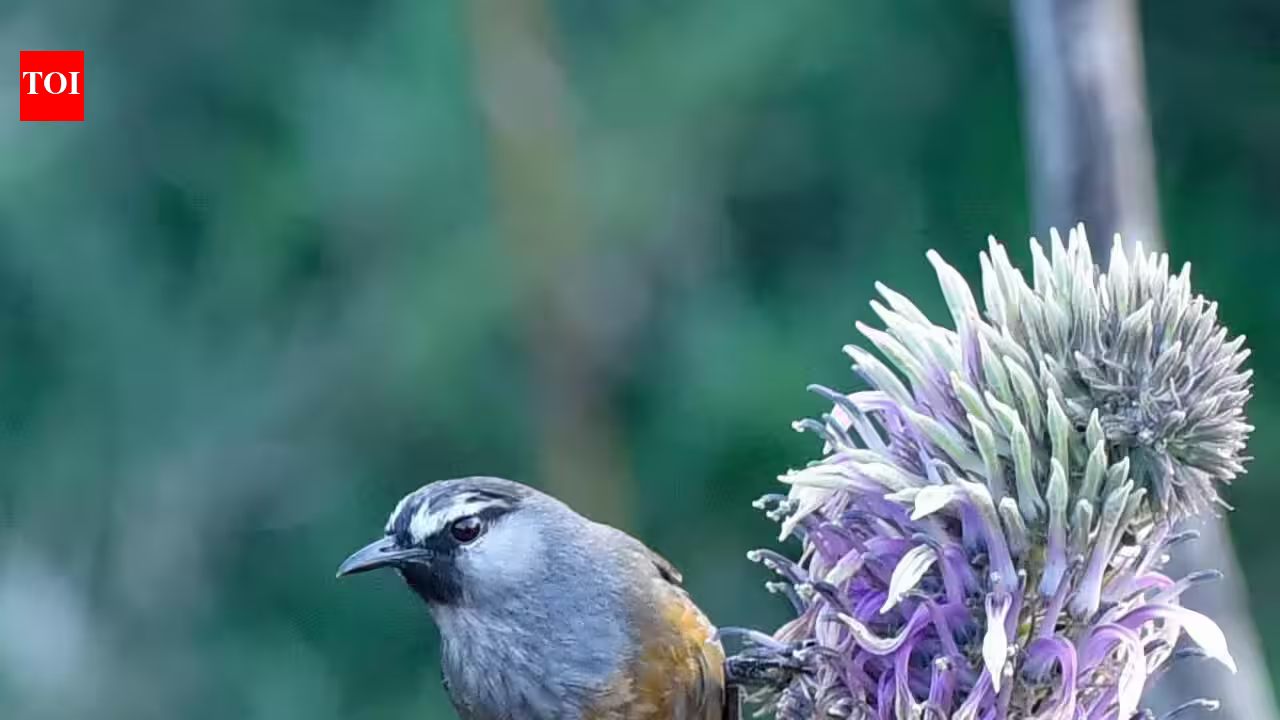
Endangered Banasura Laughingthrush Faces Existential Threat Amid Habitat Loss
Kozhikode: The Banasura laughingthrush (Montecincla jerdoni), a rare songbird native to the high-altitude forests of the Western Ghats, is teetering on the brink of extinction. A first-of-its-kind quantitative study has revealed that the species, which boasts one of the most restricted distribution ranges of any Indian bird, is under siege from climate change, infrastructure development, and recurring forest fires.
The research, published in Nature Scientific Reports, highlights that the global population of this elusive bird is likely between 1,000 and 1,500 individuals. With a known range spanning a mere 50–60 square kilometers across the “sky islands” of Wayanad, the species is exceptionally vulnerable to even minor environmental disruptions.
A Fragmented Habitat
Ornithologists from the Sálim Ali Centre for Ornithology and Natural History and other conservation institutions conducted an exhaustive survey across the region. Their findings confirm that the bird’s presence is limited to the montane shola forests of three specific hill ranges: Camel’s Hump, Banasura, and Brahmagiri.
The study highlights a grim reality: while the bird prefers higher altitudes above 1,700 meters, the actual available habitat shrinks drastically as the elevation increases. At heights above 2,300 meters, the habitable area for these songbirds is a negligible 0.05 square kilometers. Researchers noted that the Brahmagiri population is critically low, estimated at just 20 birds, making them highly susceptible to inbreeding and localized extinction.
Mounting Human-Induced Threats
The study identifies man-made forest fires as a primary driver of habitat degradation. Satellite imagery from 2018 to 2025 indicates that over 3,000 hectares of forest and grassland surrounding the bird’s habitat have been scorched by fire. These blazes transform the vital shola vegetation into open, disconnected patches, stripping the birds of their natural cover and nesting grounds.
Infrastructure projects are further compounding these natural and climate-related stresses. The proposed Wayanad twin tunnel road and other connectivity projects are viewed with alarm by experts. Because the landscape is geologically sensitive and prone to landslides, large-scale construction poses a significant risk of irreversible ecological collapse in the region.
Urgent Call for Protection
Perhaps most alarming is the fact that 99% of the Banasura laughingthrush’s current range lies entirely outside the country’s protected area network. The researchers have issued a stark warning that without immediate policy intervention, the species faces a high probability of extinction.
To mitigate these risks, the study recommends:
- Expansion of Protected Areas: Elevating the status of Camel’s Hump Mountain to a National Park and integrating the Banasura Hills into the Malabar Wildlife Sanctuary.
- Stricter Regulation: Implementing rigorous fire management protocols and placing strict caps on human activity and tourism in these fragile ecosystems.
- Scientific Oversight: Ensuring that any development, including the Anakkampoyil-Kalladi-Meppadi tunnel project, adheres to strict ecological monitoring as mandated by the Union environment ministry.
As one of the least-studied species in the Western Ghats due to the near-inaccessibility of its mist-covered, rainy habitat, the Banasura laughingthrush serves as a litmus test for India’s commitment to preserving its high-altitude biodiversity. The study concludes that the time for “minimal human interference” is now, if this iconic songbird is to survive the challenges of the 21st century.
Disclaimer: This content is auto-generated for informational purposes only.
Source: Read Original News