






Mounting Unrest: Thousands Rally Across India Against Election Commission Over Voter Roll Purges
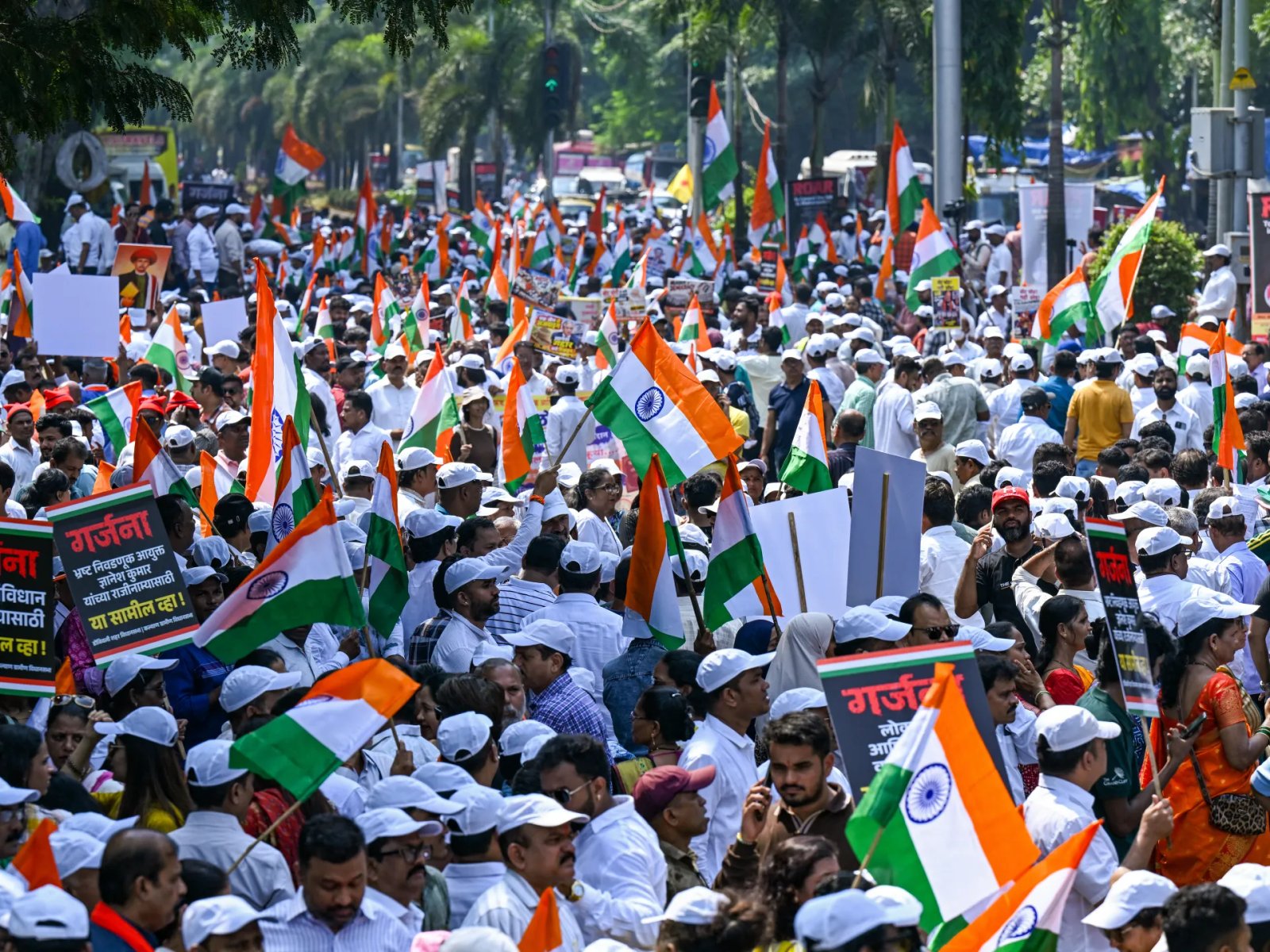
NEW DELHI/MUMBAI – The political temperature in India has surged to a boiling point as widespread protests entered their third day this Sunday. Thousands of citizens, spearheaded by youth activists and a coalition of opposition leaders, have taken to the streets in New Delhi and Mumbai to demand the immediate resignation of Chief Election Commissioner (CEC) Gyanesh Kumar.
The demonstrations, which have gathered significant momentum over the weekend, are fueled by explosive allegations that the Election Commission of India (ECI) has systematically purged millions of eligible citizens from electoral rolls. Critics argue that these targeted removals are a calculated effort to undermine the democratic process and provide an unfair advantage to Prime Minister Narendra Modi’s Bharatiya Janata Party (BJP).
A Direct Challenge to Electoral Integrity
In Mumbai, the atmosphere was charged as opposition figures Uddhav Thackeray and Raj Thackeray addressed massive crowds. The protesters, many of whom carried the Indian tricolor, chanted slogans against what they characterize as the “saffronization” of independent constitutional bodies.
Addressing the sea of demonstrators in Mumbai, Raj Thackeray issued a stern warning to the central government. “The citizens of this nation are the sole arbiters of who holds power. It is not the role of the Election Commission to decide the fate of our governance,” he declared, reflecting a growing sentiment among the public that the independence of India’s electoral body has been compromised.
Meanwhile, the capital city of New Delhi remained under heavy security as police scrambled to contain the uprising. Authorities have resorted to mass detentions, deploying buses to transport protesters away from central rally points. Despite these deterrents, demonstrators have continued to gather each evening, with many facing legal action for violating public assembly bans.
The ECI’s Defense and the Opposition’s Counter-Move
For its part, the ECI has categorically dismissed the claims of bias. Officials maintain that the recent revisions to the voter lists were standard administrative exercises aimed at enhancing the accuracy of the rolls by removing the names of deceased individuals, duplicates, and those no longer eligible to vote. In a potential bid to quell the rising tide of public anger, the Commission recently issued a directive urging local officials to expedite the re-registration of any eligible voters who may have been mistakenly struck from the records.
However, these explanations have done little to pacify the opposition. The grievances are being amplified by the “Cockroach Janta Party” (CJP), a youth-led political movement that has become the face of the ongoing resistance. Abhijeet Dipke, the CJP leader, has called for national unity, framing the current situation as a pivotal “now or never” moment for the future of Indian democracy.
Escalating Pressure as Protests Expand
The movement shows no signs of slowing down. An alliance of major opposition parties has announced a coordinated “Save Democracy” march, which is expected to culminate in a massive blockade of the Election Commission’s office this coming Tuesday. Furthermore, the CJP has scheduled a significant demonstration in New Delhi for October 10, signaling that the unrest is likely to deepen throughout the week.
As the standoff continues, the silence from CEC Gyanesh Kumar remains a point of contention. His refusal to address the public outcry or acknowledge the resignation demands has only emboldened protesters, who view the lack of transparency as further evidence of an institutional crisis. With the nation bracing for more rallies, the controversy surrounding the voter rolls has transformed into a profound test of trust for India’s democratic institutions.
Disclaimer: This content is auto-generated for informational purposes only.
Source: Read Original News