






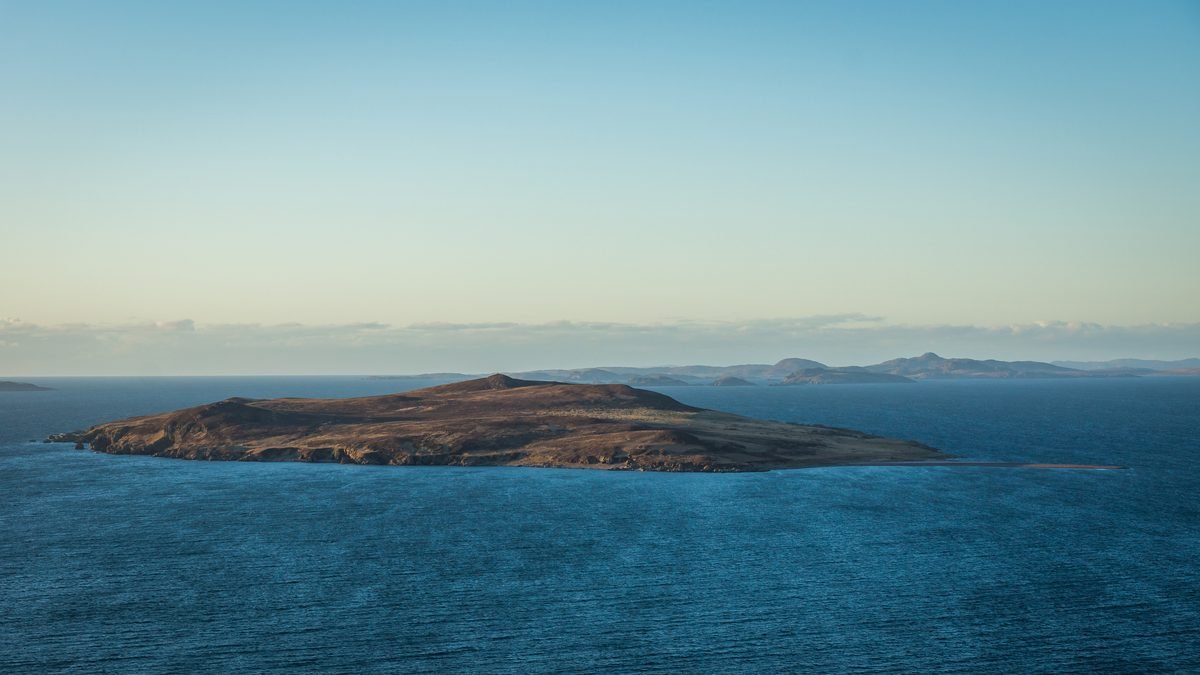
Gruinard Island, a modest, 2-km expanse of rock and greenery off the coast of Wester Ross, appears to be little more than another picturesque fleck of Scotland’s rugged northern landscape. For decades, however, this quiet inlet held a dark, microscopic secret that earned it the grim nickname “Anthrax Island.” The story of Gruinard is a sobering case study in the intersection of mid-century military desperation and the long-lasting, often unpredictable, environmental consequences of biowarfare research.
During the height of World War II, the island was requisitioned by the British government under the codename “Base X.” As fears of Nazi Germany’s biological capabilities intensified, the Ministry of Defence turned to a team of scientists at the Porton Down laboratory, led by microbiologist Paul Fildes. Their mission was clear but chilling: to develop a reliable bioweapon. They eventually settled on Bacillus anthracis, the resilient, soil-borne bacterium responsible for anthrax.
In 1942 and 1943, the island served as a clandestine testing ground. Scientists tethered sheep downwind of experimental explosions, detonating anthrax-laced bombs to observe the lethal airborne transmission of the spores. The results were devastatingly successful; most of the animals died within days. Although the military eventually shifted its focus to plans involving linseed cakes poisoned with anthrax—intended to be dropped over German pastures to decimate livestock—the project was ultimately shelved.
The environmental fallout, however, had already begun. In 1943, infected sheep carcasses improperly disposed of by researchers washed up on the Scottish mainland, leading to the contamination of local livestock. The government, realizing the severity of the threat, burned the island’s surface vegetation in an attempt to neutralize the spores. It was a futile gesture. Anthrax spores are notoriously hardy, capable of remaining dormant and lethal in soil for decades.
For the next 40 years, Gruinard remained under strict government quarantine. While rumors of the island’s contamination circulated among locals, the official nature of the hazard remained veiled in secrecy until a formal government acknowledgment in 1979. The public’s frustration with the lack of remediation boiled over in 1981, when a protest group calling themselves the “Dark Harvest Commandos” delivered samples of contaminated soil to the gates of Porton Down and a Conservative Party conference. The group, claiming their ranks included microbiologists, demanded that the state take responsibility for the legacy of its wartime experiments.
The pressure of public outcry and the potential for a wider environmental scandal finally forced the government’s hand. In 1986, an intensive decontamination effort began. Workers saturated the island with a solution of formaldehyde and seawater, a process repeated in 1987. Biological safety trials followed, with sheep reintroduced to the land to monitor for any resurgence of the pathogen. By 1988, after the animals remained healthy, the island was officially declared free of anthrax. Two years later, the Ministry of Defence sold the land back to the descendants of the original owners for the symbolic sum of £500, honoring an agreement made in 1946.
Today, the island has reverted to its role as grazing land, yet its history remains a persistent shadow. In 2022, a wildfire swept across the island, serving as a stark reminder of the fragile balance between human legacy and the natural world. While ecologists now monitor the island’s wildlife—including nesting oystercatchers and the majestic white-tailed sea eagles that frequently visit—the ordeal of Gruinard remains a potent warning. It serves as a physical testament to how quickly human ambition can poison the landscape, and how remarkably difficult and time-consuming it is to undo the damage once the seeds of destruction are sown into the earth.
Disclaimer: This content is auto-generated for informational purposes only.
Source: Read Original News