






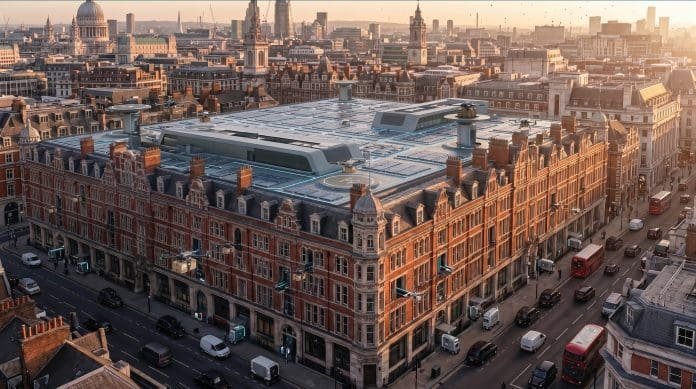

Research by the Royal Town Planning Institute reveals how aerial drones could be positively integrated into the built environment as long as their integration is carefully planned
Authored by Dr Paul Cureton (Lancaster University) and Dr Anna Jackman (University of Reading), the research points out that policymakers and the public are yet to fully understand the impact of using drones in the built environment.
Without careful attention and engagement from planners, the advice warns, communities could encounter noise and visual disturbance, privacy and security issues, and disruption to wildlife and habitats.

Dr Daniel Slade MRTPI, head of research and practice at the RTPI, stated: “As a society, we must be better at influencing how things like drones shape our neighbourhoods, villages, towns and cities for the public good, and not only commercial benefit.
“Planners and the planning system are at the vanguard of this. The time for communities and planners to imagine a better future and plan for it is now.”
The use of drones in the built environment is currently being trialled
Alongside their use as tools for planners, drones are already being trialled and deployed across the UK for applications including infrastructure inspection and medical and goods delivery.
Where the technology is appropriate, communities must be involved in meaningful consultation, enabling a genuine say in technological deployment and how the technology shapes their neighbourhoods.
While the two new RTPI practice advice notes, Planning and drones 1: Using drones to deliver planning services and Planning and drones 2: Planning for scaled drone use and infrastructure, highlight the potential benefits of drone technology as it emerges and scales, they also caution of the importance of forward-thinking planning from the outset.
Planners must engage now to prevent drone disruptions
UK Government ambition statements aspire to commercial drones in the built environment becoming commonplace by 2030.
Without careful attention and engagement from planners, the advice warns, communities could encounter noise and visual disturbance, privacy and security issues, and disruption to wildlife and habitats.
The new practice advice encourages planners to begin proactively considering these issues, as well as the potential public impacts of drones, now – rather than in response to further technological developments.
“From masts to launch and landing pads, the scaling of drone operations introduces issues such as noise disturbance and wildlife disruption, requiring careful consideration,” explained Dr Paul Cureton and Dr Anna Jackman.
“While recognising guidance, resource and capacity challenges, planners nonetheless remain vital stakeholders to consider if, how and where drones are appropriate, societally and economically beneficial investments for their communities.”
The RTPI says further national policy and guidance will be needed as drone technology and regulation develop.
However, planning authorities can begin considering now how drone infrastructure and operations may affect their areas.