








Our planet clearly has a microplastics problem: These tiny synthetic fragments are finding their way into ancient rocks, human bones, and almost every species of animal on Earth.
Now they’ve been discovered in one of the most remote, inhospitable, and unexplored parts of our planet.
Researchers led by a team from the Korea Research Institute of Bioscience and Biotechnology (KRIBB) have found microplastics in snails and mussels living around deep-sea hydrothermal vents.
These vents are some 2,000 meters (6,562 feet) below the ocean surface, showing just how insidiously microplastics (under 5 mm or 0.2 inches in size) can find their way into every part of every ecosystem.
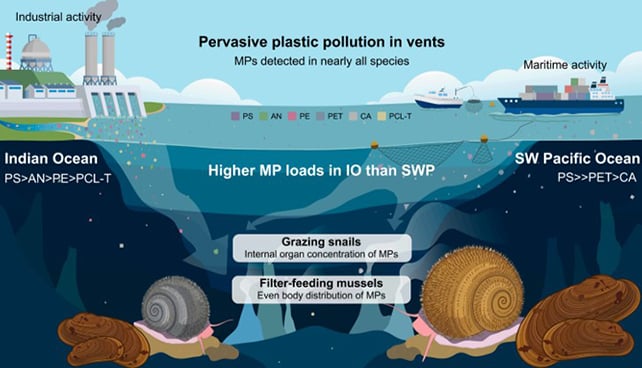
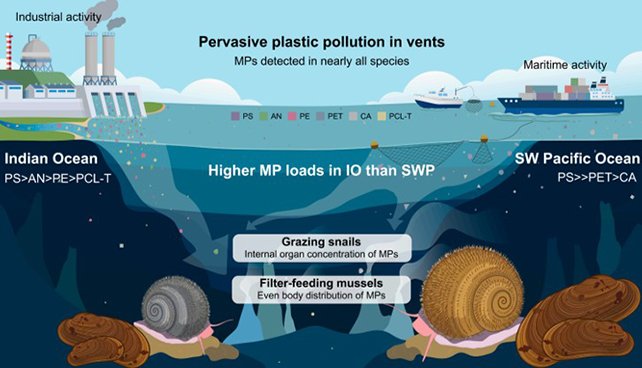
In a study published in Water Research, the tiny plastic fragments were found in 92 percent of all animals examined (11 out of 12), across the North Fiji Basin in the southwestern Pacific Ocean and the Central Indian Ridge in the Indian Ocean.
“Plastic pollution has now spread even to deep-sea hydrothermal vent ecosystems that were once considered among the most isolated environments on Earth,” says marine biologist Se-Joo Kim, from KRIBB.
These deep and dark places contain some fascinating characteristics, with life supported by plumes of chemically rich, ultra-hot seawater rising up from the depths.
Now we know that the species that call these vents home have been snacking on microplastics that have sunk down to the depths. An average of 3.42 plastic pieces were found in each animal, with the widely used polystyrene the most common type found.
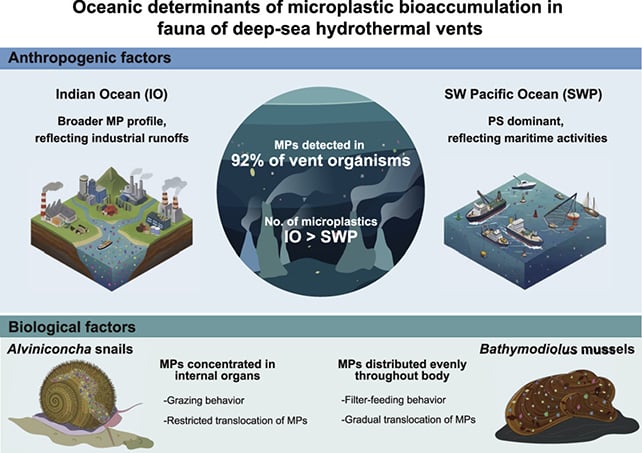
The researchers were also able to tease out some findings around how feeding behavior can affect where microplastics accumulate in these mussels and snails. In the snails (which graze on the sea floor), the plastics bunched up in the digestive organs; in the mussels (which filter feed), the plastics were more evenly distributed.
“Across the four vent species examined, microplastics were detected in nearly all individuals, but abundance varied considerably among them,” write the researchers in their published paper.
“Despite this individual-level variation, distinct tissue distribution patterns were consistent within each taxon, indicating that once ingested or taken up, microplastics are distributed differently within snails and mussels.”
By analyzing marine animals from two different sites, the research team was able to study the differences between the locations. The snails and mussels in the Indian Ocean had significantly higher concentrations of microplastics in their bodies than those in the southwestern Pacific.
Further research will be needed to determine exactly why this is, but it’s possible that regional differences in human-driven activity and pollution, ocean circulation patterns, and river networks are all playing a part.

“The larger inter-regional contrast in snails than in mussels further suggests that settled microplastics concentrations on vent surfaces vary more between the two regions than suspended concentrations in the water column,” write the researchers.
“These findings support the observation across 16 biogeographical provinces that geographic location has a stronger influence on individual microplastic loads in benthic marine invertebrates than taxonomic class or feeding mode.”
As concerning as it is to see microplastics traveling so far underwater, the data does at least give us an idea of the problem – adding extra urgency to efforts to reduce plastic pollution through improved recycling approaches and alternative materials.
Scrubbing plastic from these deep sea environments is completely impractical – which means it needs to be tackled at the source.
We don’t yet have a fully clear picture of just how damaging microplastics are to health, but the early indicators are – as you would expect – that it’s not good for us to have these little plastic bits inside our bodies and our food.
Related: There’s a Surprisingly Simple Way to Remove Microplastics in Drinking Water
Past studies have linked the ingestion of microplastics with diseases including Parkinson’s and colon cancer, and in our modern era, it’s impossible to escape them.
“Our findings provide important scientific evidence for establishing future deep-sea environmental monitoring systems and conservation policies,” says Kim.
The research has been published in Water Research.