








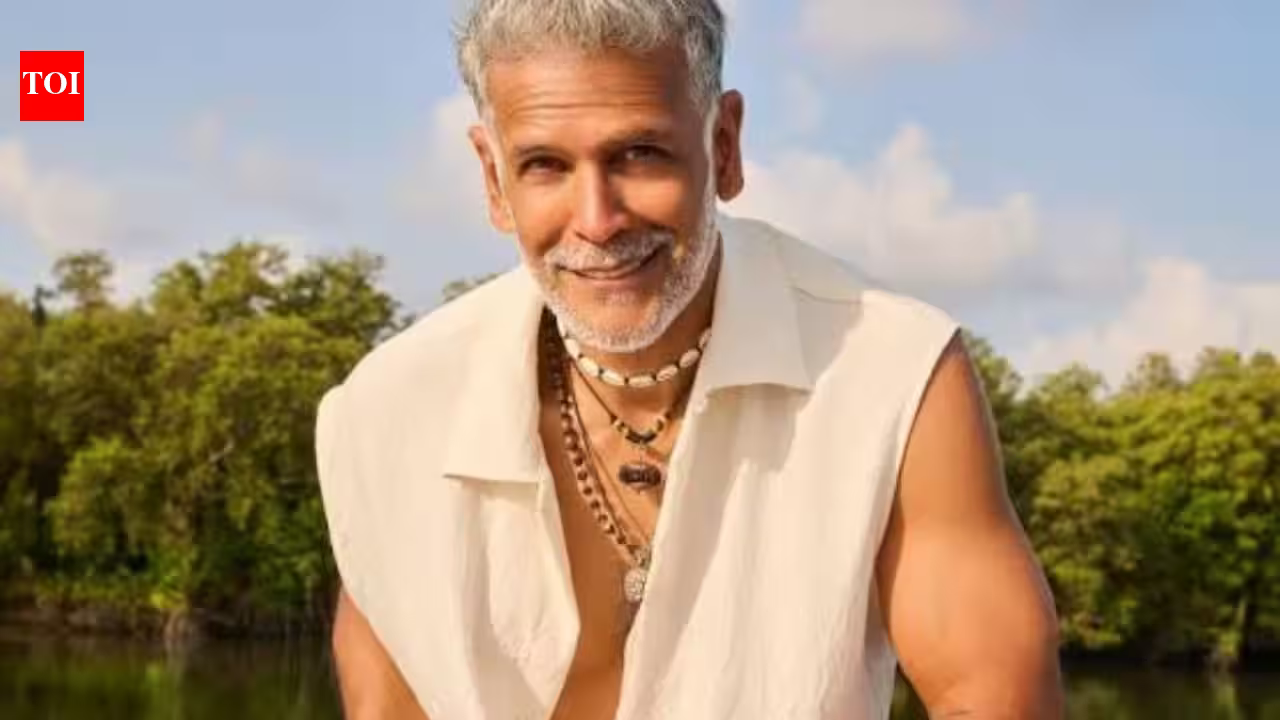
At an age when most people are considering the merits of a comfortable recliner, Milind Soman is busy defying the laws of biology. The actor, model, and eternal fitness icon recently turned 60, but rather than slowing down, he marked the milestone with a feat that would leave an Olympic athlete winded: completing two full-distance Ironman triathlons in just six days. For the uninitiated, that is 3.8 kilometers of swimming, 180 kilometers of cycling, and a 42.2-kilometer run—per event.
Yet, perhaps more impressive than his endurance is his complete lack of pretension. While the fitness industry thrives on selling expensive gym memberships, high-tech wearables, and biomechanically engineered footwear, Soman is the antithesis of the “optimized” athlete. He is a man who champions the minimalist, the ancestral, and, quite famously, the shoeless.
The Barefoot Philosophy: Freedom or Folly?
Soman’s affinity for barefoot running has become as iconic as his salt-and-pepper hair. In an era where running shoes are marketed like space-age technology, Soman’s decision to hit the pavement with nothing but his own skin is a radical act of simplicity.
Proponents of the practice argue that running barefoot forces the body to shed the “heel-strike” habit encouraged by cushioned shoes, shifting the impact toward the mid-foot and forefoot. This natural gait can potentially strengthen the intrinsic muscles of the foot, improve proprioception (the body’s ability to sense its position in space), and foster a more efficient running form. However, the orthopedic world remains divided. While building foot strength is undoubtedly beneficial, jumping into barefoot running without a transition period is a recipe for stress fractures and tendonitis. Soman himself is a testament to consistency, not necessarily a blueprint for the weekend warrior who decides to dump their sneakers overnight.
The Plantar Fasciitis Debate
One of the persistent questions surrounding Soman’s barefoot regimen is its role in injury prevention. Specifically, can ditching the sneakers help prevent plantar fasciitis, the bane of every runner’s existence? The science is murky. Plantar fasciitis, often caused by repetitive strain, is usually a byproduct of volume and intensity rather than just shoe choice.
While some athletes find that the increased muscular engagement of barefoot running creates a more resilient arch, others find that the lack of shock absorption exacerbates inflammation. If you are looking to follow in Soman’s footsteps—literally—caution is the better part of valor. Improving foot strength through exercises like toe curls and marble pickups is a safer entry point than hitting the asphalt barefoot. Always listen to the feedback loop between your feet and your brain; if there is pain, the “natural” approach isn’t working.
Minimalist Fitness: The Power of 15 Minutes
What makes Soman’s approach so refreshing is his disdain for the “no pain, no gain” industrial complex. He has repeatedly stated that he eschews gym equipment entirely. In a world of cable machines and hyper-specialized protein shakes, Soman’s routine is almost Spartan in its simplicity. He famously keeps his daily gym time to a mere 10 to 15 minutes, favoring body-weight staples like pull-ups, push-ups, and planks.
“I don’t use equipment,” Soman has stated, highlighting a philosophy that prioritizes functional, everyday movement over vanity-driven hypertrophy. By focusing on pull-ups and planks, he maintains the kind of core stability and raw strength that translates into real-world endurance. He proves that you don’t need a sprawling facility to build a body capable of an Ironman; you just need gravity and the discipline to use it.
The Anti-Diet of a Fitness Icon
If the fitness world loves a complicated macro-count, Soman loves a home-cooked meal. His relationship with food is refreshingly intuitive. He sidesteps the trend-chasing of keto, carnivore, or intermittent fasting in favor of standard, balanced, and home-prepared Indian staples: dal, sabji, roti, and rice, topped with a spoonful of ghee.
His dietary “rules” are less about restriction and more about rejection of the industrial food system. Soman avoids over-refined, processed, and packaged items like the plague. He drinks water, avoids cold beverages, and consumes alcohol so rarely that it is effectively a non-factor in his life. It is a slow-living approach that aligns with his schedule; he isn’t a 5:00 AM alarm-clock warrior, often rising closer to 8:30 AM before easing into his day. It is a reminder that wellness isn’t just about the intensity of the workout—it’s about the consistency of the lifestyle and the quality of the fuel you provide your body.
Beyond the Ironman
It is easy to look at Soman’s accomplishments and see an outlier—a genetic anomaly who defies age through sheer luck. But his philosophy tells a different story. It is one of moderation, natural movement, and a refusal to be a slave to the “hustle culture” of modern fitness. Whether he is on screen—appearing recently alongside Vijay Sethupathi in the series Kaattaan—or on the track, he carries the same aura of unhurried capability.
Milind Soman remains a vital figure in the entertainment and fitness landscape precisely because he simplifies the complex. He serves as a bridge between the ancient, primal ways of moving the human body and the demands of a modern, busy life. He doesn’t suggest you run an Ironman tomorrow; he suggests you take a walk today, eat real food, and use your own body weight to stay strong. It’s a simple message, but as Soman approaches his seventh decade, it’s proving to be the most effective one of all.
Disclaimer: This content is auto-generated for informational purposes only.
Source: Read Original News